EU-China Briefing - 12 October 2020
YOUR WEEKLY SHOT OF EU-CHINA NEWS
BY FLAVIAN BERNEAGĂ AND GRZEGORZ STEC
1. Negative Opinions on China Skyrocket in Europe
On October 6, the Pew Research Center published a report based on its survey that shows how views on China have degraded among respondents in major advanced economies.
► In 9 of the 14 countries surveyed, including the largest EU member states, these negative views peaked in H1 2020, rising significant percentage points compared to previous years;
► An important factor for this outcome was the handling of the pandemic, which 61% of respondents believed was managed inappropriately by Chinese authorities;
►Though respondents trusted the US more than China overall, European respondents were slightly more confident in Xi Jinping than in Donald Trump (however, both enjoy quite low overall scores).
Going Down
In developed economies across Europe, North America, Australia, and East Asia, China’s abrasive activity on global and domestic affairs in recent years has made people view China in a more negative light.
Pew used national phone surveys conducted with 14,276 respondents between June 10 to August 3 in these countries: US, Canada, Belgium, Denmark, France, Germany, Italy, Netherlands, Spain, Sweden, the UK, Australia, Japan, and South Korea.
In Spain, Germany, Canada, Netherlands, US, UK, South Korea, Sweden, and Australia, respondents’ negative views reached their highest percentage since the survey was first administered in 2002.
Germany, Sweden, and the Netherlands present the most radical shifts in Europe.
In Germany, 71% disapprove of China’s (compared to 54% in 2018).
In Sweden, 85% disapprove of China’s (compared to 52% in 2018).
In the Netherlands, 73% disapproved of China (compared to 45% in 2018).
Belgium and Denmark, surveyed for the first time in 2020, registered 71% and 75%, respectively.
On the other hand, views remained constant in Italy - 62% in 2020, 61% in 2007.
Why the Change of Heart?
The rapid increase in negative views comes amid controversies surrounding China’s handling of COVID-19 at the beginning of the pandemic and low confidence in President Xi Jinping.
A median of 61% of respondents across all 14 countries believed China handled the outbreak poorly, doing a “bad job”.
Xi Jinping’s public image also appears to be taking a hit: a median of 78% of respondents from all 14 countries said they had no or little confidence in him (76% median among European countries), with at least 70% in each country holding that view.
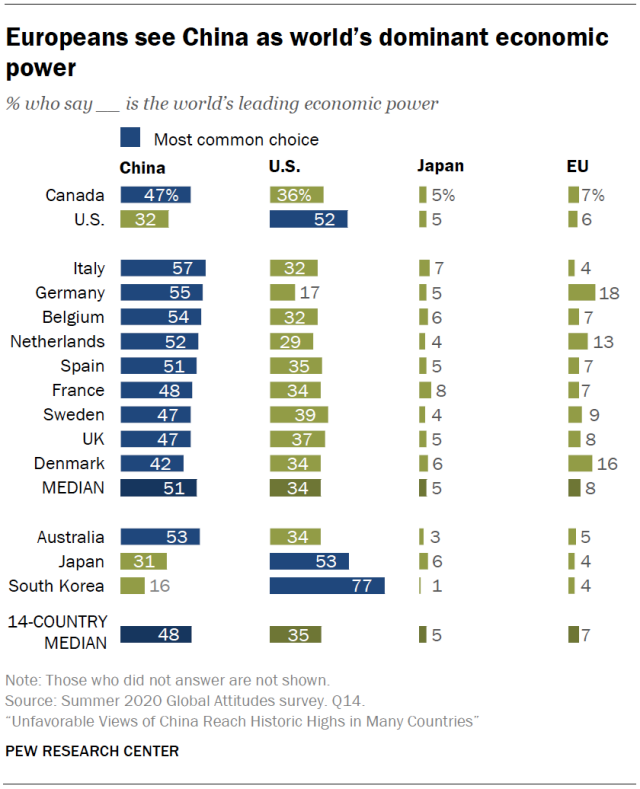
China does fare better when it comes to the perception of economic strength. In Europe, a median of 51% of respondents sees China as the world’s top economy, with scores ranging between countries from 42%-57%. The US is considerably lower—a median of only 34% of European respondents thought it was the world’s leading economy—while the EU received a mere 7%.
Xi versus Trump
When it came to perceptions of the US and China and their leaders, both have scored poorly among the European public (for the list of surveyed countries, see the graphic above).
An average of 20.4% of those surveyed in European countries said they trusted Xi, compared to only 12.4% who trusted Trump. Overall, however, both leaders score quite poorly.
The Xi-Trump gap is particularly wide in the Netherlands (29%-18%), Italy (24%-16%), Spain (23%-16%), Belgium (22%-9%), Germany (18%-10%), and France (16%-11%).
The US itself is viewed better than China in the European countries where surveys were taken. An additional 6.6% average of respondents said they held more positive views of the US than of China (still, note how small this difference is).
On comparisons related to handling the COVID-19 pandemic, more European thought on average that China handled it better than the US (40.3% compared to 13.8%, respectively).

TAKEAWAYS
► PR CATASTROPHE
The surge in unfavourable opinions about China among the European public should not come as a surprise, given the multitude of news with negative connotations coming out of China in 2020. The poor handling of the outbreak in Wuhan, quickly followed by the cover-up of the epidemic’s spread within China, contributed to negative (and, in some cases, also racist) views on China. These were followed by reporting of the national security law in Hong Kong, forced labour in Tibet, the language laws in Inner Mongolia, further repression in Xinjiang, and wolf-warrior diplomacy amidst the most severe pandemic the world has witnessed in a century.
It appears that among all those controversies China’s leadership has been pursuing a diplomatic style focused on its domestic audience and highly-assertive (almost confrontational) rhetoric. The funneling of nationalist rhetoric has been consciously employed by the government, but pushing it too far comes at the price of public opinion in other countries and may lock Chinese leadership on a fixed confrontational course with the international public, with limited room for diplomatic maneuvering.

READ MORE
Unfavorable Views of China Reach Historic Highs in Many Countries - Pew Research Center (Laura Silver, Kat Devlin, Christine Huang), Oct 6
Negative views of both U.S. and China abound across advanced economies amid COVID-19 - Pew Research Center (Laura Silver, Kat Devlin, Christine Huang), Oct 6
Negative views of China and Xi Jinping at record levels: international survey - SCMP (Kristin Huang), Oct 7
2. Germany-led Coalition of 39 UN Members Criticize China Over Human Rights - China Strikes Back
On October 6, 39 UN member states issued a joint statement in the UNGA Committee on human rights, humanitarian affairs, and social issues, condemning China’s obtrusions in Xinjiang, Hong Kong, and Tibet.
► The group called for independent observers to have free access to investigate the alleged mistreatment of minorities and related human rights abuses;
► More countries signed on to this statement than the one led by the UK Ambassador to the UN, Karen Pierce, in October 2019, which garnered only 23 signatories;
► A group of 45 countries issued a counter response statement that defended China’s actions, reinforced by a statement from China itself (supported by 26 countries) categorizing US sanctions during the pandemic as a human rights violation.
Closing the Ranks
The group was led by German Ambassador to the UN Christoph Heusgen and the statement comes after months during which Europe called for inspections in Xinjiang.
On top of the call for investigations, the group also called on China to implement the eight recommendations of the CERD (Committee on the Elimination of Racial Discrimination), which suggest halting unlawful detentions, initiating investigations into racial and ethnic profiling, motivating the collection of data from ethnic minorities, and other actions.
The CERD also references freedom of travel in Tibet, language rights in Inner Mongolia, and the rule of law and independence of the judiciary in Hong Kong.
Notably, the statement includes two important references: one to the 50 UN experts calling for a UN human rights mechanism in China; the other, to the more than 400 civil society groups that supported the creation of such a mechanism.
Here are the signatories (EU countries in bold): Albania, Australia, Austria, Belgium, Bosnia and Herzegovina, Bulgaria, Canada, Croatia, Denmark, Estonia, Finland, France, Germany, Haiti, Honduras, Iceland, Ireland, Italy, Japan, Latvia, Liechtenstein, Lithuania, Luxembourg, the Republic of the Marshall Islands, Monaco, Nauru, the Netherlands, New Zealand, North Macedonia, Norway, Palau, Poland, Slovakia, Slovenia, Spain, Sweden, Switzerland, the United Kingdom, and the United States.
What’s Different From 2019?
Human Rights Watch observed that this year’s statement gathered more signatories (39) than the UK-led statement in 2019 (23).
Compared to 2019, we see more signatories from Central and Eastern Europe (8 in total: Bulgaria, Bosnia-Herzegovina, Bulgaria, Croatia, Lithuania, North Macedonia, Poland, Slovakia, Slovenia), as well as scant representation from Central America (Haiti, Honduras) and Oceania (Marshall Island, Nauru, Palau).
The EU countries that did not sign the 2020 statement are Cyprus, Czech Republic, Greece, Hungary, Malta, Portugal, and Romania.
Reportedly, the Czech Republic decided not to join the statement in order to not further complicate its relations with Beijing, after Czech Senate leader Miloš Vystrčil visited Taiwan in early September.
China and Supporters Issue Pushback
In response, around 70 countries (split in 3 separate groups) defended China on Xinjiang and Hong Kong, followed by a rebuking statement led by China itself.
The first group, of 45 countries, was led by Cuba. It condemned the 39-country statement as “interference” in China’s internal affairs. The second one, by 55 countries led by Pakistan, defended China’s actions in Hong Kong. A third statement, led by Kuwait on behalf of three Arab nations, also showed support for China.
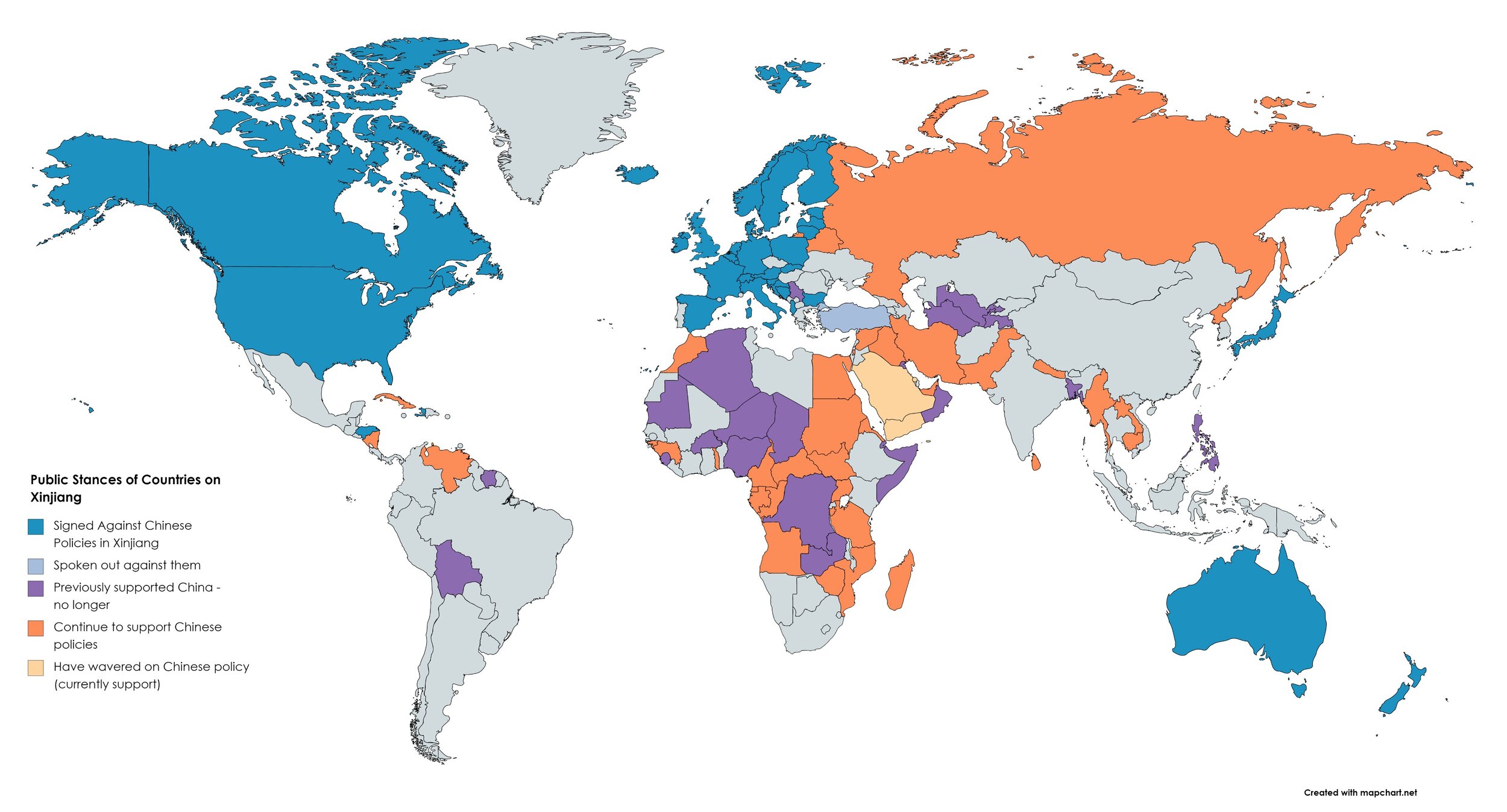
Here is a map by SupChina indicating which countries displayed support and which countries scorned China over Xinjiang and Hong Kong.
On top of these, China’s permanent representative to the UN, Zhang Jun, also made a statement on behalf of 26 countries. Zhang pinned down “unilateral”, “sectoral”, “trade” sanctions as human rights violations, since they “impede the full realization of social and economic development and hinder the well-being of the population in the affected countries”.
He also accused the US of racial discrimination and police brutality, referencing the deaths of George Floyd and Jacob Blake, and the higher mortality rates from COVID-19 among African-Americans.
The countries Zhang represented were: Angola, Antigua and Barbuda, Belarus, Burundi, Cambodia, Cameroon, China, Cuba, the Democratic People's Republic of Korea, Equatorial Guinea, Eritrea, Iran, Laos, Myanmar, Namibia, Nicaragua, Pakistan, Palestine, Russia, Saint Vincent and the Grenadines, South Sudan, Sudan, Suriname, Syria, Venezuela, and Zimbabwe.

TAKEAWAYS
► THE WORLD DIVIDED
The map above shows just how much China’s international activity is bearing fruit at the UN and how much US isolationism has created a vacuum in which China could move with flexibility. The stark difference between advanced economies and those in the Global South shows that China’s growing international economic relevance in these markets also has political connotations.
For the EU, another important question should be why 7 member states did not join in on the Germany-led statement, which got support from the Western Balkans to island-states in the Pacific Ocean. With or without the support of these 7 member states, it is clear that the path forward for multilateralism will be bumpy and reforming it will be a highly complex task given China’s sway with the Global South.

READ MORE
Statement by Ambassador Christoph Heusgen on behalf of 39 Countries in the Third Committee General Debate, Permanent Mission of Germany to the UN, Oct 6
39 Countries at UN Express ‘Grave Concerns’ About China’s Abuses, Human Rights Watch (Louis Charbonneau), Oct 6
Nearly 70 countries voice support for China on human rights issues, CGTN, Oct 8
3. EU’s FDI Screening Mechanism Becomes Operational - How Does it Work?
On October 9, the European Commission announced the EU FDI screening framework will become fully operational on October 11, 2020. Here is the regulation in full.
► The announcement comes 18 months after the EU and its member states agreed to set up a regulation aiming to coordinate the screening of FDI, thus marking an important step towards open strategic autonomy;
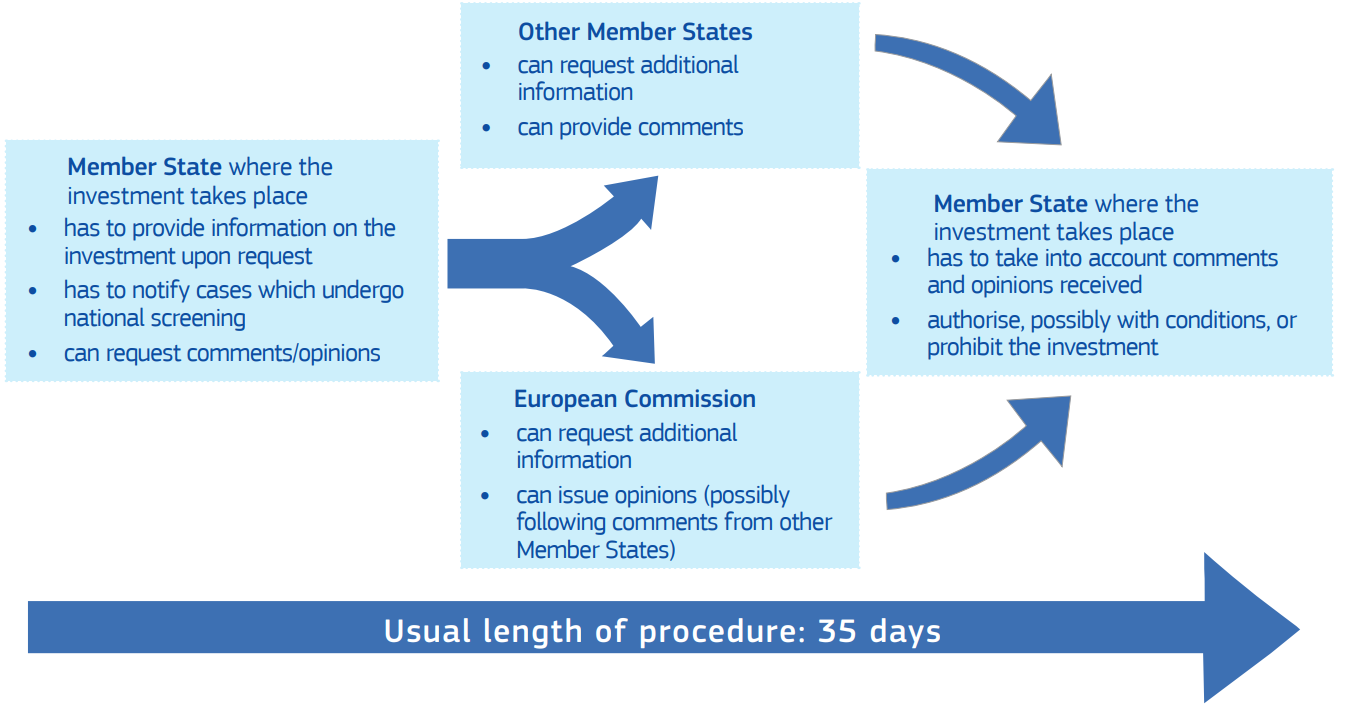
► The framework relies on three stages: member states must notify cases that require screening; member states or the Commission provide their comments; and the member states in question must take the comments into account;
► Nonetheless, while the Commission strongly encourages member states to adopt FDI screening mechanisms, the final decision is purely voluntary.
Leveling the Playing Field, One Investment at a Time
Through the operationalization of the new framework, the EU shows it is serious when telling the world that it is open to FDI, but not under any conditions.
The regulation will deal with cases in which investments could pose a threat to “critical technologies, infrastructure, inputs” or “have access to sensitive information” within the EU.
Protecting the EU investment market is particularly important, given that the EU’s openness to inflowing FDI (€6,441 billion in 2017, generating 16 million jobs) has also made it vulnerable to ill-intentioned investors or businesses controlled by foreign states.
For China, this is bad news. Recall that 72% of Chinese companies operating in Europe said they see the EU market as grimmer in 2020 compared to 2019 and specifically warned the EU to avoid “overregulation and excessive screening”.
In relation to the announcement, Trade Commissioner Valdis Dombrovskis said that “If we want to achieve an open strategic autonomy, having an efficient EU-wide investment screening cooperation is essential. We are now well equipped for that.”
The framework’s operationalization is the final step in a process that began in March 2019, when the FDI screening regulation was adopted, thus sealing the commitment by member states to coordinate with the EU on this matter.
The regulation entered into force in April 2020, after which the Commission started working on the details of its operation: notifications from member states, establishing formal contact points between MS and Commission, developing procedures to react quickly on MS notifications.
How Does It Work?
The new framework, though innovative in enhancing the Commission’s regulative powers, still relies on member states to disclose cases of suspicious FDI and act upon them.
More concretely, it is split into three stages:
Member states either provide information (on request) or notify cases of national screening.
Other member states or the Commission can ask for further clarifications and provide comments
The member states in question must take these comments into account, and authorize (possibly with conditions) or prohibit the investment
The regulation also lists a set of EU funded projects and programmes that represent essential elements of security and public order: Galileo, Horizon 2020, Trans-European Networks, and the European Defence Industrial Development Programme.
In determining whether an investment jeopardizes public security or order, member states should seek to protect the following: critical infrastructure, critical technologies, the supply of critical inputs, access to sensitive information, the freedom and pluralism of the media.
How Will It Be Implemented?
The implementation of the new regulatory framework allows member states to either maintain their current screening mechanisms, adopt a new one, or simply not enforce one at all.
Nonetheless, just before the regulation entered force in April, the Commission publicly stated it strongly encourages to adopt the new framework - particularly the countries that lack or have incomplete FDI screening frameworks altogether.
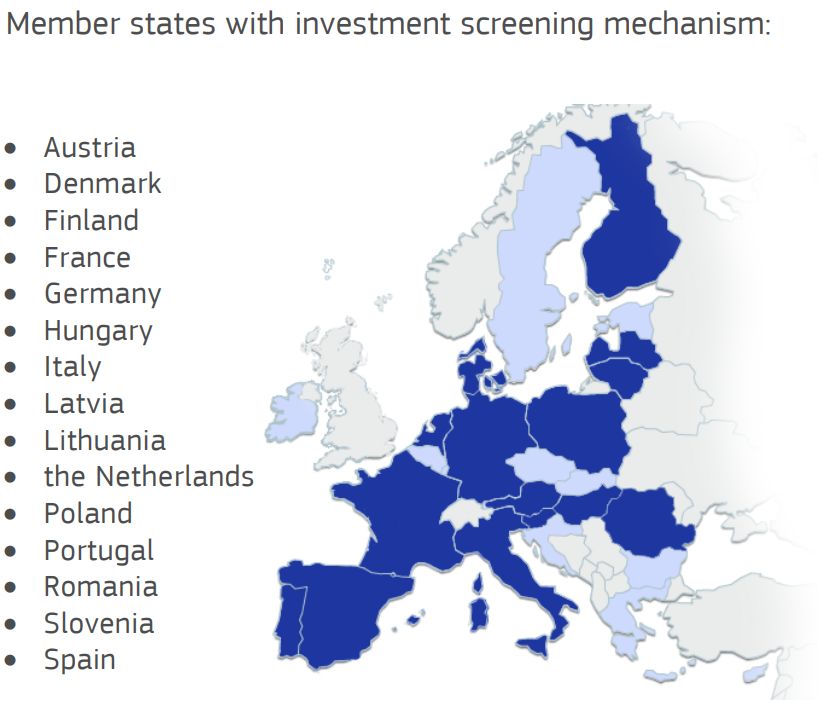
At the current time, almost half of the EU member states already have screening mechanisms. Given COVID-19’s health and economic implications, a common approach is needed to counter investment imbalances. From now on, we should expect yearly updates on the implementation process.

TAKEAWAYS
► GREAT, BUT...
The mechanism becoming operational is truly great news: it will now allow member states and the Commission to coordinate more smoothly on the sensitive matter of investments. That being said, the mechanism is voluntary: member states are expected to let the Commission know which investments ought to be screened and they are also make the final decision on whether to accept policy suggestions received from the Commission.
This means a great deal of communication is necessary, but it also means member states that want to enhance their bilateral relations with China may opt to not declare any questionable investments at all. Recall our briefing on the report by the European Court of Auditors from September, in which ECA tried to compile data from all member states on investments, but found its work often stalled by lack of transparency and reliable data. In this context, the auditors pointed out the unwillingness of the member states to coordinate with the Commission. So let’s see how effective the FDI screening will turn out to be in practice.

READ MORE
EU foreign investment screening mechanism becomes fully operational - European Commission, Oct 9
Foreign Direct Investment EU Screening Framework - European Commission
4. The EU Moves to Counter China’s Influence in the Balkans
On October 6, the European Commission announced plans to invest €9 billion in Western Balkan countries for the period between 2021-2027.
► The main scope of the investment would be to develop the transportation and energy infrastructure, as well as to generate economic growth and employment;
► The money will seek to draw the selected countries within a common regional market with the EU, thus tying it directly with the bloc’s enlargement plans;
► These plans are also meant to reinforce the EU’s standing in Western Balkan countries, in which China’s presence has been increasing.
Enlargement Groundwork
On top of the €9 billion in investment, the EU also announced a Western Balkans Guarantee Facility, which features the goal of raising €20 billion in investments.
The investments are to target large projects in transport, energy, and green and digital transitions. Specifically, the money will flow into 10 areas: road and rail networks; renewable energy; cuts to greenhouse gas emissions; waste and water management; public building renovation; and broadband roll-out.
The countries that will be benefiting are: Albania, Bosnia-Herzegovina, Kosovo, Montenegro, and Serbia—four of which are at various levels of accession negotiations—plus Albania and North Macedonia, which began talks in March 2020.
The Nitty Gritty
The EU expects the money to contribute to the normative Europeanization process of the Western Balkans, which is to be achieved through market integration.
Special consideration is awarded to the region becoming a “more attractive investment area”. To that end, the EU stated the Western Balkans must follow the acquis communautaire, must deepen regional economic integration, and must develop a regional common market.
The cash is tied to the EU’s enlargement plans, ergo the countries in question must implement reforms, particularly pertaining to the rule of law, that will increase business confidence and will speed up the accession process into the EU.
Since the von der Leyen Commission arrived in the Berlaymont, its plans for the Western Balkans rested on three pillars: reinvigorating the enlargement process; opening accession negotiations with Albania and North Macedonia; and speeding up economic convergence with the EU.
The first two pillars have already been achieved, meaning the EU is now going full-force on the third. In pushing for economic convergence, the EU also hopes the Western Balkans will be put “on the map of investors who seek to reduce the distance to EU markets and diversify supply.”
The China Factor
The EU’s plans for the Western Balkans also involve a pinch of geopolitical assertion in a region where China has gained a foothold since the launch of the 17+1 and the BRI.
The general public opinion in some of the countries (especially Serbia) now perceives China as the top investor and trade partner in the region, despite the fact that the EU accounts for 69.4% of the Western Balkans’ total trade. When it comes to FDI, the EU generates 65.5% of investment in the region.
A report by the Clingendael Institute shows that, by comparison, trade importance of China is much lower in the region, as the graph below shows:
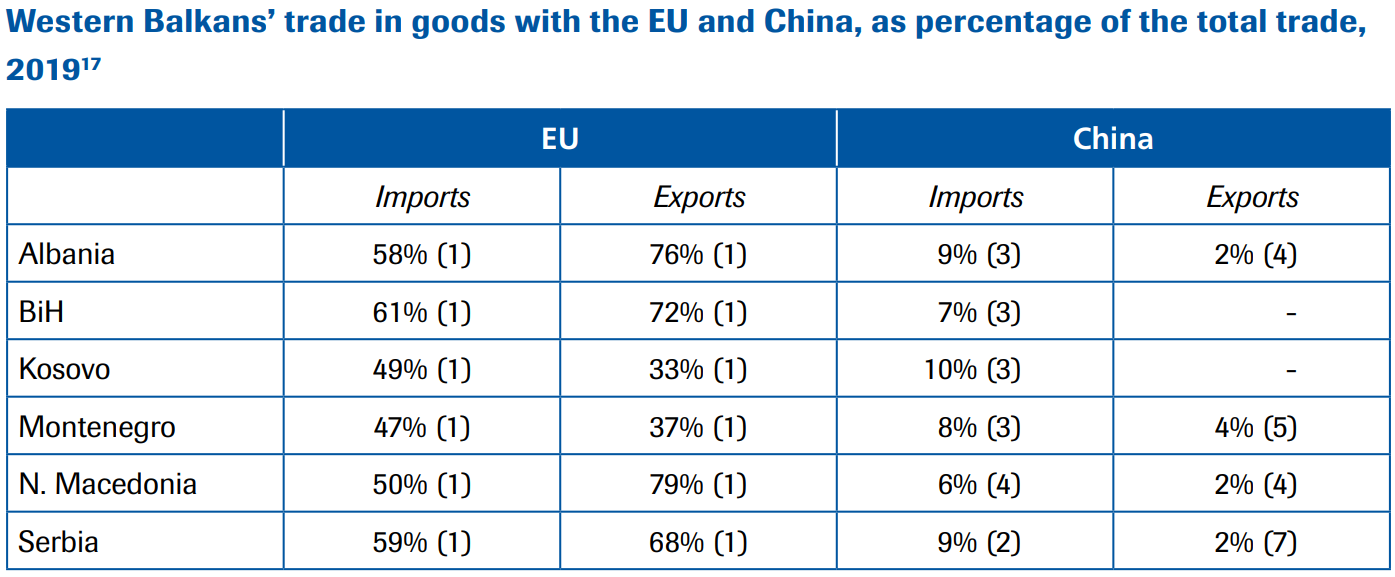
On FDI, too, China does not play a significant role in most of the Western Balkans. For example, it provides 3.75% of FDI in North Macedonia, 2.27% in Albania, and 0.36% in Montenegro.
On the other hand, Serbia has consistently been a preferred partner within the 17+1, with the two countries enhancing political and economic ties, as Belgrade sought equidistance between China and the EU. We discussed this in greater detail in a recent briefing.
While China may not be able to dethrone the EU’s trade and FDI status in the Western Balkans, the report argues China’s presence does dilute the EU’s norm diffusion in political, economic, and security aspects. As such, the EU’s requirements for eradicating corruption or improving the rule of law are stalled by the region’s interactions with China, which adheres to a different set of values in its dealings with external partners.
However, from an economic perspective, China’s growing presence is beneficial.Its investments can spur economic growth, by building infrastructure that would connect the region to Central and Southern Europe.
Still, as we told you in September, the case of Serbia shows that political proximity is detrimental to the EU’s normative soft power in the Balkans. For that reason, Jonathan Hatwell, the EEAS’ China division head, said “we need to up our game in terms of the offer”, since “China has come to dominate the narrative and perception on infrastructure investments”.
Adding to already existing projects, on October 8, Serbia and China reached an agreement for the China Road and Bridge Corporation to construct 48 kilometers of motorway in northern Serbia.

TAKEAWAYS
► IT'S POLITICS, AGAIN!
As Clingendael aptly points out, the EU’s biggest headache in the Western Balkans shouldn’t be China’s economic presence. Rather, it is about the political implications of the regions’ interaction with Chinese entities. China is telling Western Balkan countries that there is room for economic and political cooperation with Beijing without the need to adhere to European standards that may undermine the interests of the political elites.
Political dialogue on the EU’s behalf is in high demand.When the Commission dialogues with the Western Balkans, it needs to make them aware of the down-spiraling they are risking by stalling or abandoning reforms on rule of law, on independent judiciaries, on business confidence, and on eradicating corruption. The battle is one of PR, values, and appeal, as the EU already has the upper hand through its economic presence. The key solution here is for the EU to not only have this presence in percentages within reports, but also in the minds and hearts of the region’s policymakers and voters.

READ MORE
EU unveils 9 billion euro investment plan for the Balkans - AP News, Oct 6
Boosting and connecting the Western Balkans on the EU path - European Commission, October 7
China and the EU in the Western Balkans - Clingendael Institute (Wouter Zweers, Vladimir Shopov, Frans-Paul van der Putten, Mirela Petkova & Maarten Lemstra), Aug 31 2020
5. Bad Week for Huawei in Europe - Brussels 5G Won’t Run on Huawei
Huawei has gone through another challenging week in Europe, as its services were not chosen for implementation of 5G in Belgium and British MP’s have claimed they have proof of collusion between Huawei and the Chinese government.
► Instead of Huawei, key Belgian telecom providers Orange and Proximus opted for Nokia to deliver the key 5G telecoms equipment, with Ericsson providing core components;
► British MP’s further raised questions about the national security risks associated with Huawei’s equipment, in an official report by the Defence Committee;
► Globally, Huawei remains a key actor in the 5G market, but Samsung is slowly emerging as a significant competitor, along the lines of Nokia and Ericsson.
Belgium Joins the No-Huawei Party
Amid concerns about national security, the main commercial operators in Belgium preferred to opt for a trusted European vendor: Nokia (with Ericsson providing components for the core of the network).
Note that this decision comes after last week’s allegations that Germany is looking to severely restrict Huawei’s access to its national network.
Orange and Proximus are some of the first European operators to make the decision to drop Huawei from their networks. Their decision comes after Belgian security services argued Huawei’s equipment does not fit national security requirements.
The decision is somewhat surprising, given that Chinese vendors provided 100% of radio network equipment in Belgium. On the other hand, the risks associated with it were vast, given that both the EU and NATO use these networks for their headquarters’ communications in Brussels.
In a statement on October 9, Huawei said this is the “outcome of a tender organised by operators and the result of the free market”, thus showing it accepted the decision without any protest.
Orange and Proximus are the largest operators in Belgium, though not the only ones. Telenet is another big name in the industry. Currently, Telenet uses ZTE’s networks, though it has announced it will make a decision on 5G in early 2021.
UK Beefs Up National Security Arguments
On October 8, the UK Parliament’s Defence Committee published a report on the security of 5G networks.
The EU’s neighbour has been a point of reference in the block’s discussion on 5G security and developing the 5G Toolbox, inspiring EU countries to phase out high-risk vendors. As such, following developments in the UK may be useful for the EU’s future policies.
The report suggests the UK should pursue a D10 alliance(of the world’s 10 largest democracies), which would coordinate to offer alternatives to Chinese technology.
The Committee threw its support behind the government’s decision to phase out Huawei by 2027 and even suggested it should be done by 2025.
The report also stated it has proof that Huawei colluded with the Chinese government, further demonstrating the high national security risks it poses. However, no specifics were provided in the report.
The committee also suggested that, if threats from the Chinese government continue, the government should strongly reconsider China’s presence in any critical sector of the economy.
On that note, on October 7, Huawei was barred from being a sponsor in a defence conference held in Slovakia. Slovak president Zuzana Čaputová refused initially to deliver a speech at the summit and only backtracked once Huawei’s removal was confirmed.
Slovakia thus joins other counterparts in Central and Eastern Europe in taking steps to limit Huawei’s presence. For instance, the Czech Republic, Estonia, Latvia, Lithuania, Poland, Romania, and Slovenia signed memorandums with the US that targeted Huawei’s access to the 5G networks in their countries.
The Global Situation
Huawei remains the leading global 5G equipment provider, but the pressure keeps mounting, given the security controversies and growing position of Samsung, which recently managed to seal a large deal to supply 5G RAN equipment to American operators.
Huawei, Nokia, and Ericsson together comprise 70% of the market, as shown by the graph below:
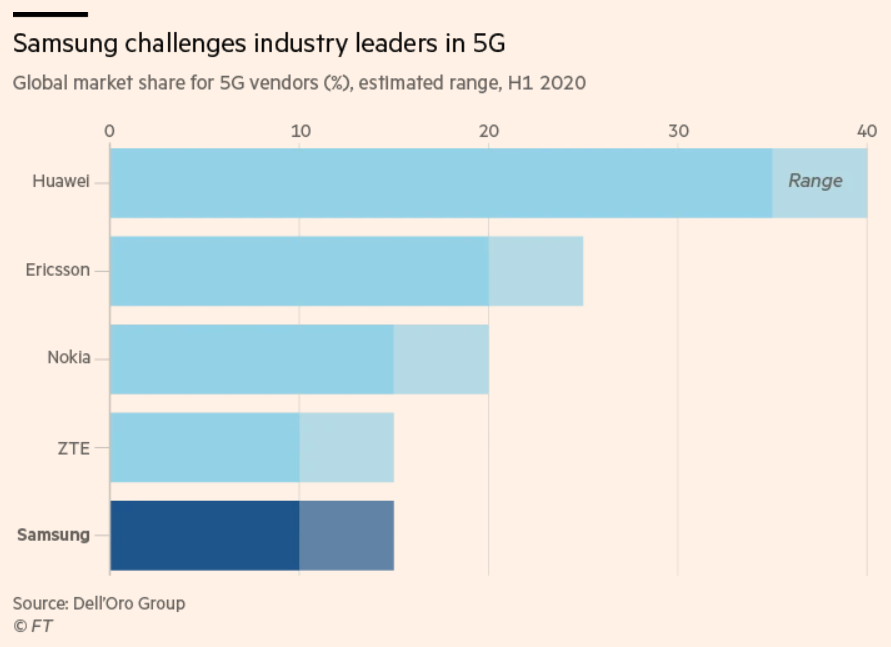
The $6.6 billion deal will allow Samsung to source equipment to Verizon until 2025, allowing its market share to almost double compared to the past two years.
If you are interested in the pre-5G reliance on Huawei in Europe, we recommend this report by telecommunications consulting company Strand Consult. For example, 40% of 4G equipment bought in Europe so far since 2016 came from Huawei and ZTE. If all of it were to be replaced, it would amount to a cost of $3.5 billion, meaning $7/mobile subscriber.

TAKEAWAYS
► THE COST MYSTERY
According to data coming from Proximus, the decision to opt for Nokia instead of Huawei turned out to be the cheaper one too. Even more, thanks to a very competitive selection process, they will be able to renew their mobile network at a much lower cost, totaling up to €80 million from 2021-2023.
This is a conundrum, since one of Huawei’s flagship claims was that it provides the best price-quality ratio on the 5G market. Huawei itself said in June that, according to calculations by Oxford Economics, the cost of excluding Huawei from European 5G would be roughly €3 billion per year, an annual cost increase of 19%. Aside from the cost, the report also says that banning Huawei would result in missed technological innovation and growth totalling €40 billion by 2035.
While the above data come from a study promoted by Huawei itself, similar concerns over the costs of exclusion of the company from European 5G have been raised over the last year by many telecommunication and cybersecurity experts. There is something rotten with these discrepancies: either they are wrong or the previously touted costs of phasing out Huawei are wrong. If you have a clue, drop us a message, we would love to discuss this further!

READ MORE
Huawei ousted from heart of EU as Nokia wins Belgian 5G contracts - Reuters (Supantha Mukherjee, Mathieu Rosemain), Oct 9
The Security of 5G: “We must not surrender our national security for the sake of short-term technological development” - UK Parliament, Oct 8
Huawei Blocked From Sponsoring Security Event in NATO’s Slovakia - Bloombers (Radoslav Tomek), Oct 7