EU-China News Brief - 13 April 2020
YOUR WEEKLY SHOT OF EU-CHINA NEWS
BY FLAVIAN BERNEAGĂ AND GRZEGORZ STEC
1. Chinese FDI in Europe is Dwindling, but COVID-19 Could Reverse That
Chinese FDI in Europe
MERICS issued a report on the status of Chinese Foreign Direct Investment (FDI) in Europe in 2019.
How much:
In 2019, investments dropped to €12 billion, compared to €29 billion in 2017 and €37 billion in 2016. These figures are closer to 2012 levels - € 10 billion
The downward trend from previous years was sustained largely owing to Beijing’s administrative barriers on “irrational” capital outflows and the EU’s new regulations on investment
Where to:
Northern Europe was the preferred destination of Chinese FDI, attracting 53% of investment
Consequently, the region surprisingly overtook the Big Three (UK, France, and Germany), who dropped to 34% of total investment in 2019 (compare to 45% in 2018 and 71% in 2017).
Finland and Sweden were the big recipients, thanks in large part to the acquisition of Amer by Anta and the investment by China Evergrande in NEVS, respectively.
In what:
Chinese investments became more concentrated: 80% of them were focused on consumer products and services, ICT, automotive, and financial services.
Consumer products and services were particularly curted, attracting 40% of total investments and registering the fourth largest acquisition in the EU since 2000, namely that of the Finnish sporting goods Amer by Anta for €4.6 billion
Despite increased European scrutiny around Chinese investment in tech sectors, ICT remained the sector with the highest percentage of single transactions in 2019 (20%), coming in second in terms of volume (€2.4 billion)
The Automotive Industry came in third, with €1.3 billion in investments
By who:
The share of Chinese SOE investment dropped heavily to 11% (compared with 41% in 2018 and 72% in 2017), the lowest level of SOE investment since 2000
Challenge of R&D Cooperation
With the regulation of FDI and equity investment by the EU since 2018, Chinese firms have adapted to the new dynamic by investing exponentially more in Research & Development (R&D) and setting up more R&D partnerships with European entities.
Europe and China have longstanding research & innovation ties, best seen in the Chinese involvement in Europe’s Horizon 2020.
The Report highlights three types of partnerships:
(1) Between Chinese and European companies
(2) Between Chinese firms and European universities
(3) Chinese firms involved in projects supported by or involving European governmentsThe Good: Europe can derive innovation and know-how from China’s talent pool and hi-tech industrial clusters. This is significant, given that China now outspends Europe in R&D expenditure as a share of GDP.
The Bad: R&D collaborations with China are also problematic. They may allow China to tap into important technology that could reduce Europe’s economic competitiveness while bolstering China’s industrial-military complex.
The Ugly: Also, human rights concerns loom over the potential for the transferred technologies to be used by China to employ mass social control, such as in Xinjiang.
A Comeback in the Making?
With European developed stock markets in freefall due to the virus, a number of anonymous European bankers reported more requests from Chinese firms for proposals on targets
Many of them are state-owned enterprises, which marks a return from Xi Jinping’s restrictions on “irrational” international expansion
The sectors targeted are strategically important: auto, energy, infrastructure, and technology
The European Armor-Up Response
Following a call by the Commission in March, multiple European countries have taken preventive steps to avoid foreign takeovers during the crisis. Examples:
Italy has extended the ‘Golden Power’ protections to banks, insurers, energy, and healthcare. ‘Golden Power’ refers to a law adopted in 2019 by the Italian government, which allows it to intervene in deals involving companies operating in the sectors of defence, national security, communications, and energy and transport.
Spain announced foreign companies wishing to take >10% of any Spanish company will need the direct ‘blessing’ of the central government. On top of that, Spain also moved to protect strategically important companies with big stock devaluations.
Germany announced it will provide guaranteed liquidity to troubled companies. Germany policy-makers are keen to keep Daimler and tech companies out of foreign hands.
But there are also outliers here such as Hungary. As we reported in our April 6th News Brief, Viktor Orban’s new powers may allow him to facilitate the building of the Belgrade-Budapest railway.

TAKEAWAYS
► 2019 DOWN, 2020 UP?
Chinese investment in Europe continued to fall in 2019, but COVID-19 may reverse this trend. Chinese SOE’s appear to have been quick to attempt to take advantage of the economic chaos that has ensued during the COVID-19 crisis in Europe and they seem determined to spike their investment. This sense in the context of fraught economic and trade relations with the US. EU member states will need to keep vigilant and amp up their regulations on acquisitions if they don’t want to mirror the fate of Kuka, the German industrial robot manufacturer acquired by a Chinese home appliances manufacturer in 2016.
► THE NEXT TARGET
European legislation in 2018 made mergers and acquisitions harder for foreign companies to pursue. As a result, Chinese companies reoriented to the R&D sector. Often overlooked by policy-makers, R&D is a highly sensitive area. Working with China means Europe can extract benefits just as much as it could shoot itself in the foot by giving away essential tech. European regulators may want to keep an eye on it.

READ MORE
Chinese FDI in Europe: 2019 Update - MERICS (Agatha Kratz, Mikko Huotari, Thilo Hanemann, Rebecca Arcesati), Apr 8
China’s Corporates Are Gearing Up in Europe for M&A Bargains - Bloomberg, Apr 7
Germany bolsters corporate defenses against Chinese 'predators - Nikkei (Jens Kastner), Apr 3
Italy: Italian Government Acts To Strengthen Further Its "Golden Powers" - Mondaq (Leah Dunlop, Elisabeta Randazzo, Niccolo Lavorano, Anastasia Pallagrosi), 9 Aug 2019
German robot maker Kuka's CEO to be replaced by Chinese owners - DW (Nik Martin), Nov 24 2018
2. Toying with the Numbers? China’s Data on COVID-19 Questioned
Wuhan Lifts the Lockdown
After 76 days, authorities removed the lockdown on Wuhan on April 8, a symbolic landmark for the city where the outbreak started
65,000 people left the city within hours after the measure was lifted, many of them migrant workers returning to their families
News of discrimination and xenophobia against African migrants in Guangzhou emerged. Chinese authorities remained largely silent on this matter.
Numbers Don’t Lie...or Do They?
A number of classified reports by US intelligence indicate the number of cases and deaths is higher than initially reported by Chinese authorities
The Economist’s analysis of data from China’s National Health Commission showed 15 instances in which the number of new cases jumped by at least 20% within one day.
In two-thirds of those instances, they were accompanied by important decisions made by the government: Xi’s speech, the sacking of a local leader, etc.
A research team from the Los Alamos National Laboratory calculated that each person who contracted the virus in Wuhan infected, in turn, 5.7 other people
Chinese authorities themselves may be unaware of the exact number of cases. Foreign Policy suggests looking at proxy data (i.e. number of urns for cremated victims of the virus), but these do not provide a clear picture either
WHO is to blame?
The proxy data suggest the number of deaths in Wuhan to be twice what the WHO reported. The global spread of the outbreak has put WHO under fire for alleged bias towards China
The criticism does not necessarily imply China coerced WHO into releasing flawed numbers. Foreign Policy’s China editor argues it may be a prime example of soft Chinese power influence.
In yet another scandal (see our previous brief for previous ones), WHO chief Tedros Ghebreyesus accused Taiwanese leaders of being racist without providing background context
On April 10, Taiwanese authorities uncovered a number of fake Twitter accounts tweeting apologies to Ghebreyesus for the alleged racism
Discrimination against Africans in Guangzhou
Reports emerged of Africans (many of them Nigerians) in Guangzhou being evicted from their homes, not welcomed in hotels, and told to leave the country
Many were randomly screened for COVID-19, despite not having left China for months
Authorities did not publicly respond to accusations of xenophobia. As fears of a second outbreak grow, foreigners may be used as potential scapegoats
The Nigerian Speaker of the House of Representatives and the Ugandan Minister of Foreign Affairs brought these issues forward to the respective ambassadors of the PRC
Global Anger and Its Repercussions
Governmental bodies have increasingly assumed more abrasive rhetoric against Mainland China and the WHO for their underreporting
US Senator Todd Young called on Ghebreyesus to appear before a Foreign Relations subcommittee to answer questions of the mishandling and underreporting
This adds to previous anger. On March 29, Boris Johnson was allegedly extremely furious over China’s underreporting, considering a change of stance on Huawei’s 5G contribution to the UK. He later tested positive for COVID-19 and was admitted to intensive care. He left the hospital on April 12th.
Nonetheless, many countries depend on China for the provision of medical supplies, meaning widespread official criticism is still not happening. This is best exemplified by Angela Merkel’s direct phone call with Xi Jinping, which gave Germany direct access to Moheco, a Chinese SOE that manufactures protective equipment.
This shows access to medical supplies is approved on the basis of political agreements and direct calls. This is particularly salient given the struggle for quality equipment in many European countries.

TAKEAWAYS
► WHAT GOES AROUND COMES AROUND
While hard data may never surface, more and more outlets are questioning Beijing’s numbers and suggesting that they should be significantly higher. As of now, many countries are still fighting the health crisis and are in need of good-quality medical supplies. As the German case exemplifies, these supplies may be available on the basis of direct talks between leaders. However, once normality resumes, a tougher rhetoric on China’s mishandling and underreporting is likely to send waves through various levels of EU-China cooperation, as EU governments are now being confronted with a radical and vivid example of dealing with a nontransparent partner. Already on April 12th reports emerged that the UK's MI6 and MI5 urged a “China rethink” once the COVID-19 crisis passes - more may come to a similar conclusion.
► PATIENT NO.10 SYNDROME
In the long-run, leaders who were personally affected by the virus may come to reassess their approach towards China. So far the main national figures involved are Boris Johnson, who went through intensive care because of COVID-19, and Sophie Trudeau, the wife of Canadian PM Justin Trudeau, who was in quarantine after contracting the virus. Depending on their personal experiences, European leaders may be inclined to become more hawkish towards China.

READ MORE
China’s data reveal a puzzling link between covid-19 cases and political events - Economist, Apr 7
Virus May Spread Twice as Fast as Earlier Thought, Study Says - Bloomberg (Naomi Kresge), Apr 8
China's Wuhan ends coronavirus lockdown but concerns remain - Al Jazeera, Apr 7
What to Make of China’s Coronavirus Figures - Foreign Policy (James Palmer), Apr 1
Coronavirus: WHO chief and Taiwan in row over 'racist' comments - BBC, Apr 9
Senate Foreign Relations subcommittee calls for WHO chief to testify - Politico (Marianne Levine), Apr 9
Tweet by James Palmer, China Editor for Foreign Policy Magazine - Twitter, Apr 9
Boris Johnson's government is furious with China and believes it could have 40 times the number of coronavirus cases it says - Business Insider (Adam Payne), Mar 29
Taiwan Finds Fake Twitter Accounts Tweeting Apologies From 'Taiwanese' to WHO Chief - Radio Free Asia (Hwang Chun-mei, Luisetta Mudie), Apr 10
Africans In Guangzhou Face Special Scrutiny Amid Coronavirus-Fueled Xenophobia - SupChina (Jiayun Feng), Apr 8
Coronavirus: China expands export checks on medical products to tighten quality control - South China Morning Post (Mandy Zuo), Apr 10
Merkels direkter Draht nach China - Süddeutsche Zeitung (Cristoph Giessen, Klaus Ott, Nicolas Richter), Apr 7
As Countries Vie for Coronavirus Supplies, Germany Cuts Deal With China - Wall Street Journal (Bojan Pancevski), Apr 8
UK spy agencies urge China rethink once Covid-19 crisis is over - Wall Street Journal (Dan Sabbagh), Apr 12
3. Status Check on the 17+1 - Report by CHOICE
Section’s Subtitle: Empty Shell, Bilateral Pearl?
A report released by the China Observers in Central and Eastern Europe (CHOICE) argues the seeming political and economic failure of the 17+1 format should not be taken at face value
Indeed, trade deficits and low-levels of Chinese investment have made CEE states disgruntled with China’s economic cooperation and the foreign policy of Beijing has not transposed in these countries, with minor exceptions
Nonetheless, CHOICE argues Beijing has not relied specifically on the wider format, but has preferred to undertake relations with the 17+1 members bilaterally. This allowed it to gain better access to the CEE governments and communicate China’s narrative
Section’s Subtitle: Paths of Action for the CEE
According to CHOICE, effective tackling of the 17+1 requires coordination at the EU level towards a common China policy and integration of the Western Balkans into the EU project
Domestically, CEE governments should support independent media and civil society to actively track China’s potential intrusions
Section’s Subtitle: ACT - adapt, counter, target
The report proposes a policy named ACT, which presumes three steps:
First, CEE must adapt, by grasping the reality of fragmented Chinese presence in the region and understand it as a long-term variable
Secondly, it must use the 17+1 platform to counter China’s influence through a multilateral response and unified positions
Finally, after a cohesive response, CEE must target China with specific demands in areas of cooperation and of contention

TAKEAWAYS
► CHINA TOOL
One of the key messages coming from the report in the EU context is to appreciate the agency of the CEE countries rather than treat them as passive recipients of Chinese, American, or other narratives. Most of the CEE states don’t attach strategic priority to their relation with China, which gives their political elites the space to use China as a tool in pursuing their own domestic or foreign goals. This makes understanding each CEE country’s dynamic with China even more difficult than it is in the case of bigger EU member states they are constrained by their well-established groups of interests (e.g. national business lobbies). We explored those topics in our recent podcast with Richard Turcsanyi about the Sino-Czech fallout.
► CENTRAL AND EASTERN WHO?
A big challenge is also the idea of “Central and Eastern Europe” itself. As the authors state, China contributed to the conceptualisation of the region, but to be fair the concept is… shaky. The grouping was selected arbitrarily by China (see our conversation with Bogdan Góralczyk, who was present at the initial announcement of 16+1) and connects countries with very different interests and identities, who are not pursuing dialogues in other frameworks. So, developing effective cooperation towards China in the region would require a great deal of political will and energy by leaders of CEE countries, many of which don’t treat China as a priority. Maybe focusing on having a stronger voice within the EU's discussion on China policy should come as a priority for CEE member states?

READ MORE
Empty shell no more: China’s growing footprint in Central and Eastern Europe - CHOICE (Vana Karásková, Alicja Bachulska, Agnes Szunomár, Stefan Vladisavljev, Una Aleksandra Bērziņa-Cerenkova, Konstantinas Andrijauskas, Liisi Karindi, Andreea Leonte, Nina Pejić, Filip Sebok), Apr 2020
Europe’s ‘17+1’ countries dissatisfied with China relations, report says, as summit is postponed - South China Morning Post (Keegan Elmer), Apr 7
RICHARD TURCSANYI: Anatomy of Sino-Czech Fallout - Lessons for Europe - EU-China Podcast, Apr 2020
BOGDAN GÓRALCZYK: EU-China Geopolitics - Poland, Hungary, and 17+1 - EU-China Podcast, Mar 2020
4. EU Bonding at Last, but Without the Bonds
Half a Trillion Coming Europe’s Way
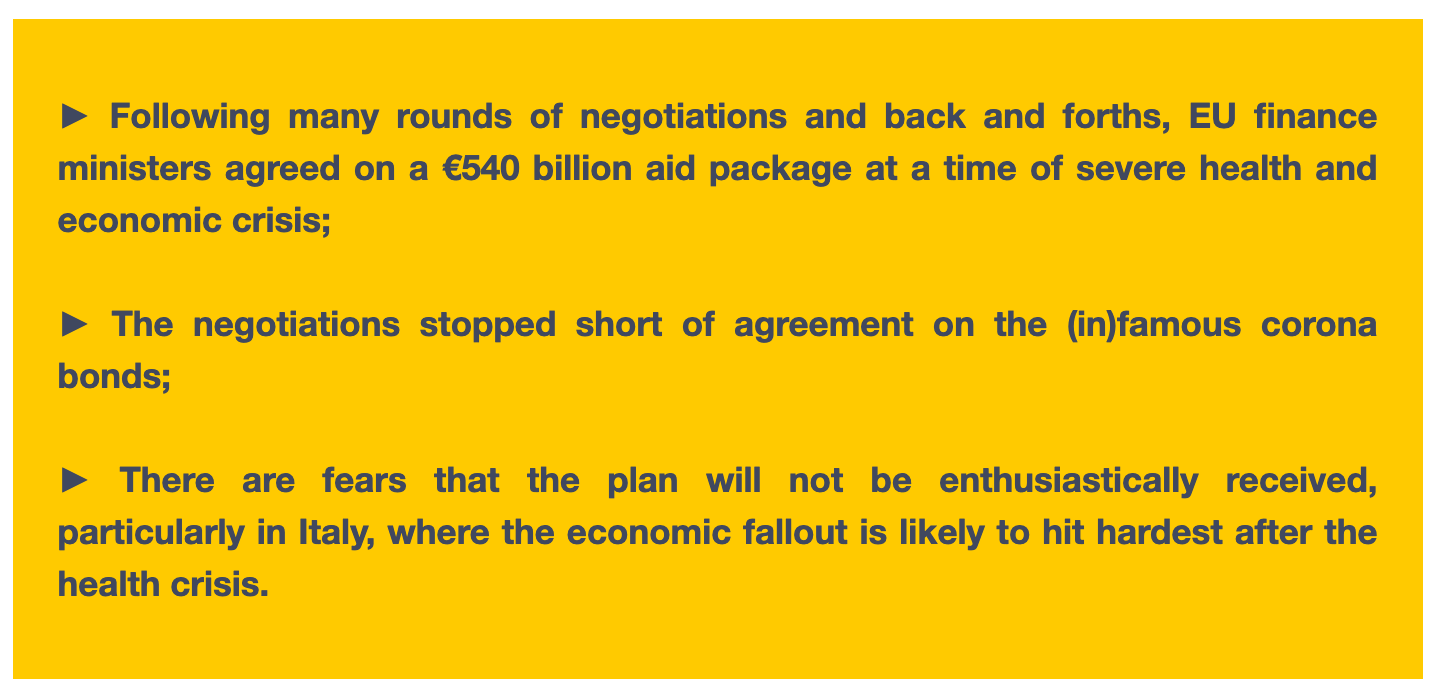
Eurogroup finance ministers reached an agreement on April 9th on a financial package to help the economies hit by the coronavirus
The €540 billion is split between:
€ 240 billion from the European Security Mechanism (for eurozone member states),
€ 200 billion from the European Investment Bank (for companies),
€ 100 billion from the Commission (through the SURE fund that will hand out unemployment benefits).Furthermore, there is an agreement to set up some sort of “recovery fund”, which is an acknowledgement that the current package is not enough.
Bonds - Too Hot to Handle
Finance ministers did not agree on the very contested corona bonds
Corona bonds are the newest name for an older concept of EU issuing joint bonds. They are seen as a way to mutualise the costs of economic recovery by issuing common debt
The prospect of common debt sends shivers down the spines of economically frugal member states, who fear they will bear the burden of the South’s debt (i.e. Italy’s debt-to-GDP ratio is 135%)
Austria, one of the more financially conservative negotiators, announced through its finance minister that the current package should not be a backdoor towards corona bonds later on. His Dutch counterpart announced, in turn, he “will never be OK with corona bonds”
Is This Enough?
The absence of debt mutualisation will make it difficult for Italian policy-makers to get an ‘OK’ at home for the package
The Italian government has cornered itself with the talk at home about corona bonds, up to the point that it may seem like the sole decisive factor
Even with hypothetical domestic support, the aid package does not solve the long-term issue of post-COVID-19 debt accumulation for Italy. Germany, for instance, has long avoided public spending for the sake of fiscal soundness. For Italy, on the other hand, further accumulation of debt will make its borrowing costs skyrocket

TAKEAWAYS
► IT'S (NOT) THE ECONOMICS, STUPID
Corona bonds quickly became a synonym for “European solidarity”. The Italian economic recovery after the health crisis is a vital topic and its debt needs to be kept in control to ensure the euro survives. On the other hand, the debate has overstepped the financial realm and is also a debate of sentiments. Policy-makers must not sensationalize technocratic discussions, lest they want Italy 2020 to become a Greece 2012.
► STRIKING THE IRON WHILE IT'S HOT
The EU has a penchant for crisis-induced reform, a feat perhaps rooted in its birth from the ashes of the Second World War. Aside from France, few players at the table are seriously thinking nowadays about deeper integration. The European Council discussing the package in the next few days could give further impetus to turn the post-COVID-19 reform into an opportunity for deeper integration. This may be a good time to think about the benefits/consequences of a European Common Fiscal Union.

READ MORE
Eurogroup agrees on €540 billion corona-package - Euractiv (Jorge Valero), Apr 10
E.U. Backs Half-Trillion Euro Stimulus, but Balks at Pooling Debt - New York Times (Matina Stevis-Gridneff), Apr 9
EU agrees on €500B of economic aid but no ‘corona bonds’ - Politico (Bjarke SMith-Meyer), Apr 10
Austria says EU deal should not be a back door to coronabonds - Reuters (Francois Murphy), Apr 9
Views from the capitals: How the row over coronabonds is tearing Europe apart - European Council on Foreign Relations (Jana Puglierin, Arturo Varvelli, Jonathan Hackenbroich, Tara Varma), Apr 8
Italy Will Struggle to Sell the EU Rescue Deal at Home - Bloomberg (Ferdinando Giugliano), Apr 10
Support for eurozone rescue deal sparks backlash in Italy - Financial Times (Sam Fleming, Davide Ghiglione), Apr 10
5. When in Deep Water, Liberalize - China’s New Reforms
Reforms to the Rescue
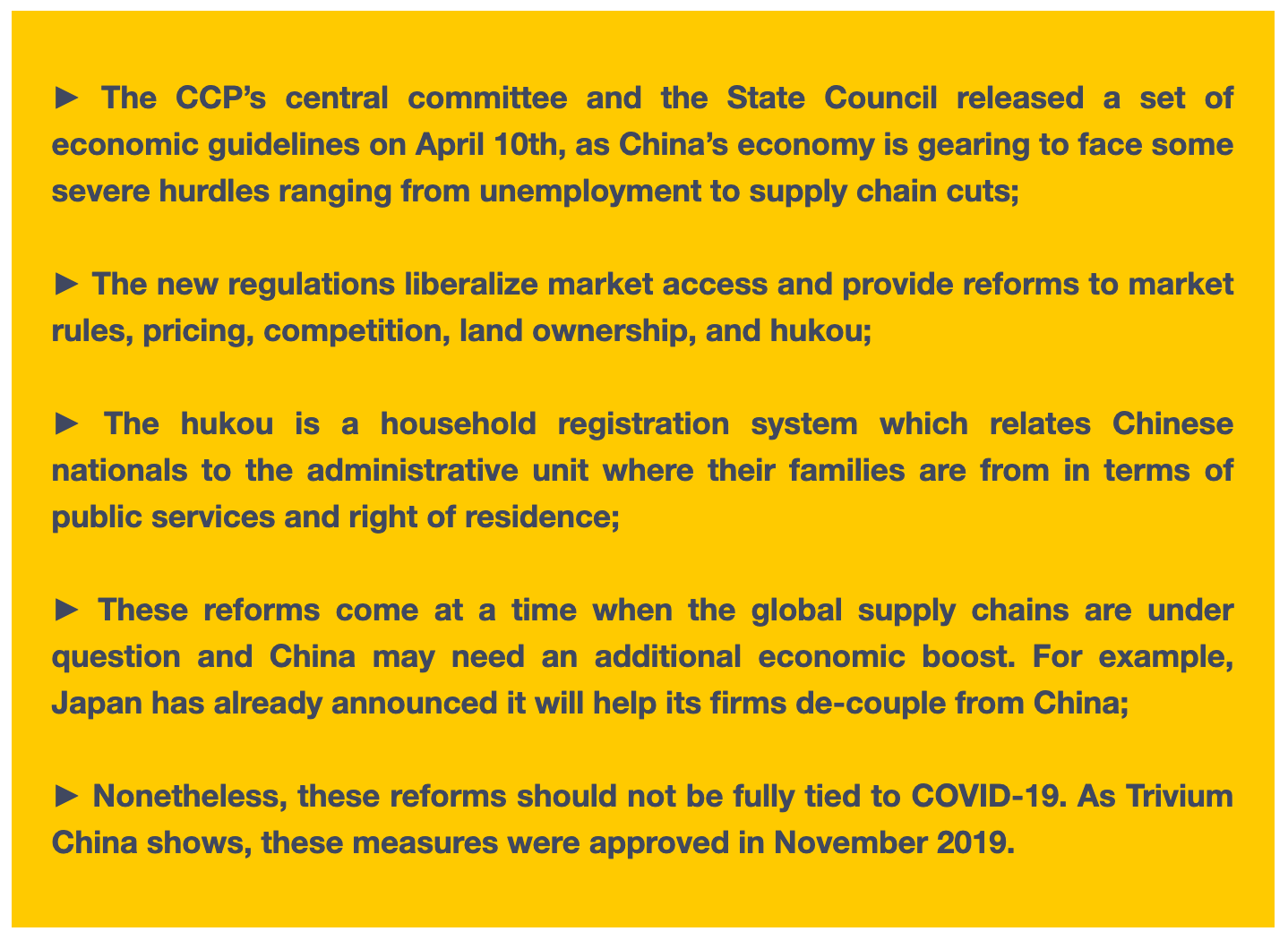
The CCP’s Central Committee and the State Council published on April 10 a set of widespread reforms in the key sectors of the economy, vowing to counter the economic effects of COVID-19
Different market players will be granted equal access and efficiency will be targeted through market reform of rules, pricing, and competition
While the guidelines do not grant land ownership in rural areas, they relax restrictions on land trading
Market-based reforms on capital, technology, and data were also pledged
Scrapping the Hukou
The reforms also promised to liberalise the hukou (户口), which is a household registration system dating back to 1958 and Maoist reforms. It limits people's ability to reside or gain access to public services outside of their hukou’s administrative boundaries
This is big news for domestic migrants who are usually separated from their families in the countryside for months on end while working on infrastructure projects in the big cities
A document released by the National Development and Reform Commission said cities with a population under 3 million should remove barriers for rural residents to apply for urban household registration status
For cities with a population of over 3 million, restrictions will be eased for groups such as migrant workers with stable jobs and college students from rural areas
For example, until now, migrant workers in Shanghai could obtain a Shanghai hukou only after seven years of residing there. Under the reform, the time they had spent in cities surrounding Shanghai will be counted towards those seven years
Urban household registration (except for megacities) will be relaxed. This means migrant workers will have a hukou based on their habitual residence, thus allowing them to enjoy the same public services as local residents (healthcare, education, etc.)
This liberalization of domestic migration could add $14 trillion to the Chinese economy
Not So New Afterall
But these vast economic decisions do not stem from the coronavirus crisis per se
According to Trivium China, all these reforms had been known since November 2019, when they were approved by the Central Commission for Comprehensively Deepening Reforms (CCCDR)
In any case, the COVID-19 crisis provided an impetus to Chinese policy-makers, as signs emerge that supply chains may be cut.
For example, Japan announced it will dedicate $2 billion of its stimulus package to help Japanese companies move away from China. In Europe, a poll by Viavoice found that 84% of respondents favor a relocation of supply chains from Asia to Europe.

TAKEAWAYS
► ACTIONS SPEAK LOUDER
It does seem that China may use the crisis to run important liberalisation reforms. This would be in line with the calls of the President of the European Union Chamber of Commerce, Jörg Wuttke not to waste the crisis, which we alluded to in the last news brief. But a problem with such pronouncements from China is that the gap between a declaration and actual implementation is large and sometimes new rules (as was often in the case with hukou reforms in the past) take a long time to be implemented or are implemented in a “creative” way locally.

READ MORE
China vows to unleash deep market-oriented reforms in new policy directive as economic uncertainty grows - South China Morning Post (Zhou Xin, Frank Tang, Orange Wang), Apr 10
China to east urban hukou restrictions for migrant workers - Global Times (Cao Siqi), Apr 10
Japan to pay firms to leave China, relocate production elsewhere as part of coronavirus stimulus - South China Morning Post, Apr 9
China’s countryside ‘returning to poverty’ as lack of reforms help fuel urban-rural divide - South China Morning Post, 26 Oct 2019
Le baromètre politique Viavoice - Libération - Coronavirus : quel monde d’après? - Viavoice, Apr 2020