EU-China News Brief - 20 April 2020
YOUR WEEKLY SHOT OF EU-CHINA NEWS
BY FLAVIAN BERNEAGĂ AND GRZEGORZ STEC
1. Chinese Economy Shrinks for the First Time since Data Have Been Recorded
End of an Era
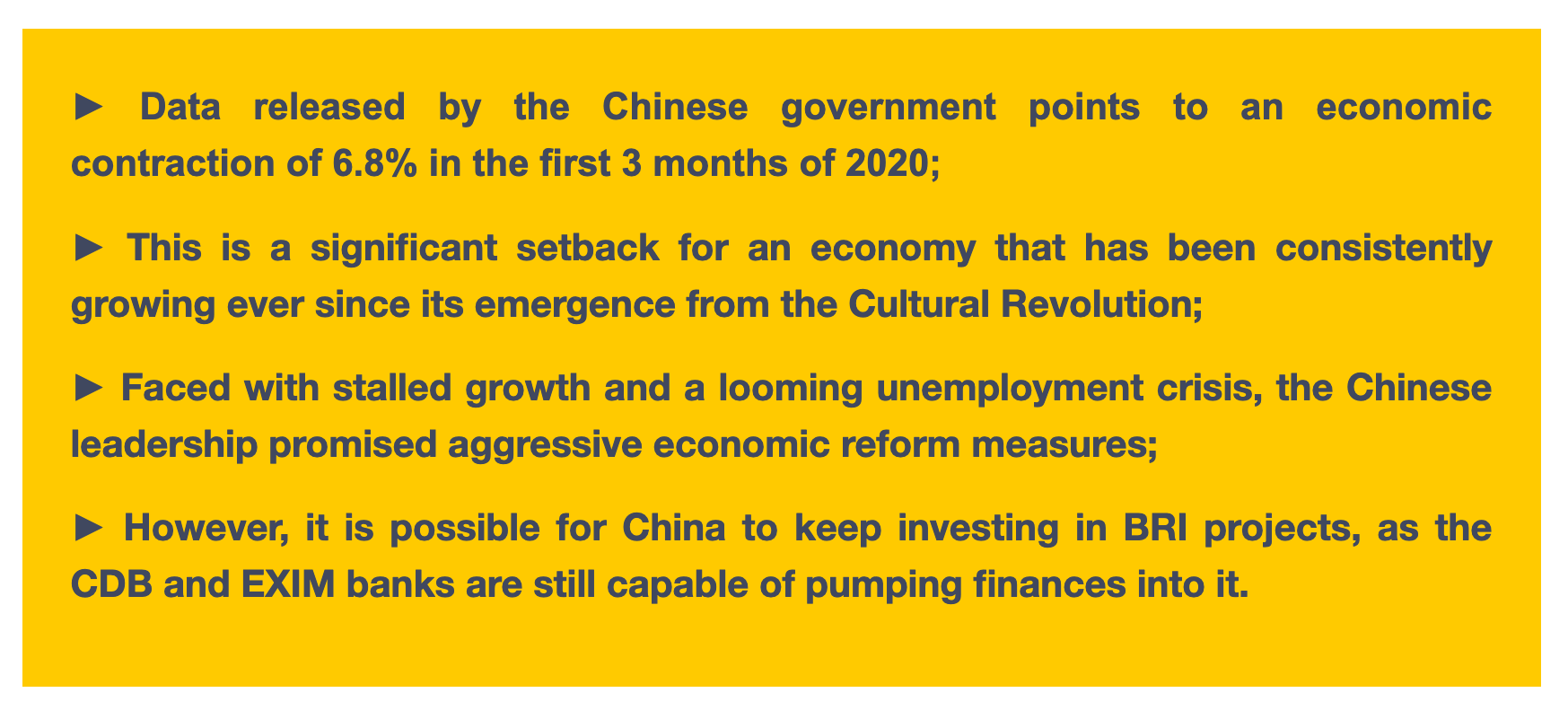
The Chinese economy shrank for the first time since analysts started tracking it, ending (at least for now) a period in which it became the world's growth engine.
With over 200 million people out of work (5.9%), China is also facing an unemployment crisis.
The situation is even grimmer as this official figure does not include many of the migrant workers, among them those who were left jobless after restrictions on travel and work were imposed.
The impact on the export sector is already harsher than the one of 2008-2009 and a further decline in Q2 is not totally out of question. If that happens, China is likely to officially enter a recession.
Our April 6th News Brief puts into context China’s economic performance through January and February.
Domestic Demand Called to the Rescue
Xi Jinping chaired a Politburo meeting on April 17 in which he pledged more proactive economic measures by the government to stimulate economic recovery.
Utmost priority will be given to boosting demand at home by encouraging consumer spending and promising to increase public spending.
This may also mean that relief measures will have to be redirected from companies (which received $227 billion in tax breaks and $509 billion in liquidity to be spread through banks) towards individual households, especially lower-income households.
However, China’s capabilities are limited. A repeat of its stimulus-induced boom of 2008 is unlikely to happen since China’s level of debt is already quite high.
The BRI Sends its Greetings
Surprisingly, the economic impact on the Belt and Road Initiative may not prove to be earth-shaking. If China wants to keep lending, it most definitely can.
As described in a report by Rhodium Group, this is because BRI loans make up a small proportion of China’s lending portfolio. Peak BRI investment was reached in 2015/2016, at $50-60 billion. Compared with China’s total bank lending of $2.6 trillion, it is a manageable amount.
Besides this, BRI is primarily funded by China’s state banks, among them the six financial mammoths: China Development Bank, Industrial and Commercial Bank of China, China Construction Bank, Agricultural Bank of China, Bank of China, and the China Export-Import Bank, which offer enough political guarantees to keep lending.
China could, in theory, now employ the BRI to play a saviour role worldwide, because receiving countries might impose less conditionality for investment under the strain of the virus.
However, Beijing may not want to extend loans to projects that do not have a promise of return, especially since it has administered multiple mismanaged investment projects already. But, if the impetus behind the new loans will be improving the international position of China in a post-corona crisis reality, then BRI is most definitely capable of still financing projects abroad.
The catch here is that, before moving to new loans, the old ones will require re-negotiation, to alleviate the macroeconomic pressures stemming from the pandemic. But Beijing has been open to renegotiating BRI debts in the past.

TAKEAWAYS
► FORT CHINA?
We can venture a guess that a challenging economic situation will make the Party less confident and make it opt for starker rhetoric to rally domestic “audiences”. This can happen even if domestic economic reforms prove to go in the liberal direction, a possibility we discussed last week. But Chinese authorities may develop the mentality of a fort under siege, which could further increase the offensive charm-like actions, which we discuss in the following news bite. That would imply more “us versus them”, more “wolf warrior” tweets, and potentially more disinformation through social media.
► NO BRAKES ON THE BRI TRAIN
It appears that the coronavirus is not necessarily going to stop China’s BRI advances. It is not only that COVID-19 gave China the possibility to run the Health Silk Road, but also financing seems to be there and, with funds needed everywhere, influence “bang for the buck” may be higher. Again, the increasingly confrontational rhetoric can be an obstacle. For example, the recent scandals in Guangzhou can affect the political climate in the relations between China and African countries.

READ MORE
China’s Economy Shrinks, Ending a Nearly Half-Century of Growth - New York Times (Keith Bradsher), Apr 16
Decline of Major Economic Indicators Significantly Narrowed Down in March - National Bureau of Statistics of China, Apr 17
Coronavirus: China’s unemployment crisis mounts, but nobody knows true number of jobless - SCMP (Frank Tang), Apr 3
China GDP: Five things to watch after coronavirus - Financial Times (Tom Mitchell), Apr 15
Coronavirus: China’s Xi Jinping promises action as economic growth machine stalls in first quarter of 2020 - SCMP (Finbarr Bermingham and Zhou Xin), Apr 17
Booster or Brake? COVID and the Belt and Road Initiative - Rhodium Group (Agatha Kratz, Daniel Rosen, Matthew Mingey), Apr 15
Coronavirus could force China to rein in Belt and Road ambitions - DW, April 17
2. China Changes Charm Offensive to Offensive Charm
Disinformation Spreads Further
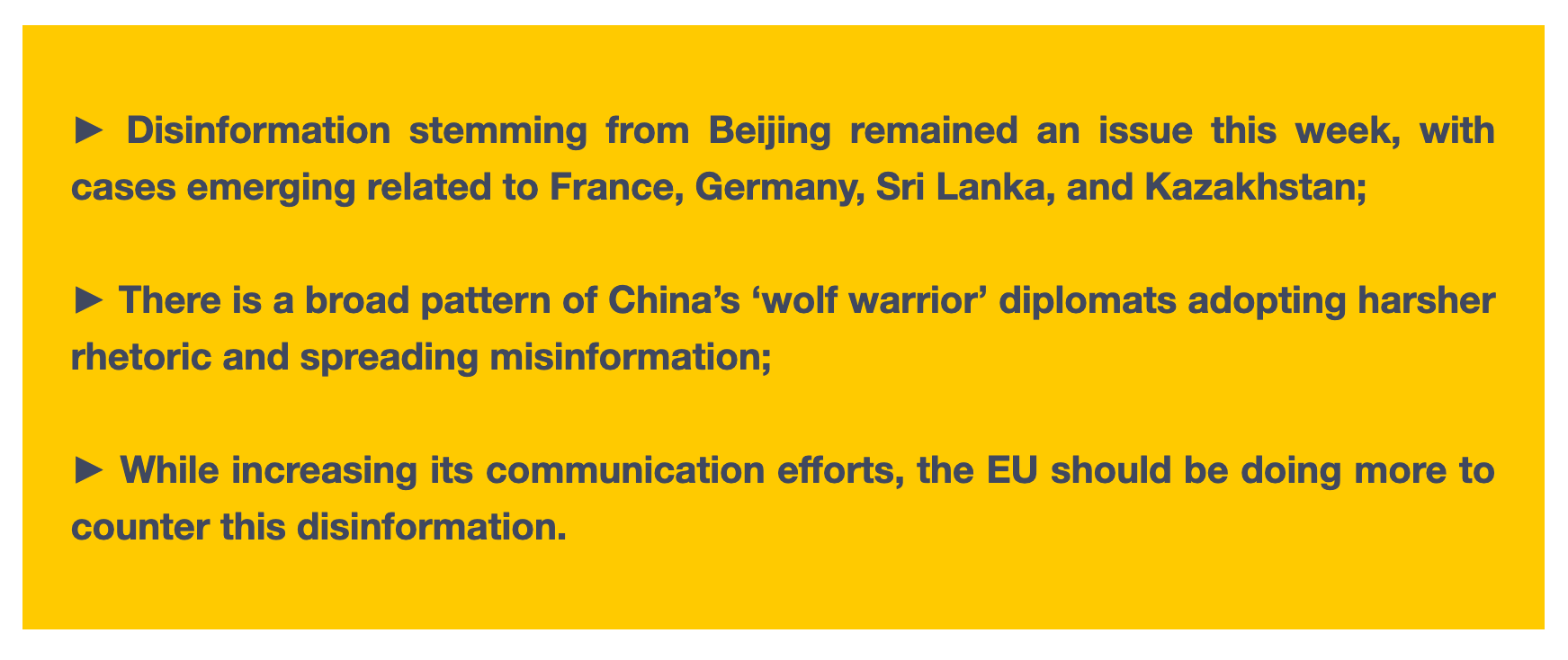
On April 14, Lu Shaye, the Chinese ambassador in France, was summoned after the Chinese embassy posted false information which said French nursing home workers were abandoning their work.
On April 12, a leaked confidential document from the German foreign ministry reported Chinese officials invited German government officials to speak positively about China’s virus response and to present the PRC as a trustworthy partner.
In Serbia, an analysis by the Digital Forensic Center (DFC) of 30,000 tweets sent between March 9 - April 9 containing the key words Kina and Srbija (China and Serbia) revealed that a staggering 71.9% were posted by bots. They were aimed at praising Chinese help to Serbia, highlighting the lack of help from the EU, and praising President Aleksandar Vučić. This comes at a time when Xi Jinping announced on a phone call with his Serbian counterpart that he will visit Belgrade this year.
Importantly, this is not simply a European trend. In Thailand, Chinese nationalistic netizens launched a campaign against a number of Thai celebrities who had expressed support for Hong Kong and Taiwan. The Chinese embassy in Bangkok stepped in to attack those who criticized China and question the One China policy. This led to a meme war, which you can observe on Twitter (#nnevvy).
In Sri Lanka, the Twitter account of the Chinese embassy was suspended after a response to a Sri Lankan critic contained undiplomatic jargon. Twitter said it was a mistake, while Chinese officials complained their freedom of speech should not be restricted.
In Kazakhstan, the Chinese ambassador was summoned after Sohu, an online Chinese platform, claimed Kazakhstan was historically Chinese territory and is willing to become part of China again.
Wolf Warrior Diplomats Show Their Fangs
For any other country, such repeated blows would be a diplomatic catastrophe. In China’s case, they seem to be a trend rather than an outlier.
Prior to the pandemic, multiple diplomats made calls for Chinese officials abroad to be more combative, which mirrored calls from the leadership for diplomats to prepare for a “long-term struggle”.
These widespread practices coupled with a lack of official statements on these matters from higher officials further give clues that there may be “blessings” from above for these types of abrasive rhetoric.
It may also be the case that young diplomats are adopting this tactic to impress their superiors, after previous such instances led to promotions and gratifications. Zhao Lijian (MFA Spokesperson) and Lin Songtian (former ambassador to South Africa) are examples of diplomats who rose in rank after becoming more confrontational.
The EU Needs to Start Pointing Fingers
So far, the EU’s responses to disinformation have been concentrated on cooperating with social media partners to remove false content and block bots.
According to the report published by DFR Lab on April 13, the EU authorities should push back against the actors who produce and disseminate false information.
So far, the EUvsDisinfo project of the EEAS has given regular reports on disinformation coming from Russia. However, a similar response on disinformation from China is lacking.
But remember that in his blog post on the “global battle of narratives” HR Borell publicly name-dropped China but omitted Russia.
At the same time, we are seeing a tougher response to China emerging from some of the media. The Daily Telegraph announced it would remove the China Watch column (which was sponsored by the PRC) and on April 17th, the German newspaper Bild took a harsh stance against China and Xi Jinping specifically, calling the coronavirus his legacy and predicting the fall of the Communist Party. But Bild’s statement also did raise a few eyebrows over including some racist comments.

TAKEAWAYS
► THE WORST DEFENSE IS OFFENSE
As we highlighted last week, China has been increasingly criticised for underreporting the progress of COVID-19, a topic we return to in today’s news brief. Continued disinformation and rhetorical attacks will only lead to increased isolation and negative response from European governments. Those efforts undermine China’s ability to guide the narrative on COVID-19 and may eventually cost China considerably.
But it appears that China gave up on increasing its soft power, opting instead for harsher narrative-forming measures (comparisons to Russia have been floating around). Such a strategy is also likely aimed at a domestic audience and it appears that Chinese authorities reward particularly outspoken diplomats. It is likely that such moves will continue as China goes into “Fort China” mode, which we discussed in the first news bite. It will be, however, interesting to observe if in the EU context there will be a correlation between the advancement of CAI negotiations and the application of offensive charm towards the EU.
► EU LITERACY ON CHINA IN DEMAND
As stated by DFR Lab in the report we already referred to:
“[EUvsDisinfo] when it comes to China, the special reports mentioned above seem to rely mainly on the work that had been done by other journalists and researchers. The European Union needs a dedicated team with Chinese speakers to track the propaganda of the communist regime.”
Just two words from us: Fully agreed! The EU and the governments of the member states should increase their “China literacy” and diversify the Chinese sources they draw information from. We discussed this in our recent podcast interview with Lucrezia Poggetti from MERICS think tank.

READ MORE
Coronavirus : la France convoque l’ambassadeur de Chine pour lui exprimer son mécontentement - Le Monde (Frédéric Lemaître and Piotr Smolar), Apr 15
Beijing tried to make German officials praise China over coronavirus outbreak – report - Hong Kong Free Press (AFP), Apr 12
Why Chinese Embassies Have Embraced Aggressive Diplomacy - Foreign Policy (James Palmer), Apr 15
Twitter ‘mistakenly’ suspended account of Chinese embassy in Sri Lanka. This is what happened - The Print (Regina Mihindukulasuriya), April 15
Young Thais Join 'Milk Tea Alliance' in Online Backlash That Angers Beijing - US News (Patpicha Tanakasempipat), Apr 15
A Bot Network Arrived in Serbia Along with the Coronavirus - DFC, Apr 13
China wants its diplomats to show more fighting spirit. It may not be intended to win over the rest of the world - SCMP (Shi Jiangtao), Apr 12
Op-Ed: The European Union’s deficient response to COVID-19 disinformation - Medium, Apr 13
Daily Telegraph stops publishing section paid for by China - The Guardian (Jim Waterson and Dean Sterling Jones), Apr 14
Coronavirus: Macron questions China's handling of outbreak - BBC, April 17
"You are endangering the world" - Bild (Julian Reichelt), Apr 17
3. EU Reassesses its Relationship with China
Tougher Rhetoric
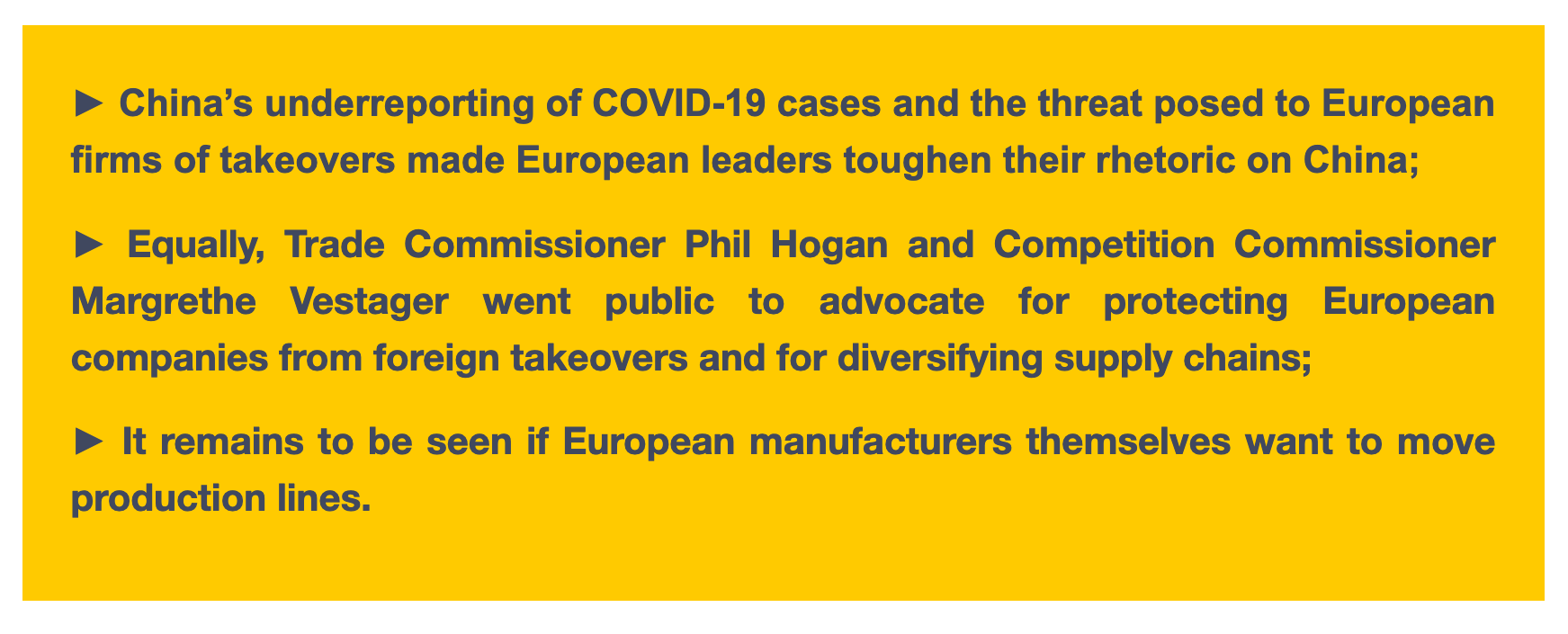
On April 16, Emmanuel Macron expressed doubts over China’s reporting, which came perhaps in a context of the scandal for which the Chinese ambassador was summoned just one day before.
“Given these differences, the choices made and what China is today, which I respect, let’s not be so naive as to say it’s been much better at handling this,” Macron said. “We don’t know. There are clearly things that have happened that we don’t know about”, he argued.
In the United Kingdom, Boris Johnson’s dissatisfaction with China’s handling of the virus has now extended to seasoned Tory MP’s, who have called for Britain to rethink its relationship with China.
In Germany, Finance Minister Heiko Maas implied that the US retreat from WHO funding may leave a vacuum for China to fill, painting China’s involvement as a potential threat. Remember, that leak from the German MFA we mentioned in News Bite 2 might have been a deliberate warning for China.
Protect and Diversify
In an interview with Financial Times on April 12, Commissioner for Competition Margrethe Vestager made an appeal to member states to protect domestic businesses and buy stakes in struggling companies that are prone to foreign takeovers, hinting at China.
Similarly, Trade Commissioner Phil Hogan encouraged EU trade ministers on April 16 to consider diversifying supply chains - possibly also encouraging repatriation, but, at the same time emphasising that “we will not be able to manufacture everything locally.”
Hogan also highlighted the updated guidelines on FDI, free movement of capital, and the protection of Europe’s strategic assets.
But on April 19th, Věra Jourová, one of the Commission’s VP’s and Commissioner for Values and Transparency, said that “the crisis has revealed our morbid dependency on China and India as regards pharmaceuticals”. She stated that the Commission is investigating how to repatriate most of the production to Europe and will announce the related plan by the end of the month.
Even so, President of the EU Chamber of Commerce in China Jörg Wuttke argues that European businesses did not indicate an express enthusiasm about the idea of relocating supply chains. Moving high-tech equipment is difficult and China remains an important market for businesses.
Even more, on April 18, Vice-Premier Liu He (previously tasked with trade talks with the US) called Commission Executive Vice-President Valdis Dombrovskis to ensure Beijing is stepping up efforts to conclude an investment agreement with the EU by the end of 2020.
There are also higher chances that Boris Johnson’s pre-COVID-19 plans to incorporate Huawei technology into Britain’s 5G networks may change.
British Foreign Secretary Dominic Raab announced the relationship with China will not be “business as usual” once the pandemic ends. He echoes a hardening of stances in Tory ranks in relation to China.
A former head of the MI6 foreign intelligence service urged the British government to prevent the Chinese purchase of Imagination Technologies, predicting a future relationship marked by deep technological rivalry.

TAKEAWAYS
► IT’S JUST THE BEGINNING, IT’S NOT THE END...
Will things never be the same again? It certainly seems that multiple EU bodies and member states say that business as usual with China will not come back once the pandemic is sorted out. 2020 was branded in Beijing as the “year for Europe”, but given the poor reception of China’s offensive charm, Europe is becoming disillusioned towards China. If China maintains its propaganda of blaming EU countries, we are likely to see a cooling down of relations between Brussels and Beijing. But it is unlikely that we would see a decoupling and disengagement, policies similar to the ones being pursued by the US. It may also be that China is going to tone down its rhetoric. Even amid the pandemic, Liu He’s call signals that Beijing is keen to get the economic boost that could be a result of completing CAI negotiations. It would be imprudent to lose such an important economic deal over controversial tweets from China’s warrior-wolf diplomats, so we should keep an eye on the potential parallel between progress on CAI and offensive charm activities aimed at the EU.

READ MORE
Europe Is Taking a Harder Look at China After Virus Suspicions - Bloomberg (Patrick Donahue and Ania Nussbaum), Apr 17
FT Interview: Emmanuel Macron says it is time to think the unthinkable - Financial Times (Victor Mallet and Roula Khalaf), Apr 16
Johnson Huawei Plan at Risk; U.K. Set to Rethink China Ties - Bloomberg (Kitty Donaldson), Apr 16
Vestager urges stakebuilding to block Chinese takeovers - Financial Times (Javier Espinoza), Apr 12
Introductory Statement by Commissioner Phil Hogan at Informal Meeting of EU Trade Ministers - European Commission, Apr 16
EU trade chief urges for more diverse supply chains after crisis - Reuters (Philip Blenkinsop), Apr 16
West must do more to stop China buying up technology: former UK spy chief - Reuters (Guy Faulconbridge), Apr 16
European Manufacturers Not Eager to Exit China, Head of EU Chamber Says - Caixin (Wang Liwei and Guo Yingzhe), Apr 15
China moves to keep EU investment talks on track - SCMP (Stuart Lau), April 18
4. Unhealthy Delays of the Past, Silk Road of the Future? - Ugly Truths about the Health Crisis
New Data on the Early Outbreak in Wuhan
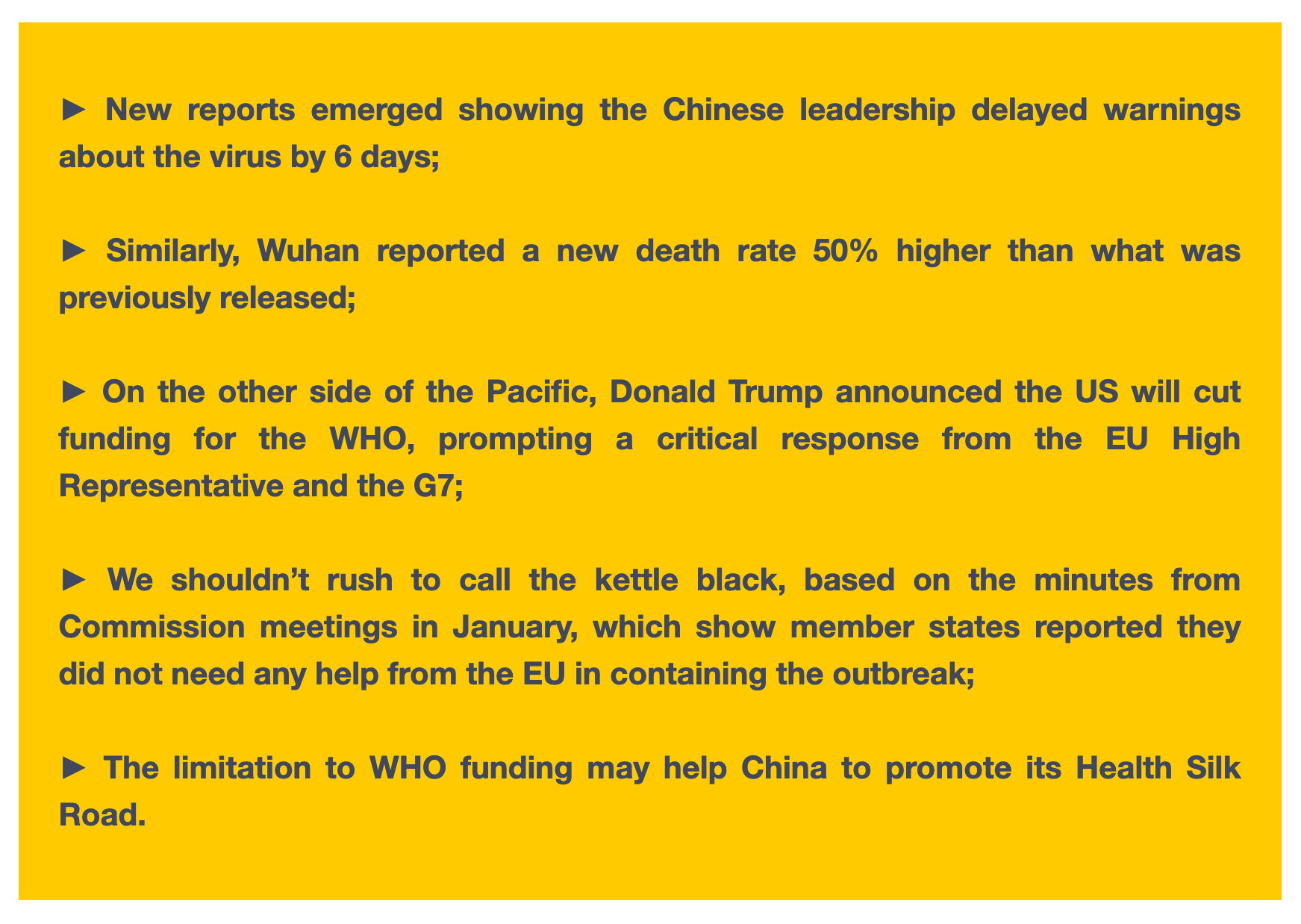
On April 15, the Associated Press announced the Chinese leadership withheld the public announcement of the pandemic for 6 days, from January 14th until the 20th.
The timing is important, because it means public awareness was set back in the early days of the outbreak.
Some experts argue the government did not disclose the information in order to avoid public panic while they were sending guidelines to local health officials. It also meant people could travel ahead of the Chinese New Year, the most important holiday in China.
It is unclear whether the progress of COVID-19 was underreported and covered up by local officials or central government officials. However, this generally seems to be a wider problem in Xi’s China, where reporting bad news to the top is avoided by local leaders with higher political aspirations.
This coincided with Wuhan announcing on April 17 that its death toll stood at 3,869 people, an increase by 1,290 in comparison to the previous figure. This is a 50% increase.
Chinese municipal authorities explained this was because some hospitals could not report cases correctly because they were overwhelmed with cases.
As Wuhan opens up again, questions re-emerge about the initial handling of the outbreak, the treatment of whistleblowers, and the failure of early-warning safety systems.
The West is not Faring Much Better
Unimpressed with WHO’s performance in the pandemic, Donald Trump announced on April 15 that the US will suspend funding to the global organization.
Aside from the moral implications of suspending funding during a pandemic, this poses serious questions over WHO’s future, because the US was by far the main state contributor ($400-500 million per year), vastly out-funding China ($76 million).
The announcement provoked a quarrel within the G7 whose scheduled video conference on April 16 switched inadvertently to the topic of WHO funding.
HR Josep Borrell took to Twitter to denounce Trump’s decision, claiming it cannot be justified at this point in the pandemic.
The previously reported minutes from a meeting between Commission officials and member state representatives on February 5, indicated the latter told the Commission that help with acquiring medical equipment was not needed, displaying a “strong level of preparedness in member states”.
There’s a Silk Road for Everything
In phone calls with Giuseppe Conte and Emmanuel Macron, on March 17 and March 21, respectively, Xi Jinping has given hints of including the pandemic response in the Belt and Road Initiative and promoting the idea of a Health Silk Road (健康丝绸之路)
The idea is not new. It can be traced back to 2017, when WHO Director Dr. Tedros Ghebreyesus praised the scope and objectives of the project.
The Health Silk Road comes in a context in which China has managed to build relatively solid health diplomacy (albeit with shortcomings). Examples of this are the medical aid provided to Malaysia, medical supplies provided through companies as part of the BRI, and coordination on health matters in multilateral forums, such as ASEAN and G20.
Some experts worry that as the BRI is evolving and, as new Silk Roads are being created, Beijing’s ability to align the world with its standards is also increasing.

TAKEAWAYS
► THE UNHEALTHY POLITICAL TRUTHS
The COVID-19 outbreak seems to be showing us ugly truths about politics. China’s Party authoritarianism with its high regard to political dynamics and limitation of freedom of expression likely contributed to the initial mismanagement and delays in responding to the COVID-19 outbreak. The President of the United States seems to be eagerly looking for a scapegoat, which he once again finds in international institutions damaging multilateral order (which may well need reform anyway). The European Union has been initially slow to respond and many member states and Eurosceptics used the EU as a scapegoat, despite the fact that it is the national authorities that reported being ready for the outbreak and that the EU has so far had limited competences in regard to healthcare (on this point, we recommend a recent discussion paper by EPC’s President and former President of the European Council Herman Van Rompuy - link).
► IMPOSSIBLE COMPARISON
Still, it is important to not fall for discourse of China’s response being more efficient. In Macron’s words, “let’s not be so naive as to say [China] has been much better at handling this”. It’s apples and oranges between systems that differ in transparency, and conclusions on handling the pandemic should take into account this important variable. We saw how Wuhan reported more deaths as the city opened up and questions about the (intentional/unintentional) accuracy of China’s data remain in place.
► ALTERNATIVE TREATMENT FOR THE WORLD
Trump’s decision to suspend funding for the WHO makes China win twice. It increases its soft-power in WHO itself and cripples the current multilateral order, thus providing momentum for China’s development of its own Health Silk Road. This is one of the reasons for the EU to oppose Trump so much on this decision. This situation perfectly captures the general problematic position that the EU has found itself in regard to global governance. In a way, the EU is between a rock of Trump’s unilateralism and a hard place of China’s efforts to reshape multilateralism in a way that doesn’t necessarily respect EU values (why would it?). On the other hand, here is an opening for the EU to show its commitment to multilateralism and its ability to grasp agency. If the Commission could convince member states to declare all contributions as a common EU contribution and increase the contribution’s value, that would be a fantastic publicity boost.

READ MORE
China Didn’t Warn Public of Likely Pandemic for Six Key Days - Associated Press, Apr 15
Wuhan just Revisited its Covid-19 Death Toll Up by 50% - Quartz (Mary Hui and Jane Li), Apr 17
Searching for answers in Wuhan’s coronavirus aftermath: people at epicentre of China’s crisis want explanations - SCMP (Jun Mai and Echo Xie), Apr 17
Coronavirus: US to halt funding to WHO, says Trump - BBC, Apr 15
G7 Leaders Chide Trump over WHO Funding Stop - Politico (Hans von der Burchard and Charlie Cooper), Apr 16
Tweet by JoseApp Borrell on Trump Cutting WHO funding - Twitter, Apr 15
Exclusive - 'Things under control': how Europe sleepwalked into the coronavirus crisis - Reuters (Francesco Guarascio), Apr 1
Trump And WHO: How Much Does The U.S. Give? What's The Impact Of A Halt In Funding? - NPR (Pien Huang), Apr 15
China already has a WHO alternative - Axios (Bethany Allen-Ebrahimian), Apr 15
Mapping China’s Health Silk Road - Council on Foreign Relations (Kirk Lancaster, Michael Rubin, and Mira Rapp-Hooper), Apr 10
FT Interview: Emmanuel Macron says it is time to think the unthinkable - Financial Times (Victor Mallet and Roula Khalaf), Apr 16
5. The Light at the End of the Roadmap - Preparations to Lift the Lockdowns
Please Follow the Exit Sign
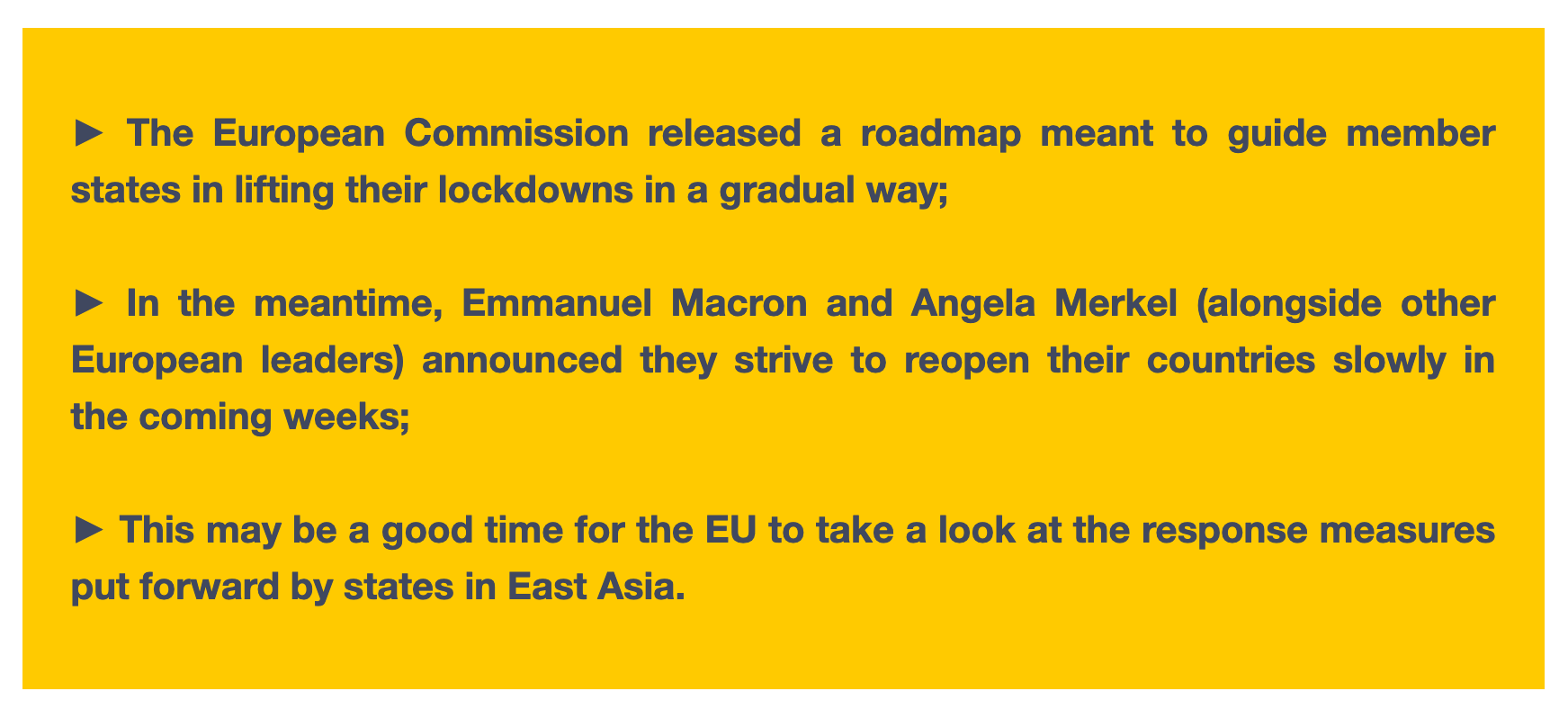
In the absence of member state impetus, the European Commission issued a plan (roadmap) on April 15 for member states to gradually open their societies and economies once the spread of the diseases stalls.
The key principle of this roadmap is that easing measures will not enter into force until: (1) there is a sharp drop in infections; (2) hospitals have enough beds, intensive care units, and equipment; (3) there is large-scale availability of testing kits.
Once these conditions are met, the easing target will move gradually. Authorities would first track people through mobile apps and keep enforcing social distancing while expanding testing capabilities.
After this, authorities would move to open internal borders while maintaining maximum levels of protection for the elderly. External borders would be opened later, on a case-by-case basis.
Return to work would then be gradually implemented, beginning with essential sectors of the economy.
Finally, gatherings of people would be progressively allowed, with restrictions for schools and universities, shopping malls, and restaurants and cafes.
The roadmap also contains an economic restructuring pledge, with a more ambitious Multiannual Financial Framework as its backbone.
Speaking of economic recovery: the Parliament adopted a joint motion for a resolution calling for a European Health Response Mechanism and recovery bonds guaranteed through a new, more ambitious budget. This is still a work in progress and pre-virus talks on a higher budget were not very successful, so for now this should be treated for what it is: only a proposal.
Member States Propose Own Exit Plans
Emmanuel Macron announced the current lockdown will be lifted on May 11th, at which point France will gradually remove restrictive measures.
The first to open in France would be kindergartens, schools, and workplaces, while restaurants, bars, cinemas, theatres, and concert halls would need to remain closed. Vulnerable groups will, in turn, need to extend their quarantine until further notice.
In Germany, Angela Merkel announced small businesses will reopen on April 20th, while schools will reopen on May 4th.
Large gatherings will remain banned in Germany until the end of August, while religious gatherings remain indefinitely restricted.
In her typical pragmatic yet straightforward fashion, Merkel told Germans that they need to live with the virus until a vaccine emerges.
Lessons from East Asia
A new policy paper by Institut Montaigne offers an insight into the responses to the pandemic from Mainland China, Japan, Hong Kong, Singapore, Taiwan, and South Korea.
The report highlights the importance of early action, which allowed five of the above six jurisdictions to avoid full confinement.
All six cases exhibited crisis management procedures, measures targeting population behaviour, mass production of medical equipment, the mobilization of industry, a testing policy; the use of digital tools, and economic policy tools.
The report highlights that a weakness in East Asia has been the lack of regional cooperation. Europe still has a chance to show the way in this regard.

TAKEAWAYS
► OPEN TO SUGGESTIONS
We now know that many East Asian countries have taken effective steps to avoid a large scale outbreak through a variety of measures. As Europe slowly moves further towards easing restrictions, it is worth noticing which measures are adopted in these exact same states. Taiwan, Japan, and South Korea offer, perhaps, the closest political models that could be copied-adjusted-pasted in the EU.


READ MORE
Coronavirus: European Roadmap Shows Path towards Common Lifting of Containment Measures - European Commission, Apr 15
Here’s Europe’s Plan to Get People Back to Work After Covid-19 - Bloomberg (Nikos Chrysoloras), Apr 15
EU Should Back ‘Recovery Bonds’ in Response to Coronavirus, says European Parliament - Politico (Maia de la Baume), Apr 17
Macron says France’s lockdown to be eased from May 11 - Politico (Rym Momtaz), Apr 13
How Germany plans to gradually reopen its economy after a weeks long coronavirus shutdown - CNBC (Spencer Kimball), Apr 15
Fighting Covid-19: East Asian Responses to the Pandemic - Institut Montaigne (Mathieu Duchâtel, François Godement and Viviana Zhu)