EU-China News Brief - 27 April 2020
YOUR WEEKLY SHOT OF EU-CHINA NEWS
BY FLAVIAN BERNEAGĂ AND GRZEGORZ STEC
1. Pragmatic Discontent and EEAS Scandal - EU’s Response to China’s Disinformation
Murmurs of Discontent
Official Statements:
While refusing to side with the US, Germany and France asked China to be transparent in identifying the source of the corona virus:
On April 20, Merkel said “the more transparent China is about the origin of the virus, the better it is for everyone in the world in order to learn from it”.
The week before, on April 16, Macron said: “Given [...] what China is today, which I respect, let’s not be so naive as to say it’s been much better at handling this”, when talking about reporting on the spread of the virus.
In a response to the European Parliament on April 20, Commissioner for Trade Phil Hogan complained market access for EU firms in China has not improved. This comes soon after a recent talk between Liu He and Valdis Dombrovskis where the two pledged to keep working on an investment agreement.
An analysis commissioned by the Czech MFA on April 21 accused China of withholding information and attempting to sabotage the West.
Equipment Problems:
In Spain, a batch of faulty masks coming from China was withdrawn after more than 1000 healthcare workers were exposed to the virus.
In Poland, controversies emerged over the certification of 7 millions of masks bought using public money and imported from China by KGHM (a Polish multinational corporation and a major copper and silver producer). The first batch arrived on April 14. The quality of the equipment was supposedly certified by an Italian agency, Ente Certificazione Macchine. However, reports are emerging that this agency does not hold the authority to conduct such assessments.
Educational Tensions:
On April 21, Sweden closed its last Confucius classroom, thus making Sweden the first European country to close all its Confucius Institutes and related projects. Three days later Gothenburg ended its twin-city agreement with Shanghai.
On April 23, EUObserver uncovered a “concept note” sent by the European Commission to national authorities. The note indicated European universities should appoint civilian spy-catchers in order to avoid the stealing of dual-use technology and to prevent foreign interference in international research collaborations.
EEAS’ Report Scandal
Politico reported on April 21 that an EEAS report was planning to criticize China and Russia for backing conspiracy narratives aimed at destabilizing the EU. The report was intended for publication on that same day.
On April 24, the New York Times reported that the final version of the report tapered the confrontational speech, after intervention from Beijing made EU officials delay and then rewrite the draft.
China allegedly complained to the EU three times and warned it of waning relations if the report was released.
Eventually, the EEAS Report was published on April 24. It explicitly mentions China’s involvement in the spread of disinformation. Its publication is overshadowed by three anonymous people who reported to Politico that Chinese diplomats indeed exerted pressure on changing the wording.
According to Politico, which—along with hundreds of individuals and institutions—has seen the original report, changes include:
Changing: “continued and coordinated push by official Chinese sources to deflect any blame” to “We see continued and coordinated push by some actors, including Chinese sources, to deflect any blame.”
Erasing a statement that China is running a “global disinformation” campaign; China’s critical response to French reaction was also erased.
You can see some more of the original report shared in a tweet from Matthias Kolb from Süddeutsche Zeitung, who stated that “the only relevant nugget of information” was related to the China-France tension and it said that, in one of the post on its website, the Chinese Embassy to France “included made-up allegations that French parliamentarians, together with Taiwanese officials, used racist slurs against WHO Director Tedros.”
On April 25, Reinhard Bütikofer, the chair of the European Parliament for relations with the PRC (whom we recently hosted on our podcast), and Peter Stano, the lead spokesperson on external affairs of the EU, took to Twitter to criticize the New York Times for not displaying facts correctly and for naming officials without their consent
Bütikofer: “The report did come out, didn't it? It does criticize China in clear words, right? It came with more carefully chosen language, yes. Isn't that wise in making the criticism less assailable?”
Stano: “If you read with open eyes and no hidden agenda you see: we don’t bow to any foreign pressure and do our job in exposing disinformation and its actors.”
But Stano came under criticism for describing Politco’s report in an email to Julian Röpcke as “(little disinfo in itself :))”, for which he later apologised.
There have been calls for HR Borrell to address the matter, which he may choose to do this week.
The report is linked in the “Read More” section below. We strongly recommend you consult it for yourself for a better picture before making up your own mind.
*DISCLAIMER: New information in news media and social media keeps coming in as this news brief is being written. Rest assured we will return to it next week once the dust settles a bit and we get a clearer picture of the situation.

TAKEAWAYS
► MASK DIPLOMACY UNMASKED
At the start of the pandemic, Beijing’s mask diplomacy appeared to win some sympathy in Europe. However, scandals related to the poor quality of the equipment imported from China, coupled with China’s disinformation initiatives and an exponential rise in the belief that China has been withholding information regarding COVID-19 have made European countries doubt China. But while we have seen some media outlets becoming more critical of China (discussed in our last news brief), it’s important not to overlook efforts made by China, such as the Chinese financial group CITIC’s acquisition of a majority stake in the largest Czech domestic media agency, Médea, on April 20th. Still, billboards thanking “Brother Xi” are likely to remain in Belgrade only. At the same time, don’t expect dramatic shifts in approaches to China. For example, recently we reported that the UK’s government is considering revisiting its decision on Huawei, but on April 21 the British MFA announced that Huawei’s contracts will not be disrupted, despite resurfacing calls to reset relations with China.
► WALKING IN THIN LINE
Let’s be clear: growing discontent is not synonymous with confrontation. The EU finds itself between a rock and a hard place. Washington wants Brussels to be more aggressive, while Beijing behaves as if it did nothing wrong. At the same time, both the US and China try to promote their narratives of how the EU is positioned amid their competition. Take, for example, the recent comments by Chinese FM Wang Yi, who praised France for its “independent diplomatic style”, which you should read as not aligning with the US on many issues amid the pandemic. Such comments will increase the anxiety about EU-China relations in Washington. These are stormy seas to navigate for an EU that refuses to fully align itself with either of the two voices and tries to build up multinational consensus amid a pandemic that pulls countries further away from a multilateral solution. An example of this problematic position is the controversy surrounding the EEAS report (albeit poorly handled), which highlighted attempts to be very “pragmatic” in voicing EU’s criticism of China’s disinfo, which some see as bowing to China.

READ MORE
EEAS SPECIAL REPORT UPDATE: SHORT ASSESSMENT OF NARRATIVES AND DISINFORMATION AROUND THE COVID-19/CORONAVIRUS PANDEMIC (UPDATED 2 – 22 APRIL), EUvsDisInfo, Apr 24
Germany pushes China for answers to coronavirus origin - SCMP (Stuart Lau, Catherine Wong), Apr 21
Analýza ministerstva zahraničí: Čína tajila informace o koronaviru a šíří propagandu - Aktualne (Lukáš Valášek, Helena Truchlá), Apr 21
Pressured by China, E.U. Softens Report on Covid-19 Disinformation - New York Times (Matt Apuzzo), Apr 24
China put pressure on EU to soften coronavirus disinformation report - Politico (Simon van Dorpe, Mark Scott, Laurens Cerulus), Apr 25
China warned EU 3 times over virus propaganda report - Financial Times (Michael Peel and Tom Mitchell), Apr 26
2. Your Friendly Neighborhood Borrell
It’s Payback Time
After facing criticism from MEPs, HR Josep Borrell went public on April 20.
He criticized the US for its weak leadership and for Donald Trump’s personal attacks on the WHO.
He did not address China explicitly, highlighting mutual cooperation in medical aid.
He sarcastically argued he has never seen a billboard in Belgrade thanking the EU, in spite of its €3.6 billion in aid to Serbia.
This was a jab taken after Serbian President Aleksandar Vučić recently publicly argued there is no such thing as European solidarity, despite the EU's financial and medical aid. Vučić also paid comparatively unproportional lip service to China (including kissing the Chinese flag) for its assistance.
The Rhetoric is Backed Up with Cash
On April 22, the European Commission dedicated €3 billion in favorable loans to ten countries within the EU’s neighbourhood:
Invited countries: Ukraine, Tunisia, Bosnia-Herzegovina, Jordan, Albania, North Macedonia, Georgia, Kosovo, Moldova, and Montenegro.
Serbia, the largest country in the Western Balkans, is not on this list.
The highly favorable loans are meant to improve macroeconomic stability so that more resources can be divested towards dealing with the health and economic impacts of COVID-19.
The announcement was particularly well-received in Kyiv, where Ukrainian President Zelenskiy called it a decision of solidarity that “proves Ukraine was right to make its European choice.”
Belgrade Isn’t Impressed
After staunch domestic criticism for refusing the Commission’s aid, Vučić:
Said the money were loans (rather than aid) meant to fix the balance of payments.
Argued Serbia does not need loans, noting it had recently declined one from the IMF.
“Why take 600 or 700 million more than we need? We already took €200 million. We declined €1.2 billion from the International Monetary Fund, and I’m proud we did.”

TAKEAWAYS
► PRIVATE PARTY, FRIENDS ONLY
The EU did not stay silent over Vučić’s low-blow comments on European solidarity and recent pro-China maneuvers. Borrell’s rhetoric on Belgrade became harsher, just as the Berlaymont conveyed highly favorable loans to other Neighbourhood partners. Interesting here is the dynamic between Zelenskiy and Vučić: one apparently attempts to draw closer to the EU by distancing his country from authoritarian systems, the other attempts to do the opposite.

READ MORE
Borrell: It is funny how only China receives billboards of gratitude in Serbia - European Western Balkans, Apr 21
Commission announces a 3 billion loan package for EU’s neighbours - Euractiv (Vlagyiszlav Makszimov), Apr 22
Serbia does not need EU’s favourable loans - Euractiv, Apr 24
3. Repatriation or Diversification - How Much Globalisation Will the EU Give Up?
The Markets Won’t Regulate This One
Europe has become over-reliant on India and China for the production of medicine:
The former hosts 20% of global pharma companies manufacturing drugs, while the latter accounts for up to 90% of the global supply of ingredients for antibiotics.
The shift to Asia happened because prices were lower and patent law has been less strict.
China has an active interest in not only being the world’s manufacturer of medicine but also becoming a leader in terms of research on original drugs.
Bring It Home
Health Commissioner Stella Kyriakides announced on April 23 that the EU will focus on ways to bring home medicine production.
Commission Vice-President Věra Jourová announced the European Commission will draft a plan to be submitted to Parliament by the end of the month on reassessing and diversifying supply chains
The Commissioner for Internal Market Thierry Breton declared that Europe may have gone “too far” in globalisation, which made anti-globalisation hawks think promptly of self-sufficiency.
Bulgarian Deputy PM Tomislav Donchev vouched on April 17 for Eastern Europe to replace China in critical industries. “Central and Eastern Europe is the EU’s own territory, and developing critical industries within the community would give it sustainability and flexibility that would save lives, jobs, and wealth in today’s situation”, Donchev said.
Low Appetite for Repatriation
EU Trade Commissioner Phil Hogan stated on April 23 that calls for total repatriation of manufacturing are illusory, given the complexity of supply chains.
Hogan suggested making use of the EU’s network of bilateral treaties in order to diversify its production lines for strategic goods and services.
As the EU’s position on diversification converges, so does the spirit of cooperation, as exemplified by the near deal on a bigger EU budget.

TAKEAWAYS
► GLOBAL BUT SAFE
As much as anti-globalists will call for repatriation of all manufacturing industries, the fact that the EU wants to develop strategic autonomy is a welcome development for its approach to globalisation. The pandemic unveiled developed countries with severe shortages in masks and protective equipment: the EU perceives this as an unacceptable consequence of offshoring production to take advantage of Asia’s lower production costs. At the same time, it is not delusional to think the entire production line would fare better at home. Globalisation will continue on the EU’s end, but expect greater emphasis on diversification and reliability of supply chains.
► POOR DECOUPLING
Still, the result of the diversification efforts will be to limit China’s economic influence in the EU. China surely doesn’t want to see manufacturers leave the country. Pair that with the calls for the member states to adopt measures to prevent Chinese takeovers and we can guess that negotiations on the Comprehensive Agreement on Investments are likely to prove very challenging. With all of the circumstances, it may be that we won’t see it this year.
► LESSONS BEHIND THE MASK
As we reported in our April 20th news brief, it is likely that China connected recent exports of higher quality medical equipment with political links in European capitals, notably Berlin (as we mentioned in our April 13th News Brief). The connection drawn between aid, exports, and politics is likely to have played its role in the EU growing vulnerable in its dependence on China.

READ MORE
Europe’s dependence on medicine imports - Euractiv (Florence Schulz), Mar 16
Coronavirus won’t kill globalization, but it will clip its wings - Politico (Jacob Hanke Vela), Apr 7
Commission aims to bring back medicine production to Europe - Euractiv (Gerardo Fortuna), Apr 22
EU should ‘not aim for self-sufficiency’ after coronavirus, trade chief says - FT (Alan Beattie and Jim Brunsden), Apr 23
EU leaders back budget reboot for coronavirus recovery - Politico (David Herszenhorn), Apr 24
Bulgarian Deputy PM: Eastern Europe could replace China in sectors critical to the EU - Euractiv (Krassen Nikolov), Apr 17
4. Report by the Alliance for Securing Democracy, on Chinese Political Interference in Democracies
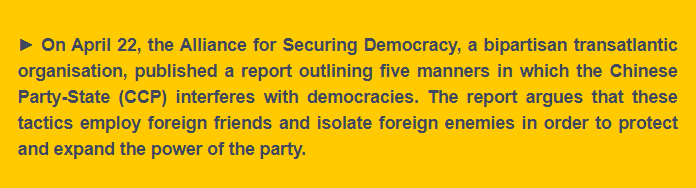
Five Components of Chinese Political Interference in Democracies
Weaponising China’s Economy
Asserting Narrative Dominance
Relying on Elite Intermediaries
Instrumentalising the Chinese diaspora
Embedding authoritarian control
Weaponising the Economy
The report states the CCP is attempting to employ China’s position as the second biggest world economy to incentivise or coerce political, diplomatic, business, and academic circles to support its interests.
An example of this is the sanctions placed on Norway after the Norwegian Nobel Committee awarded Liu Xiaobo the Nobel Peace Prize.
Asserting Narrative Dominance
“Discourse power” (话语权) is employed through media and culture to highlight global values and governance in line with the CCP’s principles, while also downplaying information that casts the party in a negative light.
This dynamic is exerted domestically through television outlets (China Global Television Network) and online (Weibo), with an example of such interference being the backlash against the NBA after an official expressed support for Hong Kong protests.
Relying on Elite Intermediaries
The expansion of a “United Front” is meant to extend interference through non-party intermediaries that are supported but not directly managed by the CCP.
The most important organizations pursuing this narrative are the Chinese People’s Association for Friendship with Foreign Countries and the China Association for International Friendly Contact.
These groups develop a private diplomacy that links external propaganda to economic and trade cooperation.
Instrumentalising the Chinese Diaspora
The CCP sees the Chinese diaspora as essential in rebuilding China’s economic and technological strength.
For this reason, Xi Jinping said the “great rejuvenation of the Chinese race requires the shared striving of the sons and daughters of the Chinese race, both at home and overseas.”
Interference with members of the diaspora vary according to the resilience of the institutions of the country in question. They range from censorship of information they receive on WeChat to navigating local politics and extending influence.
Embedding Authoritarian Control
Political interference extends to promoting authoritarian tactics that erode free elections, a free press, and civil society, while downplaying oversight and transparency.
Examples include Ecuador employing Chinese SOE surveillance technology to intimidate political opponents, and Tanzania learning how to control social media from Chinese experts.

TAKEAWAYS
► DOUBLE STANDARDS
Since 2012, China has expanded its instruments of political interference abroad. This is a bit ironic, given its perpetual stance on non-interference from foreign actors on “One China” issues. This dichotomy is not accidental and it is likely to be exacerbated, especially by “wolf warrior” diplomats (as explained in our last news brief). Also bear in mind though that Beijing views the EU’s and the US’s promotion of open societies as a similar kind of meddling.

READ MORE
Friends and Enemies: A Framework for Understanding Chinese Political Interference in Democratic Countries - Alliance for Securing Democracy (Matt Schrader), Apr 22
5. From Digital Payments to Digital Currency
Grasping the Mammoth
China’s digital payment system is big, to say the least:
So big, that it has recently reached a saturation point, with over 95% of transactions relying on mobile digital payments.
In Q1 2019, transactions of this kind in China totalled 55.4 trillion RMB (€7.2 trillion), a year-on-year increase of >24%. By comparison, Europe is only expected to hit €1.4 trillion in 2025 and the market share for mobile payments hovers near 28%.
The transition to cashless mobile payments began in China in 2014 when tech giants Alibaba and Tencent entered the banking sphere and the QR code became a common payment system.
An example of China’s digital payment prowess is Singles Day:
This business-concept holiday created by Alibaba is celebrated every November 11th (i.e., 11/11). The premise is that people who are single can enjoy massive discounts on online purchases (the promotion applies to all, regardless of relationship status).
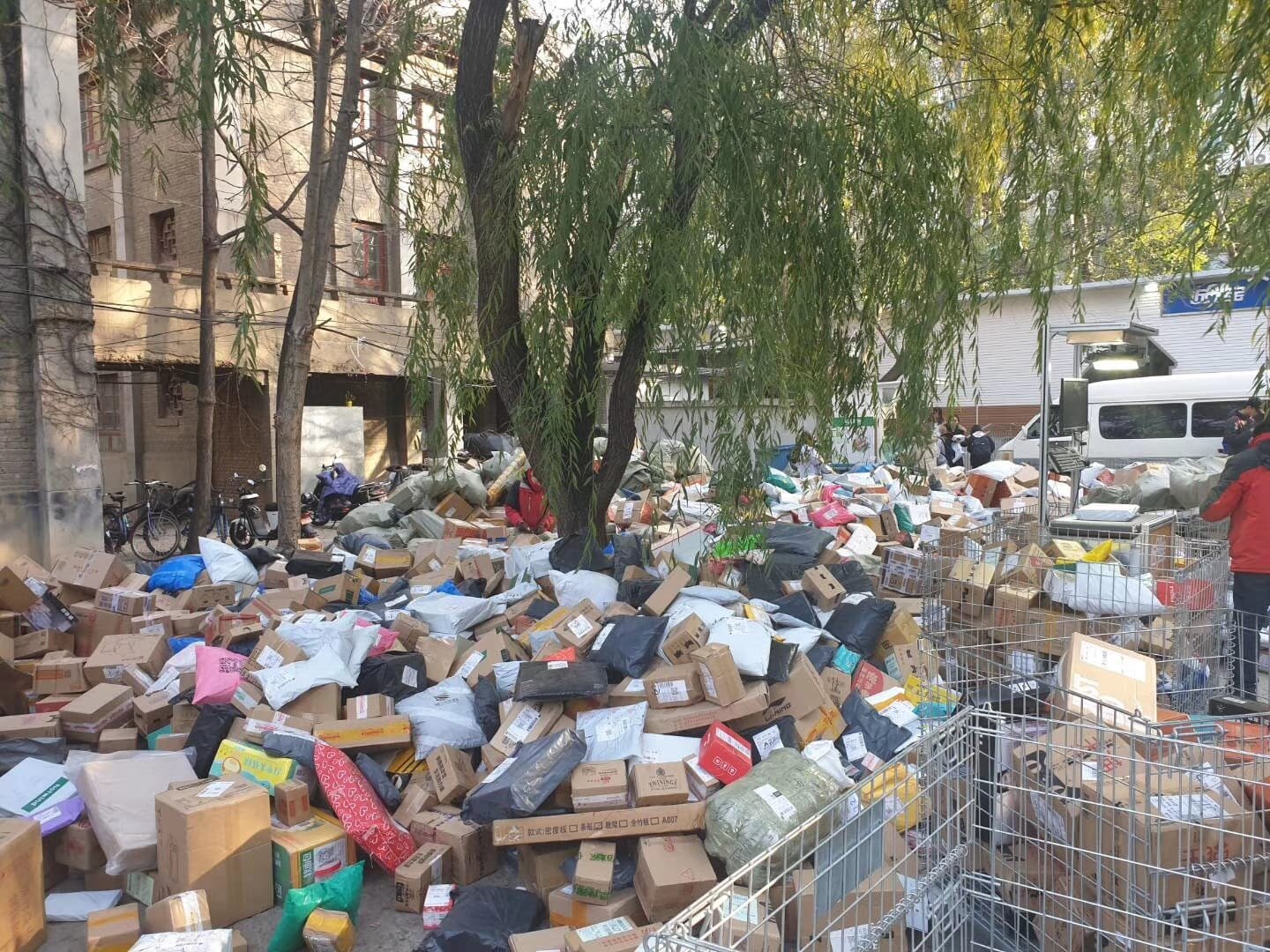
In 2019, the event generated 1.66 billion parcels being paid for digitally and delivered (more than the Chinese population). In 24 hours, Alibaba facilitated sales of $38.4 billion in gross merchandise volume.
For reference, the picture below from one of this news brief’s editors is taken three days after Singles Day in 2019, at a Package Pick-Up Centre of Peking University in Beijing.
The Mammoth’s Digital Evolution
On April 23, China announced the launching of a pilot for a central bank digital currency (CBDC).
The plan:
It will be tested by China’s four largest commercial banks.
Trials will be staged in Shenzhen, Suzhou, Chengdu, and Xiongan (a new national development zone close to Beijing).
The issuance of the digital yuan is two-tiered. First, the central bank exchanges currency with other banks and entities. Secondly, these banks and entities will exchange the digital currency with the public.
The end-game:
Ultimately, the CBDC is meant to fully replace paper money and bring the digital payment system reform full circle.
This is an immense development for an economy that was cash-dominated just ten years ago. At the same time, its implementation will be gradual; it is believed it will take several years for this CBDC to reach 10% of the monetary base.
The Options are Endless
The shift to a digital currency will be just as impactful as the way it is used by the Chinese government.
Under a digital currency, money laundering and tax evasion would become easy to trace. Similarly, big investment would receive significant oversight. For example, if a commercial bank receives CBDC to be issued to small businesses only, the money can be activated only once transferred to a small firm.
An important note: CBDC is not China’s plan to replace the dollar as the main global reserve currency. Even for digital currencies, the same rules apply: the capital account needs to be open in order to facilitate imports and pump the currency into foreign accounts, and the legal system in China needs to be transparent and fair, so that investors will trust their money is well-guarded.
In the US, Facebook has proposed its own digital currency, Libra, which is meant to provide the same type of services as WeChat Pay.
Scared that a strong Libra could lower monetary sovereignty, central banks and governments are slowly moving to reassess the possibility of issuing their own CBDC’s.

TAKEAWAYS
► WILL EUROPE EVER GO DIGITAL?
Currently in Europe, only the UK (51%) and the Czech Republic (54%) use mobile payments in the majority. A digital currency issued by the ECB across the eurozone would help fix many of the imbalances that don’t allow for further fiscal integration. It would ensure European infrastructure funds are not misused. Member states would not be able to cover up debt as happened in 2009 with the Greek government at the time. Loan performance could increase and, over the long-term, the EU would be able to condition pre-accession funds more clearly. There are many benefits to be derived from a digital currency, but, until then, Europe must step up its mobile payment share.
► TECH STANDARDISATION
Still, it is important to take note of China taking the lead on CBDC. Rapid technology development and implementation can give countries considerable first-comer’s advantage in shaping standards and norms on specific solutions. That translates to considerable power in shaping global markets. We discussed this issue in-depth on our recent podcast with Tim Rühlig (UI), who is a member of the China Task Force of the European standardisation organisations CEN and CENELEC, and provides expertise on technical standards to many organisations, including the European Commission. Click here to listen: TIM RÜHLIG: Shaping Future Markets - EU, China, and Global Technical Standardisation

READ MORE
China mobile payment market overview 2019 - China Internet Watch, Jul 23 2019
$1.47 Trillion European Mobile Wallet & Payment Market Opportunities by 2025 (2019 Databook Series) - BusinessWire, Mar 14 2019
E-commerce Payments Trends: European Overview - JP Morgan, 2019
China aims to launch the world’s first official digital currency - Economist, Apr 23
China trials digital payments, prints less cash - Asia Times (Frank Chen), Apr 24
The threat and the promise of digital money - Financial Times (Martin Wolf), Oct 22, 2019
Tweet on the Chinese Digital Currency by The Economist’s China Correspondent
The Next Generation of Digital Currencies: In Search of Stability - European Parliament, Dec 2019
Can Facebook’s Libra replicate WeChat Pay’s digital payment dominance? - Technode (Nicole Jao), Jun 28, 2019