EU-China Briefing - 2 November 2020
YOUR WEEKLY SHOT OF EU-CHINA NEWS
BY FLAVIAN BERNEAGĂ AND GRZEGORZ STEC
1. The Fifth Plenum Sets Development Priorities of the 14th Five-Year Plan
Between October 26-29, the CCP’s 19th Central Committee met in Beijing for its Fifth Plenary Session.
► The main tasks at hand were to discuss the 14th Five Year Plan and Development Objectives for 2035;
► Broadly defined boosting of self-reliance was the main theme of this meeting, as leaders further highlighted their support for the ideas of dual circulation economy;
► By 2025, China is expected to be very near middle-income status, with an innovative tech sector, but it is also expected that Xi’s overarching figure in the party and country will grow significantly.
The Path Ahead
The 5th Plenary Session is particularly important due to China’s economic plans amid the pandemic and US decoupling.
The meeting brought together 198 CCP Central Committee members and 166 alternate members.
The two main topics discussed were China’s 14th Five-Year Plan (2021-2025) for National Economic and Social Development and the Long-Range Objectives Through the Year 2035.
A draft of the policy proposals discussed in the plenum will be sent to the National People’s Congress, which will release full details of the Five Year Plan in March 2021. Find below a timeline by the Rhodium Group that may help you piece it together.
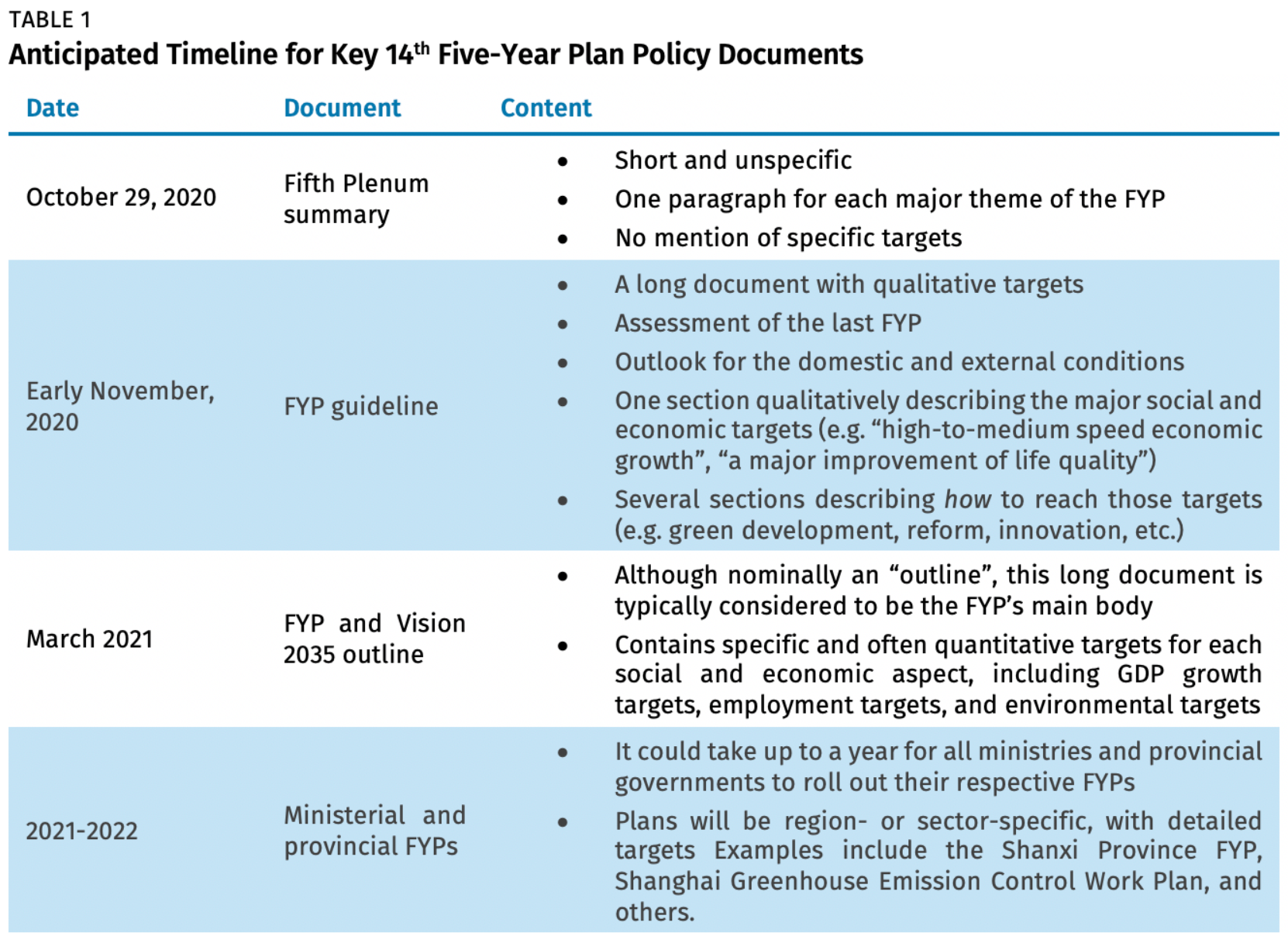
This Fifth Plenum was particularly important because it provided the path forward for China’s economic modernization agenda until 2035. This will be the midway year for Xi Jinping’s agenda of national rejuvenation by 2049. As such, a successful 14th Five Year Plan is very likely to be the backbone of the upcoming 15th and 16th Five Year Plans.
Review of the Communique
The main document stemming from the Plenary is its communique, which provides more detail on China’s social and economic development plans.
Overall, the plenum agreed that China’s development sees both opportunities and challenges, given that the world is “undergoing major changes unseen in a century”, that the technological and innovation revolution is underway, and that the international power balance is undergoing profound adjustment. Internally, they agreed China reached a stage of high-quality development, with an abundance of resources and stable domestic conditions.
With the top Chinese leadership gearing for US decoupling, the main theme of the Plenum was the turn towards the domestic economy. As such, leaders promised a domestic economy that is less vulnerable to external shocks, but also pledged to spur innovation in order to support the domestic economic development.
In fact, innovation took centre stage, as China’s modernization and improved self-reliance is to be supported by breakthroughs in science and tech. At the same time, the Plenum acknowledged the imbalance between urban and rural areas and vowed to prioritize agricultural and rural development.
On GDP, Chinese policymakers did not provide specific targets, but experts suggest that instead of being scrapped altogether the GDP goals will simply become expressed in a more indirect manner.
For example, according to Global Times, the goal of reaching per capita GDP reaching the level of “moderately developed countries” by 2035 could translate to an objective of reaching 3.5% yearly growth in order to achieve around $30,000/year per person by 2035. This is quite an ambitious target from the current $10,262/year.
On military matters, China expects the PLA to become a “fully modern army” by 2027 (100 years after its formation). According to military experts, this essentially equates to developing the capacity to perform a successful operation in the Taiwan Strait, countering US military capabilities.
Theoretically, this Plenum was also supposed to indicate Xi’s successor, but that did not happen. What did change was the party’s main slogan, which switched from “comprehensively building a moderately prosperous society” to “comprehensively building a modern socialist country”.
MacroPolo’s Forecast
On October 26, MacroPolo released a series of reports providing a quite positive forecast for China’s outlook until 2025.
The study makes three important assumptions: China’s political economy will stay under the iron leadership of Xi Jinping; a US-China war is unlikely, though tensions will become more explicit; and globalization will further reverse, as countries turn inward and regionalism becomes more important.
Economy - China will reform and become more “open, balanced, and efficient”. Domestic demand will increase and foreign investment will also go up, as China’s current antagonistic external environment will force it to embrace foreign businesses. Through the combination of domestic demand and increased FDI, China will avoid falling into the middle-income trap.
Politics - Xi will remain at the helm and will gain even more power after the 20th Party Congress in 2022. He will push to strengthen governance, discipline, and ideology, but a successor is unlikely to be announced before 2025.
Technology - China will catch up with Silicon Valley by 2025, with major breakthroughs in 5G, cloud computing, smart cities, and surveillance networks. Also, the US ban on semiconductors will constitute a minor break, as Beijing will push to develop this sector domestically.
Energy - China will seek to further decarbonize and reduce dependence on coal, coming close to peaking emissions by 2025. More investment will flow into renewable energy, which will make nuclear, wind, and solar energy the beneficiaries of reducing coal dependence.
In relation to this last prediction and our reporting on climate issues last week, China’s environment ministry announced on October 28 that a nationwide emissions trading scheme will be launched between 2021-2025, even though it was expected to be revealed in 2020. This signals that dealing with the climate challenge will not be easy for Beijing.

TAKEAWAYS
► LOCKED ON COURSE
As much as Xi may tout that dual circulation will further open China’s economy, it is unlikely that the degree of openness will satisfy demands made by the EU in CAI negotiations. The Fifth Plenum established that the dual circulation is China’s path going forward, with the main focus being on innovation. A preview of this decision was exemplified by Xi’s recent trip to Shenzhen.
All in all, it appears that the EU and China will not converge economically and, as the world becomes increasingly regionalized, they will find themselves in fewer positions of “strategic partnership”. We are ready to bet the EU will increasingly see China through a lens of “economic competitor in the pursuit of technological leadership,” even more so than up to now.

READ MORE
(受权发布)中国共产党第十九届中央委员会第五次全体会议公报, Xinhua, Oct 29
China's leaders vow to become self-reliant technology power, AP (Joe McDonald), Oct 30
Forecast 2025: China Adjusts Course, MacroPolo (Damien Ma, Houze Song, Neil Thomas, Matt Sheehan, Ilaria Mazzocco), Oct 26
2. Update on EU Budget and Recovery Fund Negotiations
As China is making final decisions on the 14th Five Year Plan, it’s worth looking at the EU’s “Seven Year Plan”, a.k.a. the Multiannual Financial Framework.
► In July, EU heads of state and government reached a historic deal in the European Council on the MFF and the Next Generation EU recovery fund;
► The deal is now in negotiations with the European Parliament, which are happening in a trilogue format (meaning we are nearing a final deal);
► One major hurdle appears to be the diverging stances on debt, as countries with high debt-to-GDP ratios would like to avoid hard conditionality.
Quick Recap
Recall that on July 20, EU leaders managed to find consensus on the recovery package and the MFF, following 5 days and nights of negotiations.
Specifically, they agreed to an EU budget (MFF) for 2021-2027 worth €1,074 billion, as well as a €750 billion recovery fund, which is split into €390 billion in grants and €360 billion in loans.
The most groundbreaking result of the negotiation (aside from the size of the financial package) is that it allows the EU to borrow money on markets equating to an EU market in debt, which comes hand in hand with enhanced powers by the Commission to levy taxes.
The last time we reported on this subject, the two main hurdles were rule of law (of which Hungary and Poland wanted little conditionality) and requests by the European Parliament to further increase the financial package.
Where We Are
Negotiations have reached the trilogue stage, which means the EU is edging closer to a deal.
FYI: Trilogues are negotiations between the Council of the EU, the European Commission, and the European Parliament, with each sending a negotiation team with a mandate. What they decide is informal and must be approved formally within their home institutions.
To unblock negotiations, the Commission has suggested eight options that would result in providing more funds for the projects suggested by MEP’s. These supplement the budget through either fines or unused recovery grants but, even so, the options do not match the Parliament’s demand for €39 billion more in research, health, and education.
On rule of law, negotiators agreed to cut funding if a rule of law breach will “affect or manifestly risk affecting in a sufficiently direct way” the good financial management of the EU budget or the EU’s wider financial interests.
Disagreement remains on a request by some EU countries to stop the flow of money into a member state if they believe they are going against EU norms and rule of law. Moreover, Poland and Hungary have not yet publicly given their approval on the proposed conditionality (and have mentioned in the past they are not on board with this idea).
However, a deal is within reach, German MEP Monika Hohlmeier (Chair of the Parliament’s Budgetary Control Committee) said progress was registered on rule of law. Furthermore, EU leaders seem to have indicated that they will not reopen the negotiation for large changes and are only open to talk about changes in wording or minor changes in sums.
However, recall that a trialogue deal is only the prerequisite. Within the European Parliament, the deal must be agreed upon both in committee and also in the wider plenary. As such, the recovery fund is not expected to enter force by January 1, 2021, as was originally expected.
Debt Controversy
Many countries are openly voicing their reluctance to attract more debt, which is important, given that loans form roughly half of the Next Generation EU recovery package.
Last week, the Commission issued its first bonds (part of the SURE unemployment program, so not part of NextGen, but operating under the same logic), worth €17 billion. The bonds generated strong investor interest and were more than 13 times oversubscribed, which means more favorable pricing terms.
Member states coming mostly from the South argue they don’t want to add to existing debt-to-GDP levels (like they did after 2008), and announced they will only tap into the grants, and not the loans of the recovery package. Moreover, they worry the Commission will reinstate its indebtedness budgetary rule, which limits debt to 60% of GDP. (It was lifted in March without a timeline to bring it back).
However, Budget Commissioner Johannes Hahn said that the second wave of the pandemic will require more financial stimulus for member states’ economies, which may push them to tap into the loans as well.
Talking about joint debt, Christine Lagarde, the President of the European Central Bank, suggested the EU should go even further and make EU debt a defined tool, so that it could be employed again in future crises (this contradicts her past remarks that this is indeed a one-time solution).

TAKEAWAYS
► SECOND WAVE IMPETUS
As Commissioner Johannes Hahn pointed out, countries in southern Europe will find themselves in a position where they will have to accept the recovery fund’s loans, even if that will be a further increase in their debt-to-GDP ratio. As the largest European economies are entering a second lockdown, this is likely to become a rule of thumb, not only for Southern Europe, but also for Hungary and Poland, whose conditionality on the rule of law may be diluted if the economic outlook starts appearing too grim.
To be sure, as of now, both of them have said they are not on board with the changes that the trilogues are suggesting. Even so, Hungary is expected to register a 7% drop in GDP, with particular implications on the auto and tourism industries (which make up around 16% of the Hungarian economy). With Germany entering a strict lockdown, the prospect is even grimmer, as Germany accounts for almost 27% of Hungary’s exports. Poland has a slightly better economic standing, as its economy is expected to drop by only 4.25%. Even so, given the economic repercussions of the expected winter spread of COVID-19 (paired with protests in Poland), it is likely that in future European Councils these two nations will be more incentivized to relaunch the economy than they were in July.

READ MORE
Interinstitutional negotiations for the adoption of EU legislation, European Parliament
EU negotiators near deal to unlock €1.8T budget and rescue package, Politico (Lili Bayer and Hand von der Burchard), Oct 28
3. Report on Brussels Bubble’s Thoughts on EU’s Future After the Pandemic
On October 26, a report shed light on the attitudes of the Brussels bubble towards the future of the EU once the COVID-19 pandemic subsides.
► The report was written (following surveys) by three organizations: the European Policy Centre, the Konrad Adenauer Foundation, and ifok GmbH;
► In spite of the pandemic, respondents declared in majority that COVID-19 will not impact the EU’s most essential functioning;
► Respondents also argued the COVID-19 crisis brought European closer together, and stated they hope that the German presidency will set the EU on a new strategic course.
Overview of the Report
The publication of the report coincides with the German Council Presidency entering the final two months of its time in the rotating chair.
The surveys,taken between July-August, included 224 individuals from 29 EU and non-EU countries, who shared their concerns and expectations on the German Council Presidency. Over half of them work in EU institutions or think tanks and most of them reported they are in senior positions.
Broadly speaking, the report found that individuals within the so-called “Brussels bubble” are not as disconnected from national affairs as it is believed. Namely, they do hope for further EU integration, but do not see it as a goal in itself.
Rather, the report says they “recognise the resilience of existing dividing lines between member states and have come to accept the idea that differentiated integration is the most probable course of action henceforth”.
Not That Big of a Headache
On COVID-19, respondents argued that, despite an initial hiccup, the EU has tackled the pandemic well, and are not concerned for the Union in the long-term.
60% of respondents say they are now satisfied with the EU’s response, with only 17% percent unsatisfied. The majority of respondents noted the EU managed to channel the pandemic reaction, after an initial period in which the member states rather chaotically took actions on spread prevention.
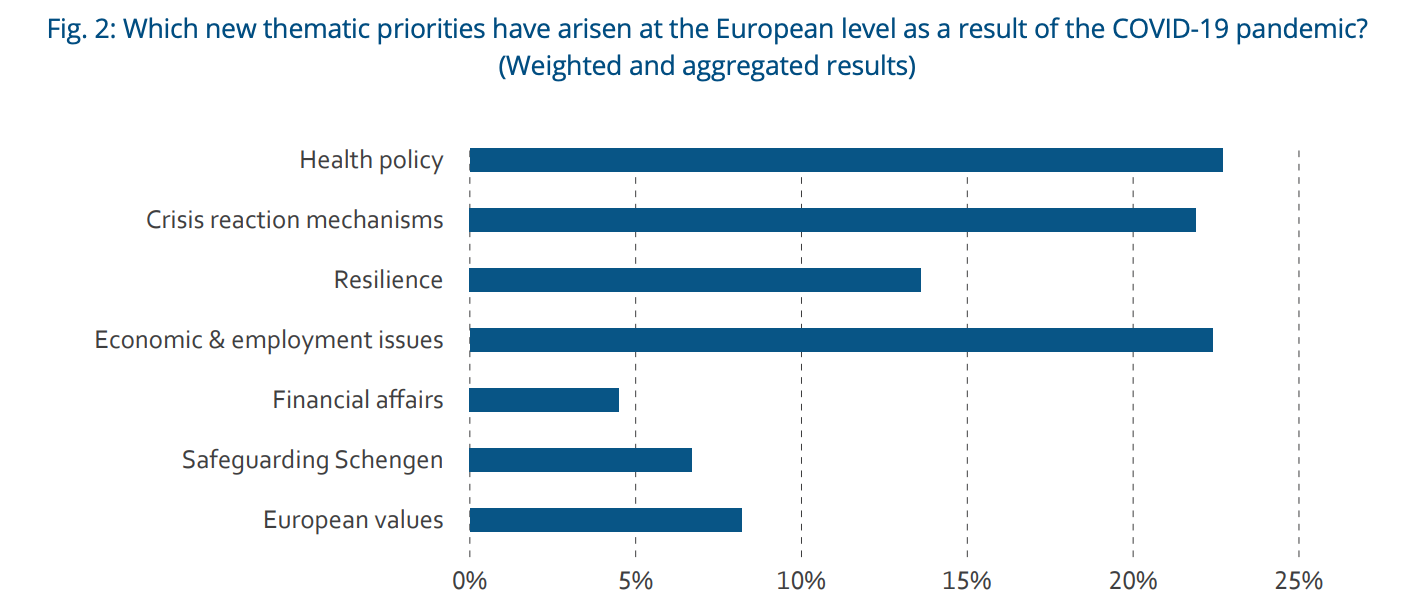
Respondents do believe, on the other hand, that the pandemic has brought about new policy priorities for the EU, especially health policy, crisis response, and economic and employment issues.
Moreover, they don’t believe the pandemic will seriously impact the functioning of the core EU functions (euro, Schengen zone, etc.). Even if countries shut their borders in response, respondents do not fear it is a long-term measure.
In a similar vein, respondents believe COVID-19 has made European cohesion stronger, with 48% of them saying the crisis brought Europeans together, 16% believing otherwise, and the rest are undecided.
Finally, 64% of them think the German presidency comes at a crossroads for Europe, which could lead to an important strategic reorientation.
Pragmatic Integration
When it comes to the future of Europe, respondents realistically assess that further integration is desirable, but is made difficult by fault lines between member states.
In this context, the EU announced in November 2019 that it would hold a Conference on the Future of Europe in the spring of 2020. The Conference would seek to gain citizens’ input on the most crucial issues the EU is facing, but plans to hold it were delayed by the pandemic.
However, a mere 22% of respondents think the Conference has the capacity to alter Europe’s future. Even so, 64% of respondents would want the Conference to be open to the possibility of treaty change, though a majority of them also argue treaty change should not be an end in itself, but a solution to Europe’s problems.
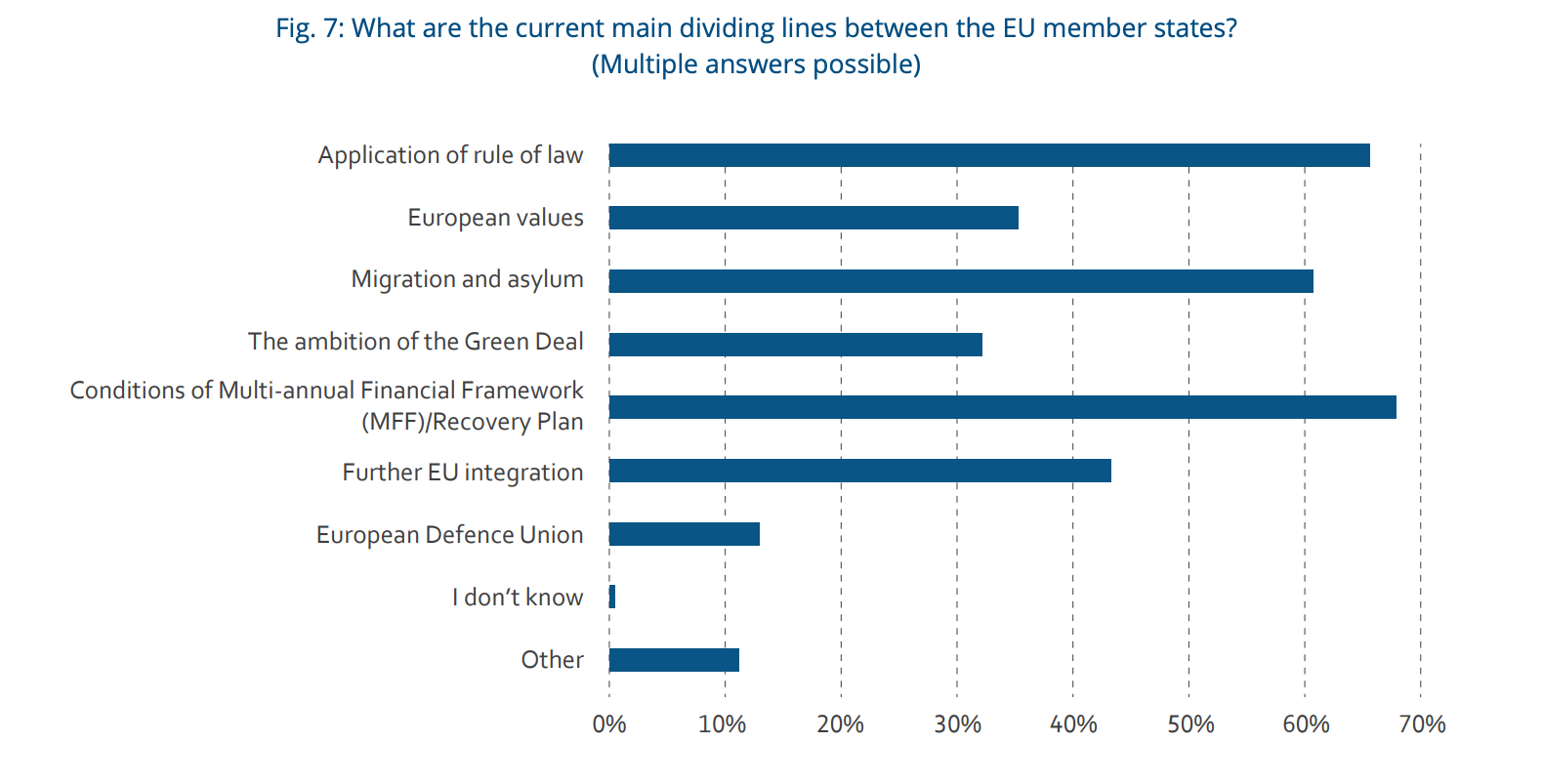
When it comes to the main divisions between member states, the respondents believe that the biggest “dividing lines” can be seen in the context of the MFF negotiations, rule of law application, and migration and asylum policies.
While 45% of respondents believe further integration is necessary, only 26% believe the EU will transform by 2050 into a United States of Europe, with 42% of them believing the EU will still be a confederation of states.

TAKEAWAYS
► IF IT AIN'T BROKEN, DON'T TRY TO FIX IT
The report states that 64% of respondents are in favor of treaty change and 45% of the EU further integrating. That being said, integration does not appear to be a sine qua non or a one-size-fits-all solution for all the EU’s ills. Rather, it is perceived as a tool that is good only if it can provide benefits to the member states.
In other words, the good old model of gradual spillover resulting from member states understanding they cannot face crises individually is alive and kicking. This has been the case with previous rounds of gradual integration, starting from coal and steel and heading straight to the common currency and Schengen. In all these cases, it’s about member states realizing they need a bigger umbrella, and the EU has always been there to offer it. Similarly, after the health and economic COVID-19 crisis passes, the Commission’s enhanced powers are bound to be in health policy or in economic and financial policy (as has already resulted from its powers to create debt and levy new taxes).

READ MORE
High hopes, low expectations – Brussels’ perspective on the future of Europe after COVID-19, European Policy Centre, Konrad Adenauer Stiftung, and ifok, Oct 26
4. Brussels in Crosshairs For Using Hikvision
On October 26, news emerged that some of the thermal cameras used in a number of EU institution buildings were produced by Hikvision.
► Hikvision is a Chinese company accused of providing surveillance equipment in and solutions for Xinjiang internment camps;
► The main concern here for the EU is moral. The policymakers who criticize abuses in Xinjiang have their temperature taken with the aid of a company that enables said abuses;
► The case raises wider questions, as Hikvision appears to own a good chunk of the European video surveillance market.
Practice What You Preach
Hikvision is primarily controversial because of its ties to the targeting of ethnic minorities in Xinjiang.
Namely, 42% of Hikvision is owned by CETC, a state-run military contractor accused of developing the “Integrated Joint Operation Platform”, a mass surveillance app used by police in alleged human rights abuses against the Uyghur minority in Xinjiang.
Together with Zhejiang Dahua Technology, Hivision controls a third of the video surveillance global market.
For EU institutions, the company supplies cameras that check whether policymakers in the Berlaymont, Charlemagne, and European Parliament buildings, have temperatures over 37.7°C.
On October 27, MEP Svenja Hahn (Germany/Renew) addressed a letter to Parliament President David Sassoli, asking how it is possible “that a European institution that continuously speaks up for human rights has not controlled the human rights record of their own suppliers” and decrying that taxpayers’ money is indirectly “supporting the authoritarian communist state financially”.
MEP Reinhard Bütikofer (Germany/Greens), the head of the Parliament’s Delegation for relations with the PRC, called the news “extremely disturbing” and called on the EU to “sever any direct or indirect business relationship with Hikvision”.
The Link to Xinjiang
Hikvision first came into wider public attention in October 2019, when the Trump administration included it on a list of companies deemed responsible for human rights abuses in Xinjiang.
Namely, the US Bureau of Industry and Security said that Hikvision was one of the companies whose actions “are contrary to the national security or foreign policy interests of the United States”, while also claiming it has ties to the People’s Liberation Army.
In response, Hikvision issued a statement that said the company takes “all reports of human rights seriously”, but did not explicitly comment on the allegations related to its tech being used in surveillance in Xinjiang.
Moreover, a January 2020 report by the Norwegian government found that Hikvision signed security and surveillance contracts worth €230 million in 2017, including tenders on surveillance tech in internment camps. The report further states it provided 35,000 facial-recognition cameras to be installed in schools, streets, offices, and mosques in Xinjiang.
The Wider Problem
The EU’s moral conundrum here is further highlighted by its attempts to control exports of sensitive tech to China.
As we told you two weeks ago, the EU is believed to be drafting a list of technologies which companies could sell abroad only with a special license granted by member states and supervised by the Commission. Moreover, in July, the main EU response to the Hong Kong national security law was to ban the export of sensitive tech.
In addition, Hikvision is an equipment provider of video surveillance for multiple European public and private actors. Rebecca Arcesati, a MERICS Analyst, says Hikvision has a “substantial market share” and “extensive procurement contracts, in addition to R&D partnerships with public and private institutions in many EU member states.”
An example of such cooperation is the 2018 partnership between Siemens and the CETC (the state contractor with a 42% share in Hikvision) on intelligent manufacturing solutions, electronics equipment, and information security.
Furthermore, in 2017, Hikvision also signed a public safety joint project with the Aalborg University. The project was meant to improve public safety through thermal cameras.
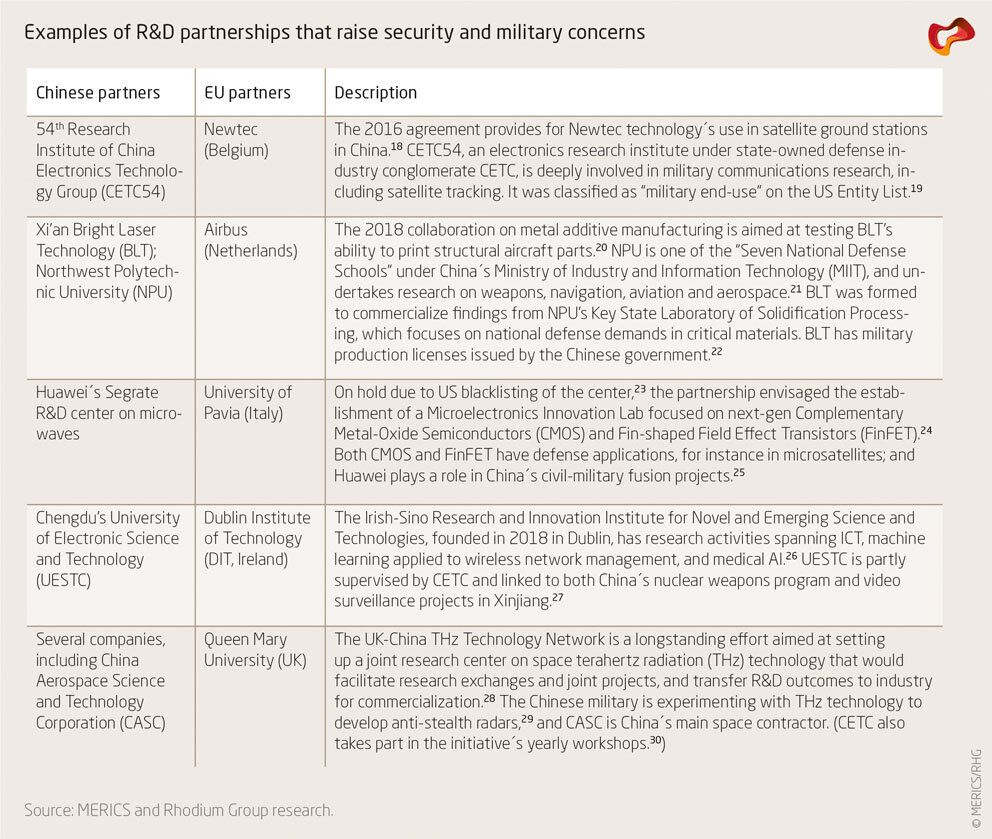
In that context, note that, on October 27, reports emerged that the Commission is working on a due diligence draft law to ensure sustainable corporate governance. Among other things, this legal framework would make companies legally responsible for ensuring their supply chains are not involved in human rights abuses, most notably forced labour (thus linking it to the forced labour in Xinjiang or Tibet).

TAKEAWAYS
► DO AS I SAY, NOT AS I DO
The EU’s credibility on its Xinjiang criticism is chipped away by the Hikvision story. Generally speaking, human rights is a values-driven policy area, which means ‘leading by example’ is the best source of legitimacy. We may hope the values-conscious Von der Leyen Commission will act on this.
However, the real goal here must not be virtue-signalling. Rather, what is needed is a comprehensive framework eliminating forced labour and participation in human rights abuses from the supply chain or imposing punitive measures on companies that take advantage of these practices.
Naturally, this is easier said than done. First of all, European consumers may complain about the rise in prices or the drop in quality that would result from relocating supply chains. Companies themselves would likely resent what they see as red tape and would deny abuses.
This brings us to square one: values vs. interests. In light of this discussion, the legislative framework on sustainable corporate governance becomes even more important, and it is essential that the Commission get substantial and coherent input from the public on it. To that end, we invite you to take part in the public consultation by the Commission on this issue.

READ MORE
Exclusive: EU taps Chinese technology linked to Muslim internment camps in Xinjiang, DW (James Franey), Oct 26
Recommendation to exclude Hangzhou Hikvision Digital Technology Co Ltd from investment by the Government Pension Fund Global, Council on Ethics, Jan 14 2020
Chinese FDI in Europe: 2019 Update, MERICS (Agatha Kratz, Mikko Huotari, Thilo Hanemann), Apr 8 2020
5. Glimpses of Germany's Post-Merkel Stance on China
As Merkel’s term is nearing its end, the race for her successor is still awfully unclear, but it is increasingly apparent that Germany’s China policy will soon change.
► Germans will be electing a new government in autumn 2021, but Merkel’s party (CDU) is still unsure who should represent it in these elections;
► Two important German political leaders (Annegret Kramp-Karrenbauer and Heiko Maas) indicated in the past week they would favour more cooperation with the US to address challenges posed by China;
► There also appears to be considerable impetus for Germany to build its Indo-Pacific Strategy on trade diversification, alongside France and through the EU.
Big Choice, But Not Big Difference
With Angela Merkel stepping down as Chancellor of Germany in 2021, the race to replace her remains unclear, but a change in Germany’s China policy is nonetheless underway.
This would amount to a significant policy change, given that Merkel has been a staunch advocate for maintaining positive relations with China, which she called of “strategic importance”, particularly for the economic ties between Berlin and Beijing. Read more on that in our past briefing.
The CDU leadership elections have been delayed until the spring of 2021, but the contest is fierce. The two main candidates are Friedrich Merz (who has the most backing) and Armin Laschet (a centrist close to Merkel). Norbert Röttgen, one other candidate who holds hawkish views on China, is not a top contender in the race anymore.
In the end, whoever succeeds Merkel may find that relations with China cannot unequivocally go back to ‘business as usual’. Mikko Huotari, the Executive Director of MERICS, said that, given that the tone of China debate in Germany has become very critical over the last year, he expects “the post-Merkel China policy, irrespective of who will succeed her, to offer a more critical perspective on China.”
The US Factor
In the past week, two top German political figures called for better relations with the US, under the condition that Washington readopts its pre-Trump stance on multilateralism.
Recall that the EU and US launched their dialogue on China last week. In this context, two high-ranking German officials made calls for the US to work with Europe in addressing a challenge posed by China.
One of them is Annegret Kramp-Karrenbauer, German Defence Minister and outgoing CDU chairwomen (who dropped out of the CDU race to succeed Merkel in February 2020). On October 24, she called herself an ‘Atlanticist’ and pleaded for a “newly strengthened Western trade alliance” to tackle Chinese practices.
Kramp-Karrenbauer decried China’s position on international trade issues, pointing out that the following points of concern go against Germany’s international trade interests:
“Aggressively directed state capitalism of China”
“Aggressive appropriation of intellectual property”
“Unequal investment conditions”
“State-subsidized distortion of competition”
She also signalled that Germany wants a “functioning multilateralism” and notably remarked that she does not find it “a crazy idea” for the EU and US to work towards dropping all trade barriers between them.
At the same time, AKK said Germany does not agree with Washington’s current “disruptive political style” and its “disregard” for the benefits NATO brings to the West. She argued “Washington too must show us that it sees the defense of our interests and values as a joint project”.
The second high-level official is Heiko Maas, the German minister of foreign affairs. Maas said on October 25 that “Americans and Europeans share an interest in open societies, human rights and democratic standards, fair trade, free sea routes and the security of our data and our intellectual property”.
Maas believes the interest of the US in China does not have to undermine transatlantic relations, but instead can present a new opportunity for transatlantic cooperation. In this line, the EU’s commercial relationship with China can become a tool in lobbying China to respect international trade rules with the support of the US.
Maas finished his statement by arguing the rift created between the EU and US in the past 4 years resulted in benefits only for China, Russia, Iran, and North Korea instead of for either of the transatlantic partners.
Differences in Diversification
A major component of Germany’s policy shift on China is trade diversification, which sparked increased interest in the Indo-Pacific region, with EU-level strategy potentially looming on the horizon.
Recall that both Germany and France have both already announced strategies that would see them exhibit increased interests in the Indo-Pacific region.
However, an analysis by Mathieu Duchâtel from the Institut Montaigne and Garima Mohan from the German Marshall Fund, published on October 30, shows that Berlin and Paris do not fully converge in their approaches towards the Indo-Pacific.
Most importantly, while France finds its strategy compatible with US strategy on the Indo-Pacific (free and open Indo-Pacific region, adherence to international law, freedom of navigation and overflight, openness and transparency for trade), Germany argues it does not see the region as a theatre for unipolarity or bipolarity, and it does not agree with US assertions that countries must ‘pick a side’ against China.
Furthermore, France sees the Indo-Pacific as a region where security needs to be prioritized and, as a result, lobbing a narrower definition of engagement with the region. Germany takes a broader approach, asking for an increase in security engagement but also asking for open shipping routes, open markets and free trade, digital transformation and infrastructure connectivity, and climate change.
There are also differences in operation. For Germany, the Indo-Pacific strategy centers around ASEAN, while other smaller bilateral agreements are not as important. The French strategy, on the other hand, has been built around signing bilateral and trilateral agreements with Australia, India, and Japan.
Since Germany launched its Indo-Pacific Strategy in September 2020, it has joined France and the Netherlands to lobby for a wider EU strategy for the region. This could result in a reconfiguration of the region for many member states who, until now, have not seen it as strategically important.
Finally, the study offers three recommendations for a wider European Indo-Pacific Strategy: build capacity for greater maritime interconnectedness with navies in the region; provide alternative projects to Chinese infrastructure proposals (particularly on digital connectivity, 5G, and critical tech); and work with like-minded states (Japan, India, Australia) to protect supply chains from disruption and manipulation.

TAKEAWAYS
► SOONER OR LATER
With Angela Merkel nearing her exit, it seems Germany is on track to readjust its China policy, regardless of who will take Merkel’s place. The new developments mentioned above give us glimpses of what this readjustment may be.
First of all, the outcome of the US election can be a game-changer for Berlin in this regard. A Biden presidency will incentivize German political leaders to explore transatlantic relations’ capacity to press hard for multilateralism. In turn, this could help address the wider European sentiment of agreeing with the US on the China challenge, but not on Washington’s current ideas on how to tackle it. Let’s wait and see, but transatlantic dialogue on China may become much more meaningful soon, with the support of China’s top European partner.
Secondly, Germany will most likely be trying to diversify away from China through its Indo-Pacific strategy, which it may bring to the European level through cooperation with France. However, given the current visible differences in the approaches, making this happen will be no small task.
All in all, it is safe to say that Merkel’s engagement agenda is slowly but surely fading, with new perspectives of greater focus for transatlantic cooperation and diversification of strategic partners.

READ MORE
Germany’s ruling party is making a hash of choosing its next leader, Economist, Oct 31
German politicians call for US, Europe to form united front on China, SCMP (Stuart Lau), Oct 26
Franco-German Divergences in the Indo-Pacific: The Risk of Strategic Dilution, Institut Montaigne and German Marshall Fund (Mathieu Duchâtel, Garima Mohan), Oct 30