EU-China Briefing - 9 November 2020
YOUR WEEKLY SHOT OF EU-CHINA NEWS
BY FLAVIAN BERNEAGĂ AND GRZEGORZ STEC
1. The Biden Presidency and EU-US-China Relations
On November 7, Joe Biden was declared the 46th president of the US, generating a sigh of relief in Europe for the future of EU-US cooperation (including on China).
► The announcement was met with excitement from a variety of leaders, most notably in Brussels, Berlin, and Paris;
► It remains to be seen whether Biden will match the EU’s expectations, given that he is likely to be constrained by a Republican Senate. However, the general line on China has become a bipartisan issue in the US;
► Broadly speaking, Biden is expected to continue an assertive stance towards Beijing, while also pursuing cooperation on pressing issues, such as climate change. A reset to the Obama administration China policy is not in sight, however.
Phew
After 4 bumpy years, it is refreshing for the EU to speak again with hope and trust about relations with Washington and EU leaders made sure to convey this message.
Ursula von der Leyen released a video statement saying she looks forward to working with the Biden administration and stating the “EU and the USA are friends and allies, our citizens share the deepest of links”.
Von der Leyen also argued that a “renewed global partnership will be critical” on “pressing global challenges”, including COVID-19, climate change, digital transformation, global security, and the reform of the rules-based multilateral system.
Germany was particularly thrilled, after 4 years in which it was consistently targeted by the Trump administration. In a much more cheerful tone than after the US presidential decision in 2016, Angela Merkel stated she looks forward to working with Biden and said the “transatlantic friendship is indispensable”. Similarly, from Paris, Emmanuel Macron urged: “let’s work together!”.
German Foreign Minister Heiko Maas also issued a congratulatory message to Biden. Maas made it very clear that China is one policy area in which he hopes for better cooperation, saying: “we will approach the elected government and make specific proposals on how we can close the transatlantic ranks: in dealing with actors like China, in climate protection, in the global fight against the coronavirus”.
Europe is now faced with a novel debate: Is Biden a trigger for renewed transatlanticism or for strategic autonomy with the US as a partner? The German defence minister, Annegret Kramp-Karrenbauer pledged the former (as she also did last week), saying “Illusions of European strategic autonomy must come to an end: Europeans will not be able to replace America’s crucial role as a security provider” while also remarking that the two sides need one another.
AKK further indicated the security lens (as opposed to an economic one) through which she sees China, calling it a “systemic challenge” and arguing for enhanced engagement with “like-minded” countries on global security (including military cooperation) and the rules-based order.
Not everyone shares the idea of focusing so clearly on transatlanticism. French Finance Minister Bruno Le Maire argued the US has long been on a disengagement trend from Europe, which makes the EU responsible for the security of its neighbourhood. Similarly, German Green Party Franziska Brantner’s spokesperson called AKK’s statement a “message of despair” and “a dangerous approach to transatlantic relations and security policy and undermines the creation of a self-confident European Union.”.
From France, Minister for European Affairs (and close Macron ally) Clément Beaune argued “it’s a mistake to believe that everything changes — Europe must above all count on itself.”
Will Biden Be a Gamechanger?
Trump may be on his way out (not until all his lawsuits are settled and, officially, not until January), but Trumpist political thought and public opinion is not going to disappear.
At the time this briefing is written, the balance in the US Senate has not yet been determined, with both Democrats and Republicans having 48 senators. If Republicans retain the Senate majority (which is more likely than not), Biden could find himself blocked in the laws he will try to pass. In this scenario, he will likely have to work with the Republicans by avoiding issues that lack bipartisan support.
In the event of a Republican majority in the Senate, Biden will also need to have a cabinet with individuals that Trump-led Republican Party will accept. This will be nothing more than a mirror of US society. Even through Biden will have gotten the most votes in a US election, the 2nd place was taken by none other than Donald Trump. Trumpism may be here to stay.
This may not turn out to be ideal for the EU, particularly on top priority issues. Addressing climate change, for example, one of the European Commission’s main goals (exemplified by the EU New Green Deal), is bound to be a stress test for Biden’s bipartisan negotiation abilities.
While domestically things may not be all milk and honey, Biden will have more room to maneuver abroad, where US presidents can “forge almost any international agreement without regard to Congress as long as you don’t call it a treaty”, according to Richard Haas of CFR. This would be further facilitated by the fact that more Republicans agree with him on foreign affairs.
Nonetheless, meaningful foreign policy requires domestic consensus. Biden could rejoin the Paris Accords or the WHO, but he will need the Senate to fund these policies. One domain where Biden will likely not be given headaches is “values-based diplomacy”, where Republicans agree to push for more respect for human rights abroad.
What does this mean for China policy? Currently, harsher stances on China are a source of bipartisan agreement, so playing “tough on China” card may become a quid pro quo for Biden to pass legislations less welcomed by the republicans (e.g. on climate change).
Ultimately, Biden will always be able to resort to the “threat of rising China” argument, which will get him bonus points with the Republicans. Already, GOP representatives have started to argue for the US to build up its industrial policy, infrastructure, and others, in order to be able to properly compete with China.
The Wider Relationship with China
Beijing has not yet officially congratulated Biden on his win. China may be hoping for a slightly easier relationship, but the general consensus is that, regardless of administration, tensions will not be submerged.
Broadly speaking, Chinese experts expect cooperation with the Biden administration on COVID-19 and climate change, but acknowledge the Obama era-type relations are not making a comeback and predict that Biden-era policies will build on Trump’s China policy.
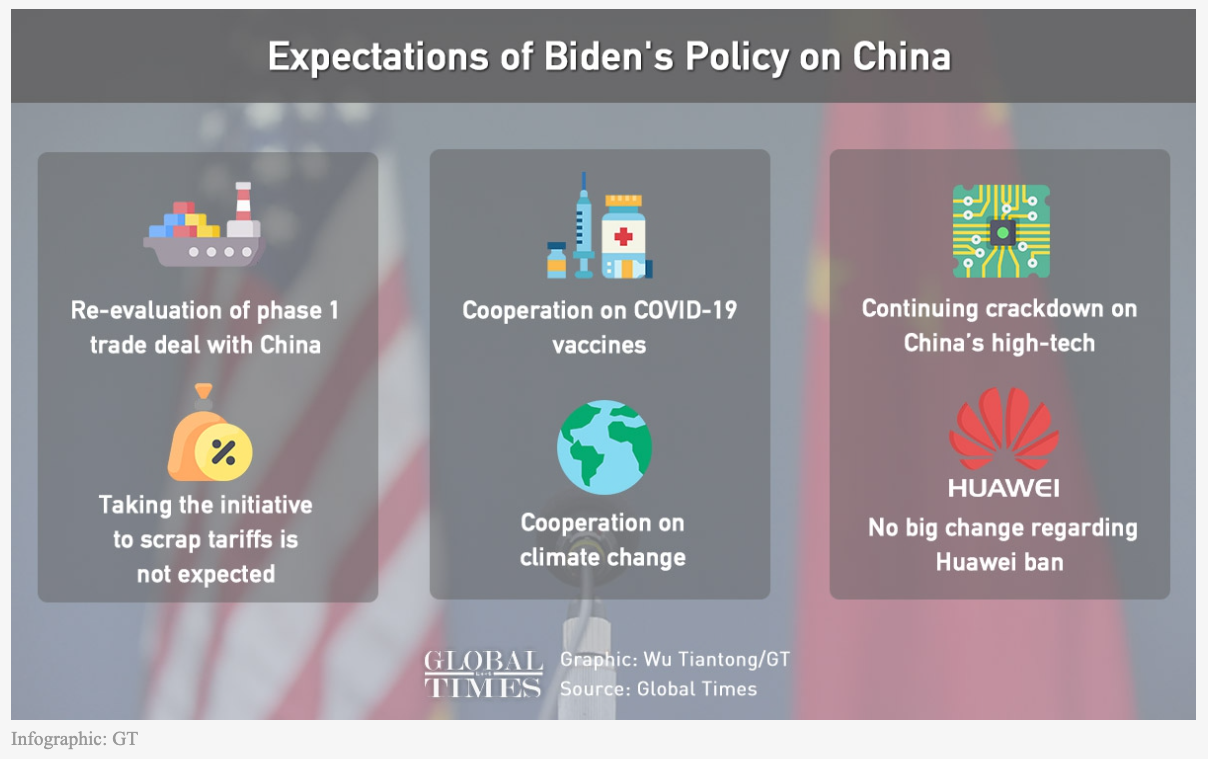
On trade, Democrat-supported protectionism is not expected to spell an end to tariffs, but experts do predict that sectors providing daily necessities for the US middle class will be spared tariffs, while other sectors will require difficult negotiations.
On multilateralism, China expects the US to perform lots of outreach work to its closest traditional partners and allies, such as the EU, so as to build a coalition of states that could apply pressure on China.
On security and defence, Biden is likely to maintain traditional levels of military support to Taiwan and keep the Trump-era sanctions on Hong Kong officials found guilty of suppressing protests. However, Biden would not use Hong Kong as a wider pawn in the US policy on China.
On tech, there is an expectation that decoupling will intensify significantly, but only on critical technology (i.e., Huawei), while not targeting everyday-use non-core tech, such as TikTok or WeChat (although the question on data privacy remains).
Chinese experts also expect Trump to use his time in the office until January to consolidate his policies on China, which could create friction in the Taiwan Strait and could result in heightened political, economic, and diplomatic confrontation with Beijing.
China is unlikely to find Biden soft, despite a change of tone. Biden previously called Xi a “thug” and pledged to lead a campaign to “pressure, isolate, and punish China”, as well as lead a separate campaign to enhance pressure on China’s alleged mistreatment of the Uyghurs.
On the other hand, China had come to terms with this reality even before the election. The general consensus is that China’s rise is on track to grant it an enhanced power status in the world and the US is bent on curbing its rise. To that end, an anonymous Chinese official said: “the US has to answer this question: can the US or the Western world accept or respect the rise of China?”

TAKEAWAYS
► WHERE DOES THIS LEAVE THE EU-US-CHINA TRIANGLE?
As we’re nearing the end of a tumultuous (to say the least) year, Biden’s win is a bubble of oxygen and a beacon of hope for liberal multilateralism and for the EU, in particular. Don’t take it from us, take it from the major European leaders we mentioned above.
That being said, there are many questions to be resolved. Yes, Biden did pledge to rejoin the Paris Accords, but if the US Senate vetoes any ambitious climate plan, that will be seen in the EU as a major step back. Even outside of selected policy domains, the EU has engaged in open strategic autonomy, which was born out of an understanding that Europe must be more responsible for itself and must defend its supply chains, its values, and its integration path. Is the promise of renewed transatlantic relationship an adjacent part to strategic autonomy or a replacement? (If it is the latter, what does that tell the EU about its autonomy capabilities?) The degree of strategic autonomy emphasized will not only define EU-US relations in times of ‘peace’, but also in potential future scenarios in which another individual like Trump becomes president.
As for EU-US cooperation on China, there is more breathing room now. For starters, cooperation proposals will have substance (as opposed to vague appeals to democracy and freedom). China will remain a key strategic challenge for the US, but the focus Biden places on partnerships means cooperation on China will not be jammed by threats and tariffs. To some degree, the US’s China policy may start to fall in line with the EU’s strategic outlook (cooperation partner, negotiating partner, economic competitor, and systemic rival).
Let’s not get ahead of ourselves, though. We still have more than two months of Donald Trump, an interval in which his will to consolidate collision with China may further worsen the status quo. With Biden, Beijing may catch a breath for a quick second, but chances are now much higher that the “West” will be making a comeback on the international scene.

READ MORE
US presidential election: Europe congratulates Biden as China challenge looms, SCMP (Stuart Lau), Nov 8
Biden wins: What's next for China-US relations?, Global Times, Nov 8
US election gridlock: ‘Biden will have one hand tied behind his back from the start’, Financial Times (Edward Luce), Nov 7
No American election will change China’s mind, Economist, Nov 7
2. China Suspends the Biggest IPO in History
On November 3, an IPO for Ant Group was not allowed to go public in the Shanghai and Hong Kong stock markets by Chinese regulators.
► Ant Group, an affiliate of Alibaba Group (founded by Jack Ma), has risen to become the largest fintech company in the world. Its share offering was expected to be the largest in history, standing at $37 billion;
► The listing was allegedly suspended in the context of Ma complaining recently in a speech about excessive regulation of the fintech sector, which put him at odds with the Party;
► The suspension shows how much importance the Chinese Party-State ascribes to companies being within its control, even at the expense of their business performance.
Not A Small Ant
The suspension is a very big deal, so we are breaking down below how big player Ant Group is within the Chinese economy.
Ant Group is an affiliate of Alibaba - one of China’s most successful enterprises - and handles over $17 trillion per year in e-payments and is behind much of China’s outstanding performance in e-commerce and fintech in the past 5 years.
Alibaba has become a tech giant in recent years through its offer of e-payment services through the Alipay app. In 2014, Alipay was rebranded as Ant Financial and then as Ant Group and shifted to broader financial services (including savings, investments, insurance, and credit). As a straightforward and non-bureaucratic vehicle, Ant ate up sectors that were traditionally dominated by state-owned banks.
As far as credit, Ant managed to bring serious competition in financial services, handing out ¥1.7 trillion worth of loans (even though it seeks to brand itself purely as a tech company). The capital is provided by banks, who see in Ant both the reason they have lost direct contact with customers and also a platform through which to establish an indirect link to them.
Ant is also the largest investment services platform in China based on assets, with a total of ¥4.1 trillion invested. Furthermore, it offers insurance services that amounted to 7% of its revenue in 2019 and has been on a grow seeing growth of 107% over the course of the last year.
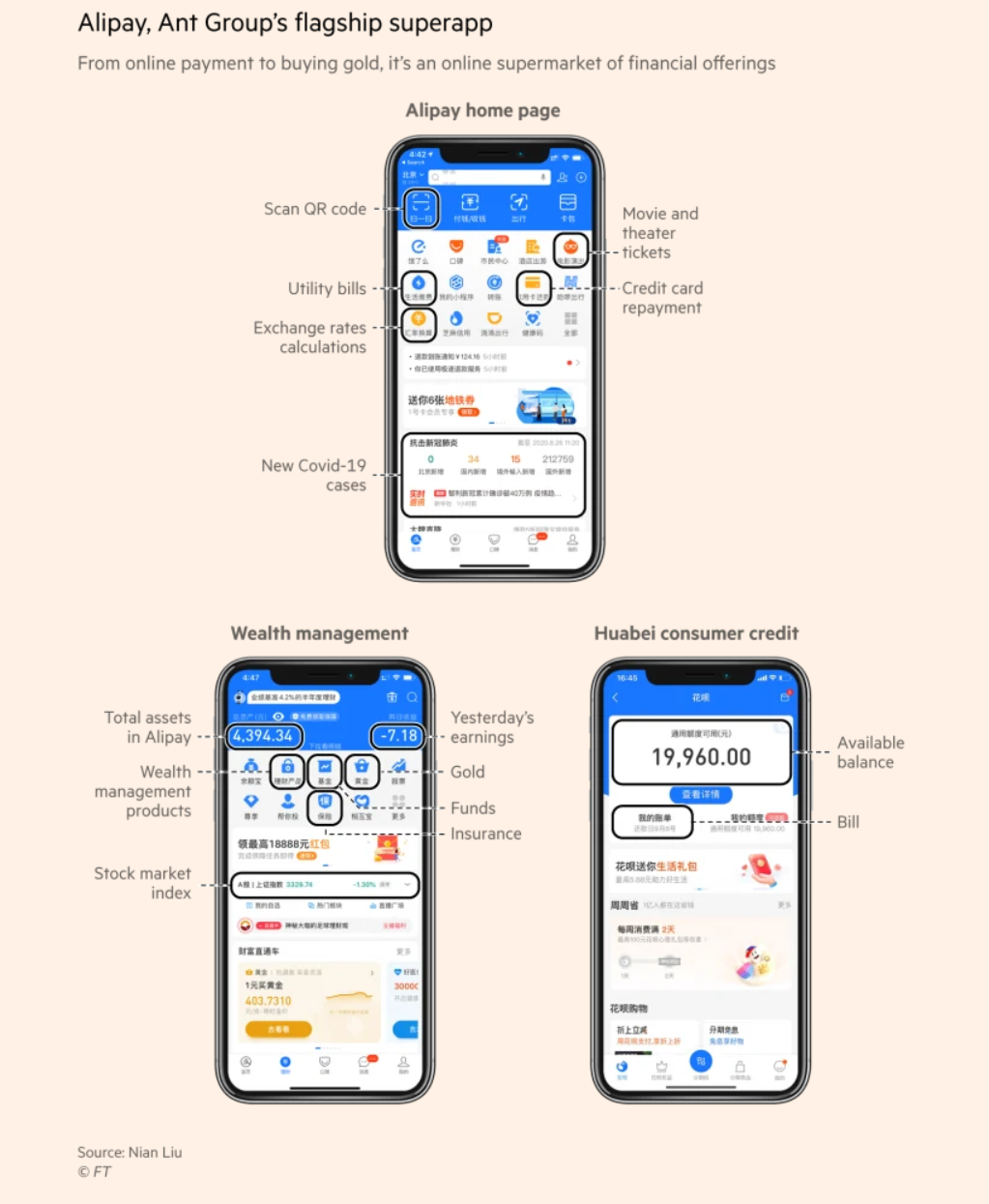
Below is a comprehensive explanation of Alipay’s interface (which has remained the name of Ant’s app), thanks to this graph from Financial Times.
IPO Suspended
Ant Group was expected to break world value records on its IPO, but Chinese regulators halted trading in the company just days before its listing, citing inconsistencies with new draft regulations.
More concretely, Ant managed to garner $3 billion in orders from individual investors from its listings in Shanghai and Hong Kong. It would have been the largest IPO in history, with a market value of $315 billion, which could have meant a larger value than JP Morgan Chase and four times the value of Goldman Sachs.
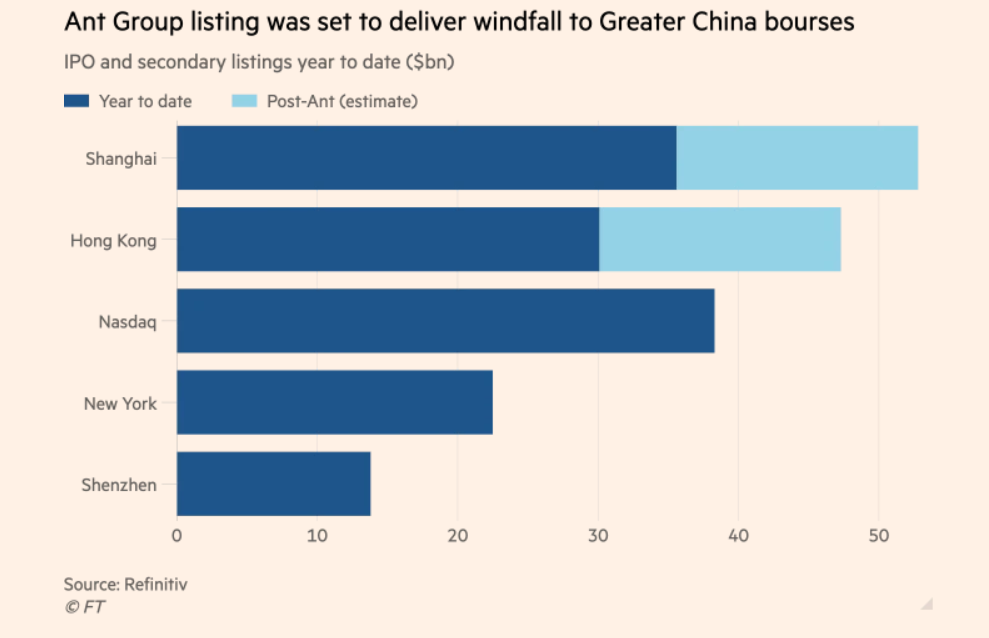
The listing also had a narrative attached to it. It was meant to exemplify China’s unparalleled innovation in financial technology and, through its listing solely in Chinese stock markets, it was meant to indicate China no longer needs US capital markets. Both the Shanghai and the Hong Kong stock markets would have surged ahead of their counterparts (New York, Nasdaq).
Just two days before Ant was expected to start trading, Jack Ma was called for a meeting with China’s central bank representatives and three top financial regulators, who told him about the suspension. For now, the suspension is expected to remain in place for at least 6 months.
Regulators said they are stalling the IPO until Ant increases the percentage of loans it provides (as opposed to outsourcing the money from banks), in accordance with new draft guidelines (which require online lenders to provide 30% of loans, much higher than the current 2% requirement). This would mean Ant needs to shift from being an intermediary between banks and customers to being more or less a bank-like entity (and also to find an extra $20 billion in capital reserves).
Losing Control is a No-No
The two-day short notice given to Ma points to the political aspect of the suspension, but it is also alleged to be a public reprimand of Ma.
Ma gave the speech on October 24 at the Shanghai Bund Summit, which had top officials on the panel, most notably Vice-President of the PRC Wang Qishan and Zou Jiayi, a vice-minister of finance.
Ma complained about excessive regulation in the financial sector, accusing banks of having a “pawnshop mentality” that asks for too many collaterals as guarantees for credit. His comments came right after Wang delivered a speech urging for a balance between innovation and financial stability (with a spotlight on the latter), which has been a staple reform initiative of Xi since 2017. As such, Ma’s comments were seen as an indirect challenge to Xi’s plans. State regulators categorized the speech as a “punch in their faces”.
Even before Ma’s speech, Ant was a specific target for Chinese regulators, who worry that Alipay and WeChatPay are too dominant and not sufficiently regulated in the fintech market, at the expense of state banks. This is one of the reasons the regulators have rolled out digital currency.
For the sake of stability and control, the Party believes companies like Ant need to be tamed. According to a senior executive at a Chinese bank speaking anonymously, the government’s logic is: “If I don’t understand you and can’t control you, I won’t let you grow.”
Après Ma, le déluge
The effect on Ant Group is likely to be very drastic, as investors are starting to ask for their money back.
For now, what is known is that Ant faces at least 6 months of delay on the IPO listing, until regulators determine whether the company has implemented required changes. Ant Group declared publicly that it is ready to coordinate with the government.
Following the suspension, shares in Alibaba fell by more than 8%, meaning Ma lost $3 billion, while Alibaba Group Holding (the company owning a third of Ant) dropped by 7.1%, both in the Hong Kong stock market.
Given the shaky status of Ant, some of the investors are asking for a refund on their investment, while others ask that the 18-month lock up period be dropped, so they can also retrieve their investments.

TAKEAWAYS
► END OF MA ERA?
Ant’s suspension cannot be understated in significance. This was meant to be one of those moments that generate “China breaks all records” kind of headlines. Generally speaking, improving financial stability in a country with high debt problems isn’t a bad idea (though, in China’s case, that debt is mostly public). The message here wasn’t about sound financial laws, it was that even a company like Ant cannot cross certain red lines the Party draws. Chen Yun, one of the most powerful officials in China during Deng’s era, once described the system in a fitting metaphor, saying that China has a “birdcage economy”: “The cage is the plan, and it may be large or small. But within the cage, the bird [the economy] is free to fly as he wishes."
For quite some time the cage seemed to be enlarging for private entities, but under Xi, it appears to be shrinking. Xi’s policies strive to make Chinese SOE’s “stronger, bigger, and better”, while those working in the private sector receive instructions that they need better ideological education and increased party presence within their companies. The decision to suspend the IPO of a national tech champion in such a fashion is a clear message: control is the paramount quality in the Party-State.
In some ways, these tight financial regulations are also related to the dual circulation economy. In the past, economic growth was owed to the excess activity created by state-run banks. Their subsidies funnelled much of China’s infrastructure boom, but they also resulted in non-productive activity. Now, with dual circulation, China wants economic growth rates to boom once more by spurring the domestic market. To that end, a loosely-regulated private entity like Ant could not have provided loans below the inflation rate, generating extra debt, but a state-run bank can.

READ MORE
The transformation of Ant Financial, FT (Ryan McMorrow, Nian Liu, Sherry Fei Ju), Aug 26
‘The party is pushing back’: why Beijing reined in Jack Ma and Ant, FT (James Kynge, Henny Sender, Sun Yu), Nov 4
Ant Group IPO delay and Jack Ma’s ill-timed speech, TechNode (Eliza Gkritsi), Nov 4
3. EP’s International Trade Committee to Discuss OSA and Propose China Task Force
On November 9, the European Parliament international trade (INTA) committee will hold a meeting that will shed light on the concept of open strategic autonomy.
► The meeting is part of the broader trade policy review, which seeks to analyze the EU’s supply chains and provide recommendations to make them more resilient;
► China is very relevant to this discussion, as the Parliament will seek to launch a China Task Force, which would streamline the China policy among EU institutions;
► In building supply chain resilience, the EU should keep in mind that much of the narrative about trade dependence on China built during the pandemic is not matched by the statistics.
Trade Policy Review Incoming
The meeting comes roughly four months after the Trade Commissioner (then Phil Hogan) met with the INTA committee to discuss the trade policy review launched on June 16.
During that meeting, Hogan acknowledged that, since the last EU trade policy review in 2015, the world had been changed by the re-emergence of China, the isolationism of the Trump administration, and also, more recently, by the pandemic (which was expected at the time to make the EU economy contract by 7.4% in 2020). These factors made it necessary for the EU to have a serious discussion on open strategic autonomy.
In the draft motion for the trade policy review that will be discussed on November 9, the INTA committee said it welcomes the concept of open strategic autonomy and encourages the Commission to provide more details on it.
INTA stresses that the EU’s OSA should be grounded in conscious respect for international law (particularly on WTO reform), that the trade review should emphasize EU competitiveness and job creation, and that it should fall in line with the EU’s environmental goals, its interests, and its values.
INTA also made 3 suggestions to the Commission to:
Reinforce EU supply chain resilience by stockpiling essential goods and looking at which production sectors could be transferred within the Union, reshored or “near-shored” in the EU’s neighbourhood. (This could be in line with new strategies on Indo-Pacific relations or could help to facilitate the enlargement process in the Balkans. Both would have implications for China.)
Act on reshoring and nearshoring so that it does not diminish the EU’s competitiveness and does not result in increased costs for consumers.
Keep in mind that the EU is “highly reliant” on third countries for raw materials needed in its green and digital transitions, so that “free and fair FTAs constitute the best and most economical way” to follow for the EU’s trade policy.
Where Does China Fit In All This?
One of the main factors driving open strategic autonomy is reducing dependence in critical sectors from China.
Recall that the reinvigorated talk about supply chain dependency can be traced all the way back to April, when the EU’s dependence on medical supplies (e.g. selected meds) and equipment (e.g. PPE) from China was highlighted.
The INTA committee draft motion stressed that “ambitious progress” needs to be made on CAI negotiations, to curb uneven playing field practices, such as public procurement distortions, prioritization of Chinese SOE’s, forced technology transfers, or joint-venture requirements. At the same time, EU trade with China must be consistent with sustainable development, human rights, and climate change.
To help streamline these issues across sectors and institutions, the INTA committee suggested the formation of a China Task Force, which would “ensure unity and coherence on all levels and in all formats to pursue a common and unified EU policy towards China.” The China Task Force would be modelled after the existing Brexit Task Force.
The committee also urged the Commission to begin an impact assessment ASAP for a potential investment agreement with Taiwan. Recall that the EU and Taiwan held an investment forum in September. At the time, the prospect of an investment agreement found support from Taiwanese President Tsai Ing-wen.
Some Things to Keep in Mind
Find below some of the more pertinent considerations to keep in mind on China in the context of open strategic autonomy, extracted from our previous briefings.
A Rhodium Group report from September found that 56% of EU exports to China and 83% of Chinese exports to the EU do not pose any sustainability or security threat to the EU. On the other hand, 46% of Chinese FDI into EU and 32% of EU FDI into China comes with negative security implications. Given these stats, the report suggests the Commission assess which sectors are threatened, and act to diversify supply chains and mitigate the risks associated with this diversification.
A MERICS report from the same month highlights the overstated narrative of EU dependence on trade with China. The report shows how the EU common market accounts for more than two thirds of member state exports, compared to only 2.4% for China. Even though the percentage varies from country to country, even a country like Germany (considered very dependent on China) registered only 7.1% of exports heading to China (as opposed to 59% heading to other EU countries).
The MERICS report also highlights that China, in turn, is very dependent on EU equipment and tools in its industrial upgrading. This is best exemplified by the EU’s advanced semiconductor sector, on which China has come to rely even more after the US banned it from accessing the American semiconductor market.
The narrative of overdependence is believed to stem from individual large corporations—such as German auto sector companies, Dutch semiconductor equipment companies, or British metal and mining companies—all of which derive large profits from their presence on the Chinese market.
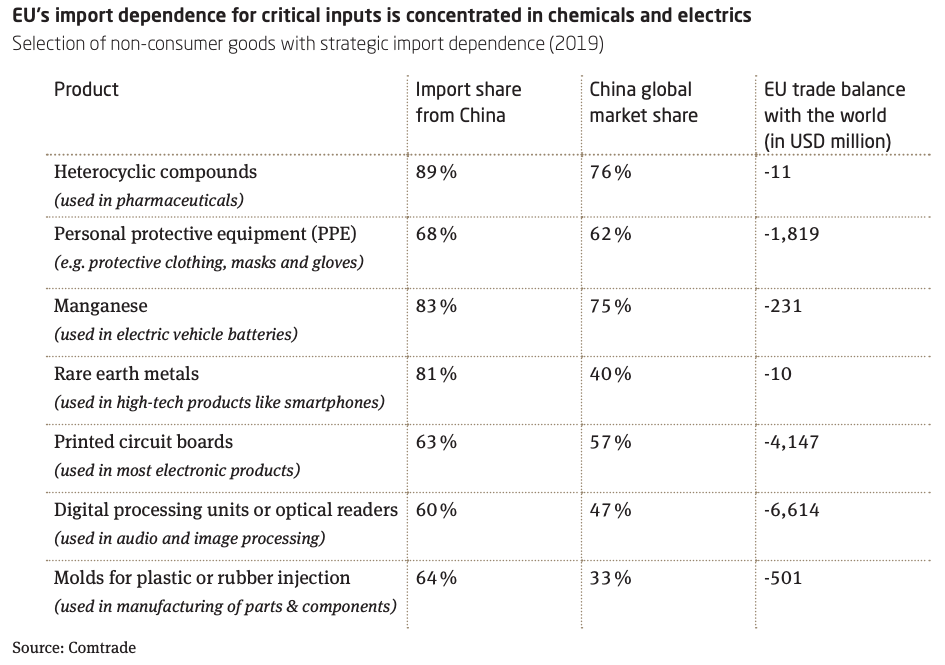
That being said, it should be understood that there are still some sectors where the EU should pursue open strategic autonomy. The pandemic has clearly unveiled the EU’s dependence on China in medical supplies and PPE. Furthermore, Europe is shorthanded in the rare earth sector, where it needs the Chinese market to access supplies of cobalt and platinum (a sector in which China is proving very difficult to replace from a cost-quality ratio).
Going forward, China has been investing a lot in emerging technologies, which could become a future dependence. For example, China plays an important role in critical subsectors, such as the one on lithium batteries, in which it holds 61% of the market. Listed below are sectors in which the EU depends on critical inputs from China.
Source: MERICS
Finally, as you may remember, a report from June by the EU Chamber of Commerce in China shows that, while EU companies operating in China are not happy with the prioritization of domestic companies (SOEs in particular), they still do see in China a growing market with plenty of opportunity and profits to be extracted. Any future OSA strategy should keep in mind that EU companies have reached a point where they are “in China for China”, meaning the majority of them (89%) do not consider relocating outside of China.

TAKEAWAYS
► CHINA TASK FORCE
We are all in favor of this initiative. The need for such a task force is strongly underpinned by the fact that China is a particular country with a well laid-out coordination mechanism (albeit one that is challenged by horizontal competition between provinces) provided by the Party. To respond and shape a more united approach across sectors and address a wide range of interconnected issues, a task force is needed.
► CHINA'S NARRATIVE ON TRADE
It is worth pointing out that while the EU is preparing its OSA, China launched the 3rd China International Import Expo. The Expo started on November 4 and provided Xi with an opportunity to voice China’s narrative on trade amid the pandemic.
His speech was very much focused on denouncing the pursuit of “unilateral dominance” by the US, which he contrasted by presenting some of China’s latest opening up feats in the past year. Some important achievements to note are the reduction in national negative list for foreign investment from 40 to 33, the increase in pilot free trade zones from 18 to 21, the development plans for the Hainan Free Trade Port, and the reform of Shenzhen.
Xi also pledged that further opening up for imports is underway. This is to be facilitated by more pilot free trade zones and free trade ports, and they will focus on the digital economy and the Internet sectors. Among other things, Xi also pledged to deepen China’s free trade agreements and even gave a shout-out to the Comprehensive Agreement on Investment, promising to speed up negotiations. This is all worth taking note, but let’s see how implementation progresses.

READ MORE
The EU-China Diverge - Centralization and Open Strategic Autonomy
Towards a "principles first approach" in Europe’s china policy, MERICS (Mikko Huotari, Jan Weidenfeld, Claudia Wessling), September 20
4. Trilogue Reaches a Deal on the Rule of Law - Will it Work?
On November 5, the European Parliament and the German Presidency of the Council of the EU reached a critical agreement linking disbursal of EU funds to respect for the rule of law.
► Rule of law breaches could be sanctioned if they come with commensurate budgetary implications;
► The deal must now be approved in the Parliament Plenary, and most importantly, in the Council, where it must get the green light from Budapest and Warsaw;
► The agreement helps nudge the wider MFF negotiations forward, but a final deal on it is not expected until the beginning of 2021.
“Historic” Agreement
Negotiators from both the Parliament and the Council praised the preliminary deal as “historic”, a sentiment echoed also by the Parliament’s political groups.
Recall that last week, trilogue negotiations were still ongoing, with significant progress being made on rule of law.
The new agreement was well received by the Parliament group leaders, with Manfred Weber (EPP) calling it “historic”, and Dacian Cioloș (Renew) calling it a “ground-breaking mechanism”.
The deal would allow the Commission to preventively limit disbursement for a rule of law breach, which would put the matter to a vote in the Council, where it would need a QMV in order to approve the cuts in funding. Negotiators identified some instances in which it will apply, citing threats to judicial independence, failing to correct arbitrary decisions, and limiting legal remedies.
While it is more than just a diluted anti-fraud policy, the agreement does have its limits. First of all, its breadth is confusing. It focuses on breaches that "affect or seriously risk affecting the sound financial management of the EU budget or the protection of the financial interests of the Union in a sufficiently direct way".
At the same time, it will apply to “breaches that are widespread or due to recurrent practices or omissions by public authorities, or to general measures adopted by those authorities”. A proper evaluation will only become possible once the final text is released.
Next Steps
The preliminary deal is now moving to the upper echelons of the European Parliament and the Council of the EU.
It will need to be approved in the European Parliament plenary, as well as in the Council of the EU (where the main worry are the responses from Hungary and Poland).
The two countries previously threatened a tit-for-tat, saying they will stall wider MFF negotiations if rule of law conditionality is imposed.
Criticism has already poured in from Warsaw, where Polish Prime Minister Mateusz Morawiecki said Poland will “exercise its right to object”, on any rule of law conditionality. Similarly, from Budapest, Justice Minister Judit Varga said the EU is “blackmailing Hungary politically and ideologically” amid the pandemic.
Tough Times Ahead
The rule of law mechanism is just one step in the wider negotiations on the EU’s budgets for 2021-2027, which require quick agreement, given the EU’s economic forecast ahead.
The German Permanent Representative to the EU, Michale Clauß, indicated “there has been movement” on negotiations, but more needs to be agreed upon before the MFF is finished.
On November 5, the Commission updated its recession forecast, indicating an expected drop of 7.4% in 2020, compared to a forecast of 8.3% GDP decrease predicted in July. However, the economic recovery is expected to slow down in 2021 as forecasts of rebound dropped from 5.8% to 4.1% . The forecast did not take into account neither the possibility of a no-deal Brexit by the end of the year nor the impact of the €750 billion recovery fund.
However, as more European countries enter stricter lockdown measures, these will have adverse effects on business and budgets, leading to the worst recession in the EU’s history, as per the statement by the Commissioner for Economy, Paolo Gentiloni.

TAKEAWAYS
► RUNNING OUT OF TIME AND FRIENDS
Last week, we presented the cases of Southern European countries that were not very happy to take on loans, but are increasingly finding themselves in an economic situation where they cannot afford too many personal whims, given the bleak economic forecast. This week, the situation with Hungary and Poland is not quite the same, but it does rhyme.
Both countries will need to access EU funds ASAP, because if they wait too long on finalizing negotiations, the entire economy will take a hit and, as a result, the outcome for them will be more negative. Moreover, Joe Biden’s election as president signals that the EU may now count on the appeal of the incoming administration in Washington to have an impact on Central and Eastern Europe’s approach to the rule of law. Ultimately, though, the discussions will be tough, as both Budapest and Warsaw are likely aware that if a QMV based rule of law mechanism enters into force they will have a hard time mustering a coalition to protect themselves from punitive measures over rule of law breaches. That is why they hope to use the unanimity requirement in MFF negotiations: now or never, you might say.

READ MORE
European recovery slows downs amid high uncertainty, Euractiv (Jorge Valero), Nov 5
EU institutions strike budget deal on rule of law mechanism, Euractiv (Vlagyiszlav Makszimov), Nov 5
‘Historic’ EU rule of law deal faces challenges, Politico (Lili Bayer, Maia de la Baume), Nov 5
5. China Leads Vaccine Efforts in the Developing World
As multiple vaccine candidates are entering final testing stages around the world, China is asserting its leadership in the field, which also marks a return of its health diplomacy, with a focus on developing countries.
► Namely, 4 of the 11 vaccine candidates that are currently in Phase 3 of testing are Chinese and vaccine trials are taking place in many developing countries, with China promising them early access to the vaccines;
► The EU has had a vaccine strategy since June, which resulted in 3 signed contracts and 3 sets of exploratory talks with vaccine producers. On the international stage, its efforts seem to focus on multilateral institutions, such as WHO;
► Given the second waves forming across much of Europe and the West, Chinese authorities appear to be imposing new restrictions on foreigners entering China.
Health Diplomacy Is Back
In line with previous decisions to send medical supplies abroad as part of its diplomatic practice, China is now pursuing a similar policy on vaccines.
Recall that in March, Xi Jinping talked about a ‘Health Silk Road’ in phone calls with Giuseppe Conte and Emmanuel Macron, which echoed an idea from 2017. In the context of the pandemic, it equates to China providing medical aid and medical supplies with other countries and coordinating on health matters with international institutions and forums. However, much of this is run through bilateral rather than multilateral channels.
Some important numbers: According to Xi, China had delivered assistance to 150 states and 7 international organizations by October 20. This meant 179 billion masks, 1.73 billion protective suits, and 543 million testing kits.
Recall also that in May, Xi Jinping made an address at the World Health Assembly, in which he pledged $2 billion in funding and that a vaccine from China will be a global public good.
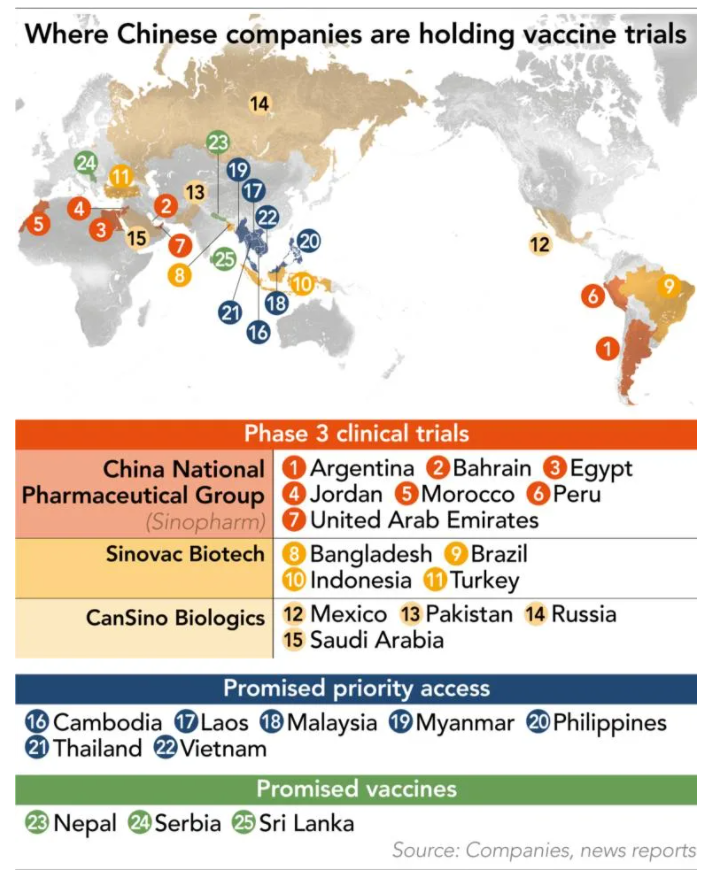
This pledge is now nearing an important milestone, as 4 Chinese companies have entered the final stage of testing . Out of them, Sinopharm (a company based in Wuhan) is expected to gain full approval in November or December.
However, even if China manages to become the first country to provide a tested vaccine, it is unlikely that it will be used in developed Western countries, most of which are trying to reduce their dependence on medical supplies coming from China by reshoring relevant sectors. They are likely going to wait to use their own tested vaccines.
However, in the developing world, the situation is different, as Chinese vaccines are in phase 3 trials in 18 developing countries (more details below). Moreover, China offers loans for future vaccine purchases (e.g., $1 billion in loans to Latin American and Caribbean countries), and has been signing deals. For example, the company CanSino is expected to offer 70 million vaccines to Mexico.
Source: Nikkei
For Beijing, this allows it to score important strategic diplomatic points to generate good relations with developing countries through its health diplomacy, also not jeopardizing any demand for vaccines domestically, where the pandemic has been largely contained.
China’s positioning is 180 degrees from that of the US. Aside from the $2 billion to COVID-19 response and loans to developing countries, China also joined in October COVAX, an initiative that aims to distribute vaccines globally in an equal manner. By contrast, the US refused to join COVAX and Donald Trump said he will prioritize the vaccination of Americans (which may change with Biden, but it would take time).
China’s strides are also gaining attention from an ally within the EU: Hungary. Hungarian politicians Tamás Menczer said on November 5 that “if the vaccine is developed in the East first, neither the lobbyists in Brussels nor those of international pharmaceuticals will prevent us from importing the vaccine.”
The EU’s Vaccine Strategy
The EU is also positioning itself at the helm of vaccine-making, having signed 3 contracts with future potential vaccine providers.
Recall that in June the Commission hosted a Coronavirus Global Response, through which it managed to fundraise €9.8 billion. The Commission accounted for €1.4 billion of the sum, while China made only a modest contribution at the time (€45.6 million). In the meantime, the pledged sum was raised to €16 billion and the EU has also announced it will join COVAX, for which it pledged an additional €400 million in support.
Most importantly, the EU managed to sign three contracts with potential vaccine providers: AstraZeneca, Sanofi-GSK, and Johnson&Johnson. The first two contracts will secure 300 million vaccines each, while the last one stipulates 200 million vaccines.
On top of that, the Commission also pursued exploratory talks with three other companies: BioNTech-Pfizer, Moderna, and CureVac. These provide contractual frameworks for an initial purchase of, respectively, 200 million vaccines+100 million more later, 80 million, and 225 million.
The Commission has also prepared a strategy for vaccinations, once a vaccine arrives. This includes preparing vaccination capacity, ensuring easy access to target populations, deployment and mass storage of vaccines with different characteristics, and the clear communication of benefits of vaccination.
The EU also announced that it would prioritize vaccination for healthcare works, people over 60 years old, people particularly at risk through their health conditions, essential workers outside the health sector, workers who cannot socially distance, and vulnerable socioeconomic groups.
What About Returning to China?
Amidst renewed COVID-19 waves, the Chinese government is tightening restrictions on both foreigners and Chinese nationals seeking to return to China.
Recall that in September, China allowed foreigners with valid resident permits to return to China for work, personal matters, and reunions. The initiative was praised by the European Chamber of Commerce in China as a “landmark in terms of getting the economy back to full health”, but the Chamber also said it “must now work towards a solution for students to safely enter China as well.
The return process is nonetheless extremely complex. Returnees are required to take both a nucleic acid and an antibody test, both within 48 hours of boarding the flight to China. Moreover, because consulates are understaffed, administrative delays may go further than that 48-hour interval. Finally, any layover will require returnees to do the same process in each country they visit.
Even more, it appears even foreigners with valid residence visas have started being denied entry permits (from Italy, UK, Spain, and Belgium), thus signalling that China is tightening border entry once more. The decision was decried also by the European Chamber of Commerce, who called it a “serious body blow to business sentiment”.
One particularly affected demographic are international students, who have protested their barred entry on social media through the hashtags #TakeUsBackToChina and #TakeUsBackToSchool.

TAKEAWAYS
► BETTING BIG
China is betting big on its vaccine diplomacy in the developing world, which is partially caused by the fact that the US or the EU are not interested or active, but also because it can score bonus diplomacy points in regions within the developing world where it is already present through aid and infrastructure projects. It is an admirable choice and, assuming its vaccines are safe, it should be praised as such. Many lives can be saved.
That being said, the entire story on vaccine diplomacy is yet another example of China prioritizing bilateral over multilateral solutions. China prefers to sign individual contracts with developing countries, even though it could very well use (and empower) the WHO as a medium to do this exact job. The EU, on the other hand, is focused on multilateral alternatives, such as reforming the WHO. The EU probably does not want to promise a vaccine before it actually has it, but it’s equally true that much less visible vaccine support for developing countries, coupled with the second wave, places the EU in a weak diplomatic position.

READ MORE
China Is Winning the Vaccine Race, Foreign Affairs (Eyck Freymann and Justin Stebbing), Nov 5
Red Pill? Behind China's COVID-19 vaccine diplomacy, Asia Nikkei (CK Tan and Erwida Maulia), Nov 4
Coronavirus: Commission lists key steps for effective vaccination strategies and vaccines deployment, European Commission, Oct 15