EU-China Briefing - 27 July 2020
YOUR WEEKLY SHOT OF EU-CHINA NEWS
BY FLAVIAN BERNEAGĂ AND GRZEGORZ STEC
1. EU’s Update on 5G Toolbox Implementation and ‘Huawei Measures’
On July 24, the European Commission released a report on the implementation in member states of the EU Toolbox on 5G Cybersecurity.
► The Toolbox, published in January 2020, seeks to address the strategic and technical measures that ought to be taken in the building of 5G infrastructure in Europe;
► The report concluded that member states have taken important steps to protect their 5G cybersecurity but that work remains to be done on defining the content and scope of the measures;
► Importantly for Huawei, measures aimed at minimising the exposure to high-risk suppliers are at an advanced stage, though a third of the MS lack an adoption timeframe.
Recap
The 5G Toolbox is the EU’s attempt to craft a coherent, across-the-Union cyber policy on 5G, with critical implications for Huawei’s future in Europe.
The Toolbox outlined that member states must take concrete steps to recommend improvements by April 30 and prepare a report on their implementation by June 30.
The Toolbox involves strategic and technical measures. The former concerns the creation of increased regulatory powers for network procurement, while the latter concerns measures to strengthen the security of 5G networks by "addressing the risks arising from technologies, processes, human and physical factors".
As of May 2020, 12 Member States had deployed 5G commercial services, which are for now governed by the EU Telecommunication Framework. This Framework is quite outdated, as it was adopted in 2002 and last updated in 2009.
At the same time, member states have undertaken steps to enhance coordination between themselves in regard to standardization and developing relevant certification schemes.
Key Risks
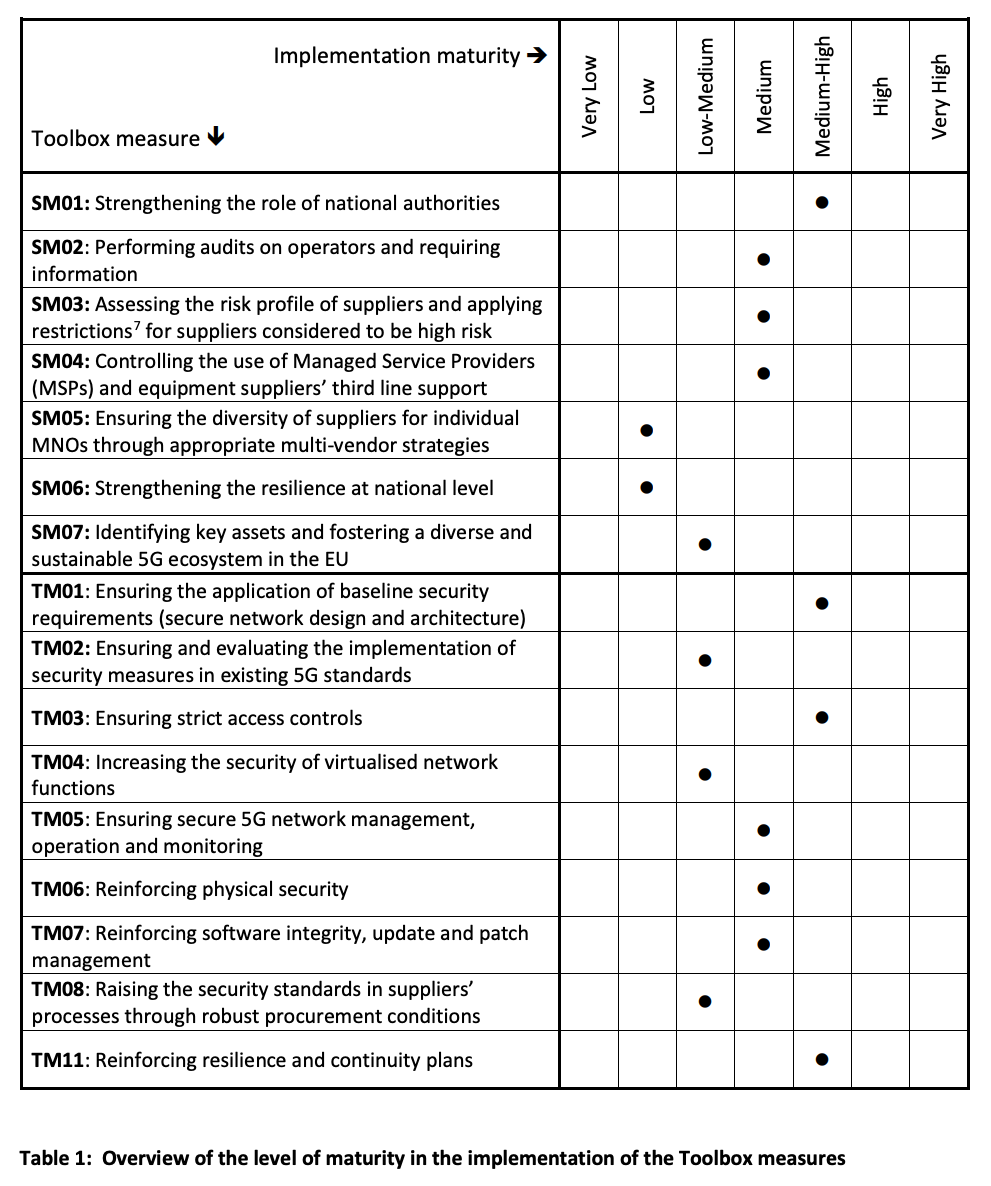
The key risks identified by the report (as outlined in the table from the EC report attached below) are misconfiguration of networks, lack of access control, and interference through the 5G supply chain.
At least 20 member states consider these issues to be of high or very high importance.
Similarly, existing measures were described as insufficient in averting risks related to dependency on a single supplier, state interference in the 5G supply chain, exploitation of the network by organized crime groups, and exploitation of the Internet of Things.
Overall, most member states have taken steps to implement the Toolbox. They carried out gap analyses and launched processes to review and upgrade existing security measures, as indicated in the table below.
The report also highlights that in some member states, defining the content and scope of measures has been stalled by the lack of political impetus needed to kick start the process. Moreover, not all MS have shared detailed information about every measure they took.
What Does This Mean for Huawei?
Though the words ‘Huawei’ and ‘China’ do not feature in the report, the table above contains three aspects that are of particular concern to the Chinese company: SM03, SM05, and SM06.
SM03 - Identifying and applying restrictions for high-risk suppliers
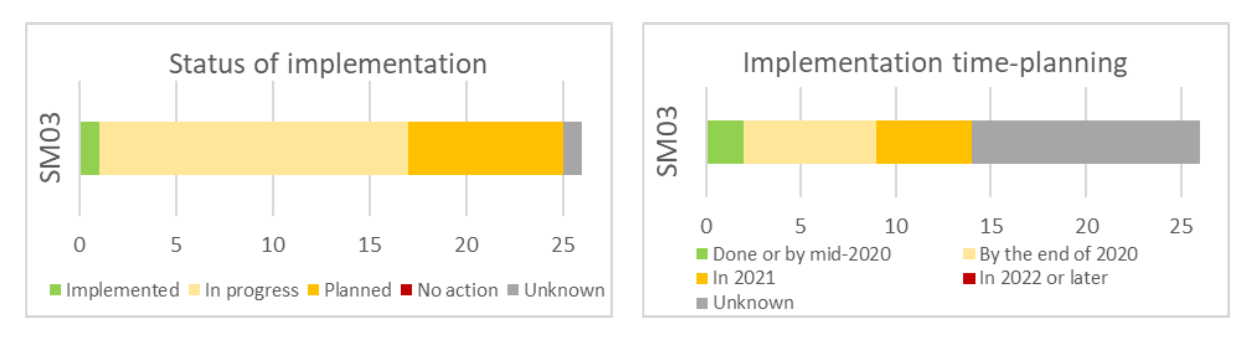
When it comes to measures aimed at minimizing exposure to high-risk suppliers, 14 MS said their exposure to high-risk suppliers is Medium or High, but 8 MS provided no response, many of them stating they lack a framework or a timeframe for determining the risk of suppliers.
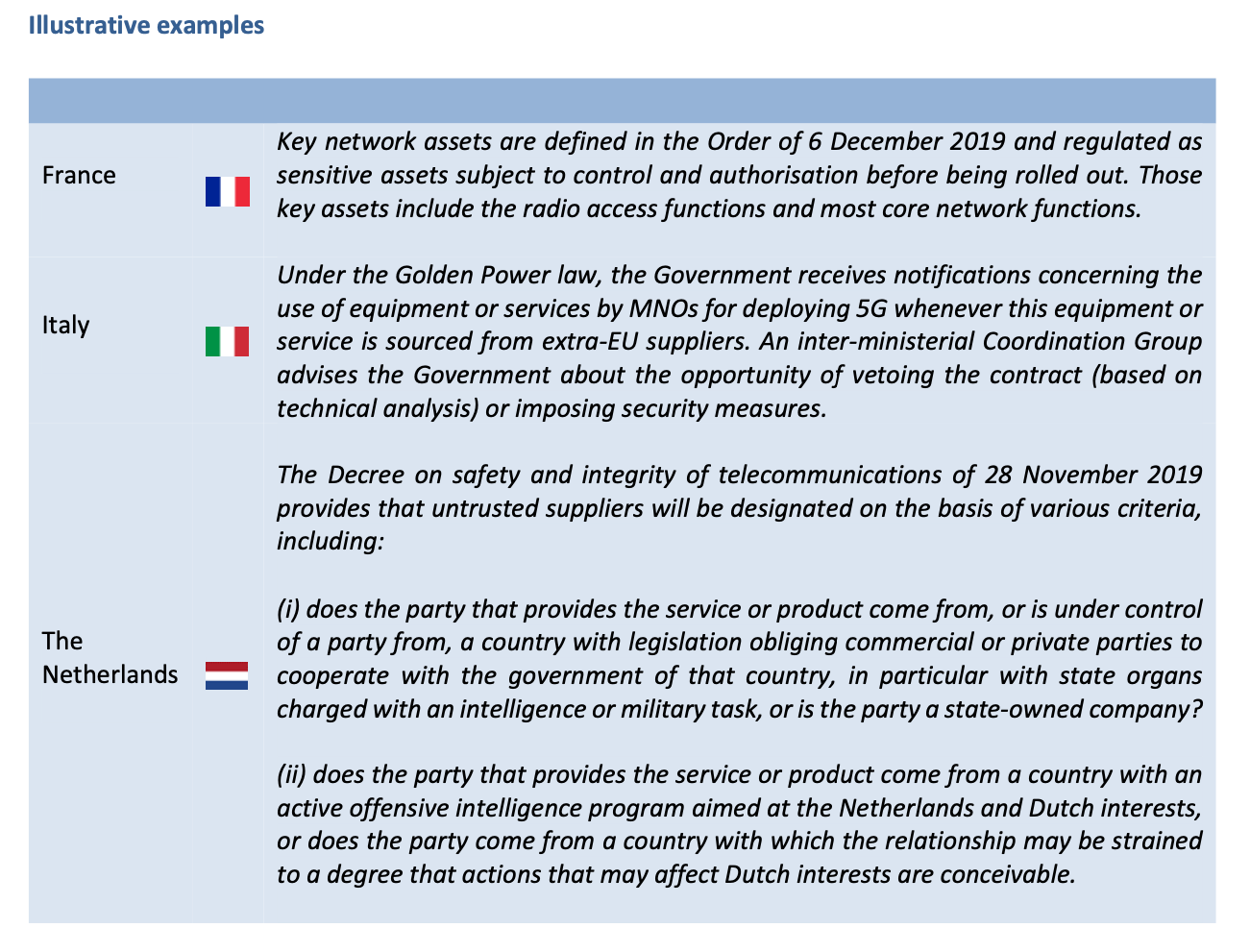
For the 14 MS, the process is quite advanced, as they indicated they plan to take into account the origin of suppliers and the risk of interference from third countries.
When implementing these measures, MS must define implementation plans for operators currently using the supplier’s equipment; must take into account risk factors posed by the supplier; must rigorously analyze the supplier in question; and, based on that analysis, must exclude them if they present risks for key assets.
SM05 and SM06 - Ensuring Diversity of Suppliers and Strengthening Resilience at National Level
Most member states have yet to draw plans to address existing dependency on suppliers and to prevent future dependencies.
What does this mean for MS? It implies they must make sure their mobile operators do not depend on one single supplier and that they have a well thought-out strategy to select multiple 5G vendors.
12 MS have work in progress on this topic, with only 5 MS having an implementation plan by the end of 2020. In total, 16 MS lack an implementation timeframe, so further work is needed to clarify what the parameters of such strategies would be.

TAKEAWAYS
► SLOW, BUT STEADY
According to the report, the strategic measures that Huawei is most interested in are those least addressed by current measures, which may mean that the Chinese company is facing a bumpy road ahead as the measures get beefed up.
The report also points out the difference in approach between the US and the EU on addressing the Huawei challenge. The US rhetoric-intensive, “freedom-loving” actions contrast sharply with the EU’s low-key, norms-focused approach (a trait we vouched for back in January).
Ultimately, the Toolbox is a set of recommendations and guidelines, but member states who are slow in enforcing 5G cybersecurity reform will be pressured into pursuing it, once coordination at the EU level is breathing down their necks. We have already seen political pressure lifted in publishing the Toolbox in January, and this trend is likely to continue.
The recent UK decision to ban Huawei by 2027 provided additional political momentum. Furthermore, on July 24, France announced plans that would amount to a de facto ban on Huawei by 2028. The measures would allow French mobile operators to be granted licenses with Huawei only for a duration of three to eight years, which we discussed in our briefing two weeks ago.

READ MORE
Report on Member States’ Progress in Implementing the EU Toolbox on 5G Cybersecurity, European Commission, Jul 24
2. Towards a Coordinated EU Response on Hong Kong
On July 24, more details emerged about an EU-wide coordinated response (currently in the making) to the Hong Kong national security law.
► The document is expected to limit exports to Hong Kong of tech that can be used for repression or surveillance, though other sanctions are also discussed.;
► 8 MEPs, 5 of whom are members of the Inter-Parliamentary Alliance on China (IPAC), called on the High Representative Josep Borrell (and, therefore, the Commission) to demand an investigation at the UN into human rights abuses in Xinjiang.
EU Plans to Limit Tech Exports to Hong Kong
The official EU response on Hong Kong is expected to be released on Tuesday, July 28.
Aside from limiting tech exports that facilitate “internal repression, the interception of internal communications or cyber-surveillance”, the 27 EU leaders also agreed on sanctions including trade curbs and a review of visa agreements.
If released on Tuesday, the response package will have come exactly a week after the Commission’s 22nd annual report on Hong Kong, which mentioned the “over €136.2 billion worth of investment stock and over 2,300 EU companies operating in Hong Kong.”
The reports coincided with a release of a joint statement by representatives of 10 foreign affairs committees in European Parliaments which called on China to “rethink its decision to impose this law [...] in order to restore the good faith with European nations”.
The ten committees come from Belgium, Estonia, Luxembourg, Germany, Norway, Denmark, the European Parliament, Latvia, the Netherlands, and the UK.
The package also comes after the UK published the details of its decision to grant Hong Kong BN(O) holders the opportunity to settle in the UK. Home Secretary Priti Patel clarified that the proposal does not imply skills tests, minimum income requirements, or caps on numbers.
Xinjiang Pressure
On July 24, eight MEPs - most of whom are part of the Inter-Parliamentary Alliance on China (IPAC) - decried that the EU has taken few steps to address human rights abuses in Xinjiang.
The MEPs argue the “EU should demand an UN independent international fact-finding mission” and should initiate sanctions against those responsible for abuses in Xinjiang.
This also comes in the context of labour unions and NGOs highlighting that brands operating in Xinjiang are indirectly benefiting from the oppression of Uyghurs. An NYT investigation even uncovered that Uyghur forced labour is used in the production of PPE.

TAKEAWAYS
► HOLD YOUR BREATH
The national security law in Hong Kong has created important political momentum across the EU and the document that is expected on Tuesday is a concrete development towards an EU foreign policy (which was facilitated, one again, by Franco-German cooperation).
Keep an eye on Tuesday’s announcement and look beyond the measures imposed. The political language surrounding the announcement, as well as the coordination between member states on the matter, will be very important for how the policy will develop further. The news will surely be followed with interest in Beijing, particularly after Pompeo’s calls for a united stance of democracies against China.

READ MORE
EU to limit tech exports to Hong Kong after Chinese clampdown, Reuters (Gabriela Byczynska), Jul 24
Hong Kong 2019 Annual Report: an exceptionally challenging year, EU Commission, Jul 22
Home Secretary announces details of the Hong Kong BN(O) Visa, UK Gov, Jul 22
3. Pompeo Looks For Friends To Get Hawkish on China
In a speech held on July 23 at the Richard Nixon Presidential Library (of all places), Mike Pompeo called for an end to “blind engagement” with China.
► The speech came after the Chinese consulate in Houston was ordered closed, which was followed by the retaliatory closing of the US consulate in Chengdu;
► Pompeo made a call to countries in the “free world” to coordinate their opposition to China, echoing a Cold War narrative that is growing in the White House;
► Importantly for Europe, Pompeo tried to frame the choice not as siding with the US or China, but as picking between freedom and tyranny.
Distrust and Verify
In his speech, Pompeo, the US Secretary of State, made it clear that he wants to retire engagement policy and revert to a type of containment, which was referred to as “comprehensive, multidimensional, relentlessly objective candor”.
Pompeo argued that “if we want to have a free 21st century, and not the Chinese century of which Xi Jinping dreams, the old paradigm of blind engagement with China simply won’t get it done.”
Instead, he offered a much more assertive, even confrontational approach: “the only way to truly change communist China is to act not on the basis of what Chinese leaders say, but how they behave. And you can see American policy responding to this conclusion. President Reagan said that he dealt with the Soviet Union on the basis of ‘trust but verify’. When it comes to the CCP, I say we must distrust and verify.”
His speech also tried to create a division between the CCP and the Chinese people, whom he described as “dynamic, freedom-loving people who are completely distinct from the Chinese Communist Party”.
A Message to the “Free World”
Pompeo also outlined his vision for “free nations” to team up in a coalition to oppose China and “defend freedom”.
Pompeo acknowledged that not all countries would adopt the same stance, but he argued they should “start by doing what America has done – to simply insist on reciprocity, to insist on transparency and accountability from the Chinese Communist Party”.
The Secretary of State brought back the Cold War narrative by referring to the USSR and highlighting that “the CCP is repeating some of the same mistakes that the Soviet Union made – alienating potential allies, breaking trust at home and abroad, rejecting property rights and predictable rule of law”, but acknowledged that “The USSR was closed off from the free world. Communist China is already within our borders.”
He called on institutions (including the UN and the G20, where China holds significant leverage thanks to US isolationism) to employ “economic, diplomatic, and military power” before suggesting that it may be the time for “a new grouping of like-minded nations, a new alliance of democracies.”
In his conclusions, Pompeo said “If the free world doesn’t change, communist China will surely change us. There can’t be a return to the past practices because they’re comfortable or because they’re convenient.”
What About Europe?
Pompeo also made a call on, among others, Europe to not “repeat the mistakes of these past years”. Based on developments in the past month, he is hoping Europe will join the US in deploying a tougher line on China.
Recall that at the end of June, Pompeo said he was on board with an EU-US dialogue on China with a “shared understanding of the threat posed by the CCP”. The same principles were shared during Pompeo’s state visit to the UK on July 21, with the scope of building a coalition against China.
Similarly, on July 13,Trump sent national security adviser Matthew Pottinger and Robert O’Brien to meet with European counterparts in the UK, Germany, France, and Italy to discuss the West’s competition with China.
Recall also that one of the core elements of Jens Stoltenberg’s vision for NATO 2030, presented on June 8 ,was responding to the security challenges associated with China’s rise. That is another medium through which Pompeo could seek recruits.

TAKEAWAYS
► WHO'S BUYING IT?
Pompeo’s speech may sound inspiring to China hawks and those fed up with Beijing’s recent actions, but it is based on rather shaky assumptions. The first one is that the Chinese people at large hope for regime change. This is not accurate, as the party’s legitimacy has been fueled both by improved standards of living and by nationalist rhetoric that has an opportunity to grow every time anti-China rhetoric comes out of Washington.
Another flawed assumption is that the US can easily assemble a Cold War-like team of countries to stand up to China, especially after three years during which the Trump administration went after most of the US’s major allies. Also the “freedom and values” card may not be that convincing given that the deployment of Federal forces against civilians participating in Black Lives Matter protests, the detention camps at the border with Mexico, and the repeated spreading of disinformation by the President have made that narrative hard to sustain.
In Europe, Pompeo’s speech will most likely resonate with countries that are heavily dependent on NATO, though his decision to nitpick on Germany may not end up being helpful, as we outline in the next news bite.
But Foreign Policy China bureau chief James Palmer suggested the speech may actually be aimed at Beijing. Pompeo would like for Beijing to retaliate on US businesses, giving White House hawks more decoupling ammunition. However, the fact that China retaliated by closing a similarly-sized consulate (Chengdu) shows that Beijing is calculating strategically its next steps. That may not last long. The nationalist rhetoric cited above is a gunpowder keg that is difficult to control; Xi Jinping has made excessive use of it since coming to power.

READ MORE
Communist China and the Free World’s Future, Mike Pompeo, Jul 23
Pompeo’s Strategy Depends on Beijing’s Own Paranoia, Foreign Policy (James Palmer), Jul 24
Pompeo's Surreal Speech on China, The Atlantic (Thomas Wright), Jul 25
4. China Responds to Pompeo and Calls Germany
The Chinese Ministry of Foreign Affairs reacted to Pompeo’s speech on July 24.
► MFA spokesperson Wang Webin characterized Pompeo’s speech as being “full of ideological prejudice and a Cold-War mindset”;
► Hours after the speech, Wang Yi held a conversation with Heiko Maas after Germany was accused by Pompeo for its soft China stance.
China Not Interested in Escalation
Wang Webin accused Pompeo of wanting to “deflect attention with slanders against and oppression of China and score some political gains”.
He also rejected claims of a gap between the CCP and the Chinese people, by citing a policy brief by the Ash Center for Democratic Governance and Innovation at Harvard University, which argues the Chinese people's satisfaction with the Chinese government is over 93 percent.
Further, Wang said Beijing is “committed to developing a China-US relationship featuring non-conflict, non-confrontation”, but called on “the US government to discard its Cold-War mindset”.
The retaliation also featured a generous use of Xi Jinping’s slogans, as it talked about China being committed to an “independent foreign policy of peace, the path of peaceful development, a new type of international relations, and a community with a shared future for mankind.”
Wang Webin also tried to downplay the possibility of an anti-China international coalition, saying that the US administration’s “petty tricks cannot fool the American people and the international community.”
Maas-Wang Call after Pompeo’s Speech
Germany was one of the countries indirectly targeted by Pompeo because it “hasn’t stood up in the way that it needs to with respect to Hong Kong”.
Mere hours after the speech, Heiko Maas and Wang Yi held a phone call, in which the latter argued “any conscientious country with an independent will shall not join forces” with the US in its call for decoupling.
However, the two readouts of the conversation are not the same. The Chinese one says the two talked about cooperation on a COVID-19 vaccine and the CAI, but did not mention Hong Kong. The German one said they talked about Hong Kong, CAI, 5G, and the conflicts in Libya and Iran.
Maas stuck to the official EU narrative on China, calling it an “important partner, but also a competitor and a systemic rival”. Maas stressed that it is “crucial that we stay in dialogue, especially on critical issues”.

TAKEAWAYS
► LAST HOPE?
While EU circles may not necessarily be overwhelmed with joy at the prospect of working with Pompeo and Trump, the mood in Brussels is surely shifting. In a recent interview with Der Spiegel, HR Josep Borrell said “We are not just discovering today that China is a communist country with an authoritarian regime. What is new is that Beijing now sees itself as a world power and is acting as such [...] The West was naive with regard to China; we thought that with increasing trade there would be change.”
Similarly, Hervé Jouanjean, a former Commission director general in charge of Asia, including China, argued many of the issues with China have remained the same for a decade, when he was working in the Berlaymont.
But Germany stands as the pillar of the EU's relationships with China. More specifically, Beijing is interested in maintaining good relations with Angela Merkel, who has been committed to maintaining stable economic ties with China (which has recently attracted plenty of criticism, as we argued in a past briefing). However, China is playing on borrowed time, as Merkel’s time as Chancellor is coming to an end in 2021. (We recommend the SCMP’s Stuart Lau’s article for more details on this.)
The broader problem here is exactly what we argued at the beginning of June: Beijing is betting on maintaining the status quo, but it does not suggest any reframing of current tensions. If maintained, such an approach is doomed to fail, as the narrative no longer has salience for China’s partners.

READ MORE
Foreign Ministry Spokesperson Wang Wenbin's Regular Press Conference on July 24, 2020
Chinese foreign minister urges Germany to resist US push for China disengagement, SCMP (Stuart Lau), Jul 25
EU-China ties hinge on Germany's political future as reign of Beijing ally Angela Merkel nears its end, SCMP (Stuart Lau), Jul 25
5. European Council’s Consensus on Recovery Package and Way Forward
On July 20, following five days of marathon negotiations, the 27 heads of state and government of the EU reached a deal on Next Generation EU and the MFF 2021-2027.
► It is a historic deal, as it doubles the EU’s budget and, more importantly, allows the EU to assume debt in order to finance its deficit spending;
► Issues remain over how money disbursement will be handled and on whether the rule of law will become a core condition for disbursement;
► Negotiations are not done yet! The European Parliament (the final decision-maker on the budget) said it will veto the proposal if the EU budget is not increased further.
Deal!
When we left off last week, negotiations had been in a deadlock for four days, as leaders disagreed on the size of the package and on single-country veto powers over disbursement.
Eventually, the European Council agreed on a €1,074 billion EU budget for 2021-2027, and to maintain the €750 billion threshold for the recovery fund, albeit split between €360 billion in loans and €390 billion in grants (the Commission proposal suggested €500 billion in grants and €250 billion in loans).
The real win here, nonetheless, is that the EU will be able to borrow money on the markets, with a long repayment deadline (up to 2058), thus creating a market in EU debt (and maybe sowing the seeds for a future reserve currency).
To repay the debt, the EU will inevitably levy more taxes. These would be common taxes, amounting to a stepping stone towards a more integrated common fiscal union.
The deal was warmly welcomed by its main designers: Merkel, Macron, von der Leyen, and Michel. Generally, all leaders, including the frugals, were content with the result, although Dutch PM Mark Rutte said it shouldn’t be called “historic”.
To no one’s surprise, the far-right in Germany, France, and the Netherlands indicated they are unhappy with the deal.
Challenges Ahead
Questions still hover over two important topics: How are the governance of disbursements and the conditionality of the rule of law to be interpreted?
The portion of the fund that comprises grants is tied to a commitment by member states to pursue reform (a main frugal condition for compromise). Countries must establish targets and make progress towards them if they want to see the money.
The final deal stipulates that “no Commission decision [...] on the approval of payments will be taken until the next European Council has exhaustively discussed the matter”. The way “exhaustively” is interpreted will be definitory for the disbursement of grants.
Leaders also left Brussels with ambiguous language on the rule of law. They agreed that “a regime of conditionality to protect the budget and Next Generation EU will be introduced [...]. In this context, the Commission will propose measures in case of breaches for adoption by the Council by qualified majority”.
Both Hungary and Poland claimed victory on the topic, but if QMV will be used instead of unanimity, that leaves Hungary and Poland without a blocking minority in the European Council. Von der Leyen herself stated the reference to QMV shows the bloc’s “clear commitment” to the rule of law.
The Parliament Strikes Back
The European Council may have reached consensus, but the legislative train has not reached its destination. Next station: the European Parliament.
On July 23, the European Parliament issued a press release, in which it called the agreement a historical move, but said the “cuts to [the] long-term budget are unacceptable”.
As such, it threatened to not approve the MFF proposal if a new agreement is not reached, one that would increase EU sources of revenue and would link EU funding to the rule of law.
When questioned over her role in watering down articles on the rule of law, von der Leyen said she “disagreed completely” with them. She shifted the onus onto Charles Michel, saying they were on the negotiation box from the first day of negotiations.

TAKEAWAYS
► DON'T POP THE CHAMPAGNE YET
Now that the dust has settled on the tense negotiations, it is good to outline the big winners, but also to outline the negotiations ahead. The outcome is a reward for Emmanuel Macron’s efforts in the past three years to crystalize his vision for Europe into something more concrete; it is a step forward for Angela Merkel’s legacy building; and it is also a win for Ursula von der Leyen and Charles Michel, who worked to facilitate the most important outcome achieved by EU heads since Jacques Delors’ proposals for the Euro and the single market.
BUT, do not get overly excited. Even before the European Council, the Parliament said it sees the Commission proposal as the bare minimum (as we outlined last week). Now, the Parliament has made it even clearer that it won’t rubber stamp the European Council’s decision, that it expects the EU to gain more own resources (Brussel lingo for sources of revenue), and that it wants a comprehensive link between how the money is sent out and a commitment to the rule of law. It definitely does not help that one day after Orban returned from the summit, the editor of Hungary’s largest media outlet was fired. This led to more than 80 journalists resigning in Budapest, but it also prompted Dacian Cioloș, the EP president of Renew Europe, to call on the EPP to take a stance on the rule of law in Hungary.
Long story short, though the initial agreement is a concrete point of reference for future negotiations, we still have a long way to go until all is ratified.

READ MORE
EU crosses the Rubicon with its emergency recovery fund, FT (Martin Sandbu), Jul 22
EU pandemic recovery package stokes rule-of-law dispute, FT (Peel, Hopkins, Chazan, Shotter), Jul 22
EU long-term budget deal must be improved for Parliament to accept it | News, EP, Jul 23