EU-China Briefing - 20 July 2020
YOUR WEEKLY SHOT OF EU-CHINA NEWS
BY FLAVIAN BERNEAGĂ AND GRZEGORZ STEC
Click & Read:
1. UK Bans Huawei Starting Next Year - Impact on EU
On July 14, Boris Johnson approved a compromise plan at a meeting of the National Security Council which would ban 5G equipment from Huawei.
► New Huawei equipment within 5G networks will be banned starting in January 2021, while the existing 5G infrastructure will have to be replaced by 2027;
► Beijing retorted through the state-run newspaper Global Times, which called on China to retaliate in a “public and painful” manner;
► The UK’s decision opens the door for other countries to follow in its footsteps and for other 5G providers to fill the vacuum.
Johnson Shows Huawei the Backdoor
British PM Boris Johnson outlined a plan to fully ban Huawei equipment from the UK by 2027, while also minimising the disruption on businesses and consumers.
Nonetheless, Johnson did not mandate telecom operators to remove 2G, 3G, and 4G equipment provided by Huawei.
Specifically, this means Huawei will keep being classified as a high-risk vendor, and the current limitations on the use of equipment for wireless and wireline networks from Huawei will be maintained.
The decision was taken against a background of Sino-British relations becoming more fraught since the beginning of the pandemic and reaching a tipping point with the imposition of the national security law in Hong Kong.
Donald Trump claimed credit for the decision, saying that US sanctions on Huawei in May did the trick in changing London’s position. However, the UK had already been considering a tougher stance on China and alignment with the US, even before the sanctions were imposed.
Interestingly, according to the Observer, the British government privately told Huawei that “geopolitical” factors related to US sanctions played a role in their decision.
According to previous indications by the UK government, the ban was expected to add £2 billion in costs and delay the 5G rollout process by 2-3 years.
However, Telecom providers and suppliers were quick to discern that moving away from Huawei will not be overly lengthy or costly. BT suggested the change would cost no more than £500 million, while Ericsson claimed the substitution of Huawei equipment could happen faster than by 2027.
China’s Retaliation
Global Times called for a retaliation that “should be public and painful”, while Huawei is trying to convince Johnson to delay the decision.
The state-owned tabloid Global Times argued China needs to answer back, otherwise it would be seen as “easy to bully”.
However, Chinese officials are treading more carefully, assigning blame to US pressures. Chinese ambassador to the UK Liu Xiaoming claimed the ban on Huawei questions the UK’s independence from Washington.
In turn, Huawei officials asked for a meeting with Boris Johnson, seeking to delay the ban on new Huawei equipment until after the UK elections of 2025, with hopes that a future government would take a different approach.
If negotiations fall through, Huawei could retaliate by limiting support to infrastructure on 2G, 3G, and 4G; scrapping plans to build a research institute in the UK; or targeting UK companies and individuals.
Also, the Chinese social media giant TikTok (owned by Bytedance) announced it has cancelled talks on opening a global headquarters for its company in London.
Lessons for Others
The UK’s decision is likely to be a threshold for other governments in Europe, which had partially informed their stances based on developments in the UK.
Norbert Röttgen, a potential successor to Angela Merkel in the CDU, says the UK’s decision offers “important lessons” and “rightly stresses that, where modern technology is involved, economic and security issues cannot be treated separately”.
Polish Prime Minister Mateusz Morawiecki pleaded that Europe should collaborate with the United States on a tech alliance, particularly when it comes to 5G infrastructure.
On July 13, the Italian government sent a secret document to Italian telecom operators, imposing extra oversight for non-European 5G component suppliers.

TAKEAWAYS
► EXTERNAL EXPERIMENT
Even before the UK decided to phase out from Huawei’s involvement, the EU member states observed how developments were unfolding in the UK, in order to better craft its 5G Toolbox. As the UK’s position on Huawei enters a new chapter, many EU countries may feel inspired to follow in its footsteps, particularly countries interested in fostering close ties with Washington, such as those Central and Eastern European member states that are betting heavily on US security and defence commitments.
Nevertheless, all EU countries will pay close attention to China’s expected retaliation. But the conciliatory stance on Huawei that Angela Merkel is trying to nurture seems increasingly unlikely to be echoed far (even within Germany).

READ MORE
UK orders ban of new Huawei equipment from end of year - Financial Times (George Parker, Nic Fildes, Helen Warrell, Demetri Sevastopulo), Jul 15
China won't passively watch UK's Huawei ban: Global Times editorial - Global Times, Jul 15
Pressure from Trump led to 5G ban, Britain tells Huawei - The Guardian (Toby Helm), Jul 18
2. The Response on Hong Kong Shows Challenge of EU Foreign Policy Building
On July 13, HR Josep Borrell announced the EU’s foreign ministers discussed a package of measures to respond to the Hong Kong national security law, but had failed to agree on specific measures.
► The ministers are considering banning exports of tear gas and rubber bullets, ending extradition agreements, and extending asylum claims and study visas;
► This shows the challenge of EU’s foreign policy powers; an ECFR discussion shows how this challenge could be overcome on the Paris-Berlin axis. Cooperation on the recovery fund highlighted that a Franco-German agreement could go a long way towards establishing a more geopolitical EU foreign policy;
► However, China’s rise is not seen as a foreign policy priority by most EU policymakers; they perceive Russia as the bigger challenge.
FAC Discusses Hong Kong Response
After the Foreign Affairs Council on July 13, Josep Borrell indicated the EU is looking to release a coordinated response to Hong Kong “in the coming days”.
It will consist of a measure package to be implemented both at the EU and member state levels, which means individual governments can announce their own measures separately.
The topics discussed in the FAC included extending an export ban on “sensitive technologies” (tech that can be used to suppress protests), suspending extradition treaties with Hong Kong, and tailoring new visa schemes that would allow easier entry into the EU for Hongkongers.
Borrell said ideas are still “under consideration”, but indicated that part of the response must tell China that the national security law— he called “draconian”—will have an impact on EU-China relations.
Even so, economic sanctions and tougher measures are not likely to be part of the common package, since they were met with opposition from China’s closest trading partners in Europe.
In contrast, other countries have beefed up retaliatory measures, as we discussed in a previous briefing. The US revoked Hong Kong’s special business status, while the UK promised a path to citizenship for over 3 million Hong Kongers with BN(O) status and moved to suspend the extradition treaty with Hong Kong.
More recently, the US also moved to impose further sanctions on China: it restricted access to sensitive US technology and is even considering a travel ban for all CCP members.
Overall, the response to the Hong Kong issue can be counted as another example of how the EU is struggling to develop a common foreign policy on China.
Crafting a geopolitical Europe
But this has to be put in perspective. An ECFR report—published on July 14th and based on a survey of European policymakers and experts—shows that a common EU foreign policy could most likely be facilitated through Franco-German cooperation.
Pre-COVID-19, France and Germany disagreed on multiple fronts: rapprochement with Russia, a common defence union, and French accession vetoes for North Macedonia and Albania.
However, repeated attacks on NATO and Germany from the Trump administration and the necessity to collaborate on pandemic recovery have shown that Franco-German cooperation has the potential to kick start a stronger EU common foreign policy.
France holds better relations with Southern Europe, while Germany is trusted by more member states in Eastern Europe. The study argues the two should employ their influence to push for a geopolitical Europe.
A ‘geopolitical Europe’ would imply the EU acknowledges the big power rivalry between the US and China and understands that internal policy debates stall the creation of a stronger Europe abroad, but acts in a manner that is less divisive than Macron’s pleas for detachment from the US and rapprochement with Russia.
What About China?
The ECFR survey highlights that most policymakers think Russia is a more important foreign policy issue than China, not only in Central and Eastern Europe but also in France.
France, specifically, advocates that fitting the EU between the US and China requires strategic dialogue with Moscow, which will prevent it from joining hands with Beijing.
The idea is not liked by many member states, as only Italy, Austria, Belgium, Greece, Croatia, and Bulgaria favor rapprochement with Russia.
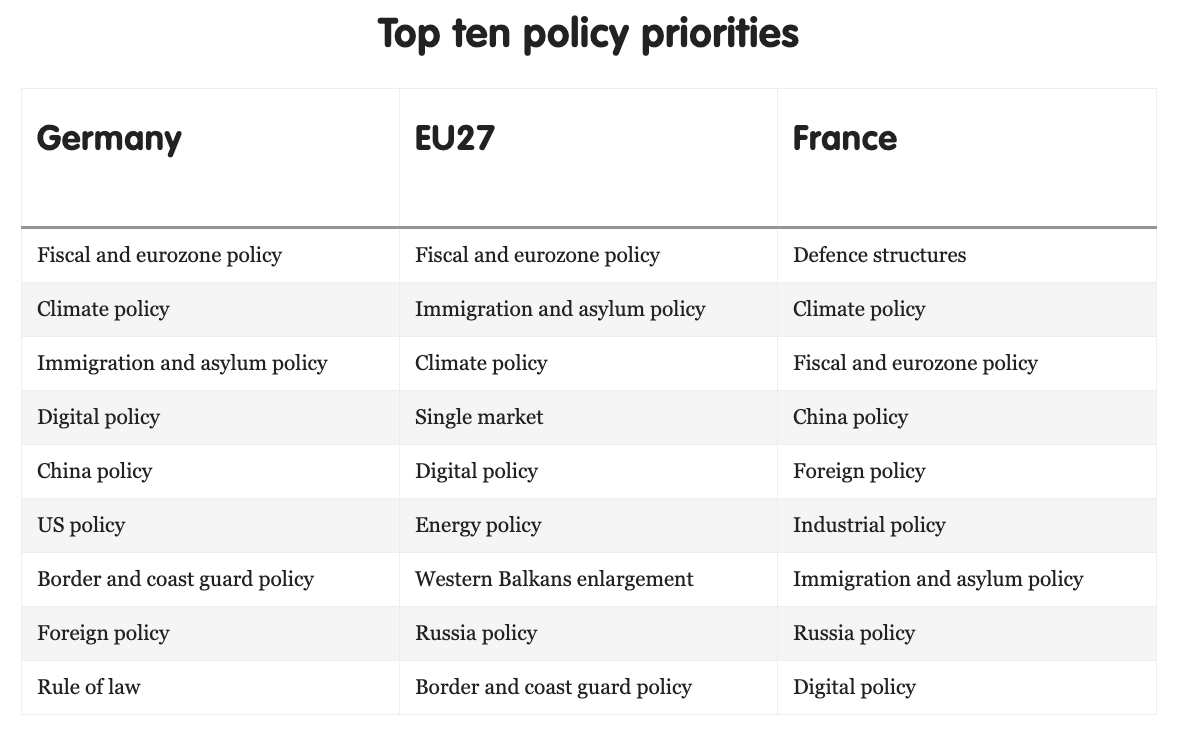
Source: ECFR
When it comes to China, policymakers in both German and France list it as one of the top five policy priorities. However, when measuring the EU27 average, China ranks 12th in its priority list.
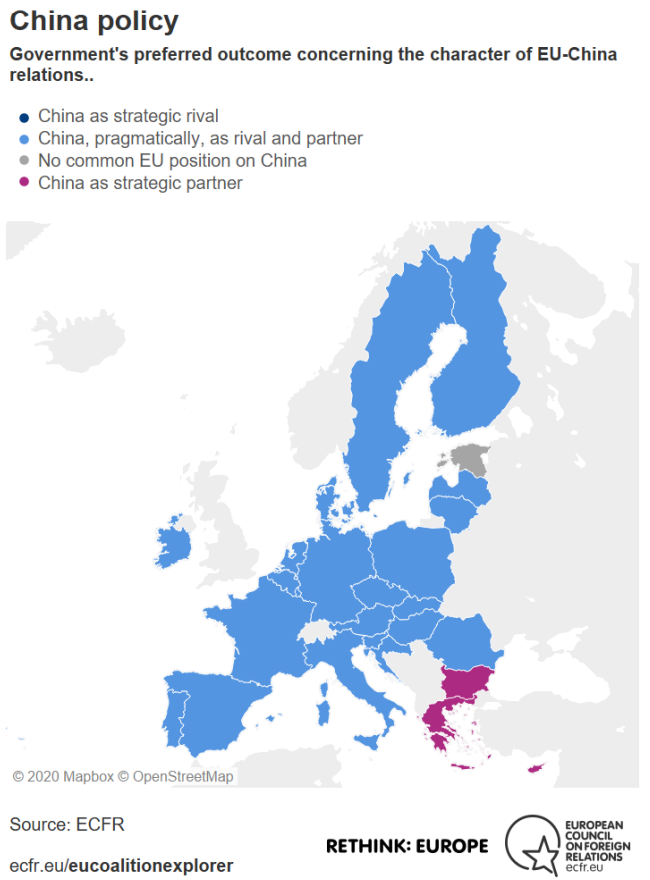
This is problematic for a geopolitical Europe, which will see itself fractured by the US-China competition unless it develops a common stance on China at the EU level.
However, many member states are reluctant to work through the EU on China, and prefer to deal bilaterally with Beijing, in the hope of attracting economic benefits.

TAKEAWAYS
► TOWARDS COMMON CHINA POLICY
The ECFR survey shows that EU member states at large do not think China is the key issue and declare being content with the framework of the 2019 Strategic Outlook. Therefore, a large scale overhaul of EU-China relations remains unlikely, as member states seem to prefer a pragmatic approach to EU-China relations. This is opportunism mixed with a realistic assessment. Some projects (e.g. Budapest-Belgrade railway) are indeed quite problematic, but the EU’s economic recovery also depends on not undercutting the pre-pandemic global trading system, of which China is an important pillar. So what we may expect is pushing for interests and values more, but within an already established dynamic of the relationship (although China’s reactions can change that).
Overall, this is in line with the reactions coming from member states over the last few months. The EU is not interested in decoupling and does not want to focus solely on the systemic rivalry. On the other hand, the EU wants to become more realistic in understanding global affairs and, in doing so, become “less naive” about China. There is now added political pressure to better define exactly what this means, both in terms of “economic competition” and “systemic rivalry”, but possibly in an evolutionary way.

READ MORE
The Big Engine That Might: How France And Germany Can Build A Geopolitical Europe - European Council on Foreign Relations (Jana Puglierin and Ulrike Esther Franke), July 2020 - We highly recommend the study!
EU foreign ministers debate responses to Hong Kong national security law - South China Morning Post (Stuart Lau), Jul 13
It’s complicated: Europe-China relations in a world of superpower competition - European Council on Foreign Relations (Mark Leonard), Jul 13
3. China’s Economy Is Expected to Grow, but Experts Question Official Data
On July 16, China’s National Bureau of Statistics (NBS) announced Q2 year-on-year GDP growth of 3.2%.
► The growth appears to be attributed largely to a surprising strength of exports, particularly on ‘work from home’ tech;
► Nonetheless, analysts doubt that the official data reveals an accurate picture, and argue many firms are still operating under capacity;
► At the same time, alarmed by overheated stocks, Beijing moved to cool down the economy by selling shares from two state-backed funds.
Milk and Honey?
The past week saw positive news from official channels on China’s economic recovery.
The two-track economy that we told you about in mid-June took further shape: industrial output is at 4.4% YoY growth (compared to 5% of Q3 2019), but consumer spending dropped by 1.8%.
Imports expanded for the first time since December 2019—reaching 2.7%, up from a decline of 16.7% in May—while exports grew by 0.5%.
Overall, Q3 and Q4 2020 are expected to bring ~5% growth, as demand for consumption and investment increases, although the development of the pandemic could seriously alter this.
Goldman Sachs expects Chinese economic recovery to make the yuan appreciate against the dollar to up to 6.70 in the 12 months to come, with the condition that Joe Biden is elected president in November.
On July 14, the Chinese Ministry of Finance announced the establishment of a National Green Development Fund worth 88.5 billion yuan. Its aim is to sustain green sectors of the economy, such as clean energy, environmental protection, and pollution prevention.
In a letter to the Global CEO Council on July 16, Xi Jinping committed China, yet again, to deepening its market reforms, in an attempt to reassure the global business community and to stave off decoupling narratives.
Looking Closer
Despite the rosy outlook from official statistics, analysts are skeptical, saying the data does not match the facts on the ground.
The main problem is that consumer purchases saw their sixth month of YoY contraction (In June, they dropped by 1.8%, as mentioned above).
Similarly, most of the restaurants saw heavy contractions of up to 50% throughout April and May, and even in late June, 10% of them remained closed. Nevertheless, official data claims 1.9% growth in YoY Q2 output in services.
The industrial sector, similarly, saw less than 68% of enterprises working at 80% production levels in late May, which resulted in a 1.3% contraction. However, official data claims 4.8% growth in June.
Generally, the economic recovery was driven by the state sector. The NBS document shows investment in SOEs increased by 2.1%, while that in private companies fell by 7.3% (importantly, this figure was missing from the document published in English).
Unemployment fell in June to 5.7% (compared to February’s 6.2%), but newly added jobs nonetheless decreased by 25% on a YoY basis.
Cooling Down the Stocks
There have also been interesting developments on the stock market, as China’s most overheated stocks witnessed significant drops.
Beijing sent a strong signal that it wants the market to match the pace of the economy. As such, it announced plans on July 13 to sell the shares of two-state backed funds.
On July 14, overseas investors sold $2.5 billion of stocks, which made this month’s rally on the Chinese stock market’s $1.5 trillion look vulnerable. It was the biggest drop since pandemic lockdowns were imposed.
The Shanghai Composite Index saw its worst percentage performance on July 16, falling 4.5%, while the Shenzhen Composite Index fell by 5.2%.

TAKEAWAYS
► MODERATE THE OPTIMISM
Many believe China is (and is going to be) experiencing the fastest economic recovery among the major economies, which would reinforce arguments for maintaining the global trading system and strengthen practical arguments against decoupling. While China’s economic recovery may indeed end up being the fastest, policymakers should keep in mind the skepticism of analysts when it comes to the data coming from China.
Recall our news brief from May, where we pointed out that China was not very eager to issue a large stimulus package due to its debt and its budget deficit, which exceeded 8% in May, and the secrecy about the unemployment figure that we discussed in one of our monthly reports. It is best to take the news about the pace of China’s recovery with a grain of salt.

READ MORE
China Markets Dispatch for July 16 - Trivium - We advise you to follow Trivium China for daily updates on China’s economy!
Is China’s second quarter GDP as rosy as it seems? - South China Morning Post (Frank Tang), Jul 17
China’s Hottest Stocks Sink as Beijing Cools Speculative Fervor - Bloomberg, Jul 13
4. Closing the Ranks - Xi’s Vision
An article published by Xi Jinping on July 15 in Qiushi (a periodical of the CCP’s Central Committee) strongly reiterates the centrality of the Party (and Xi) in China’s leadership.
► The article (which is actually a set of extracts from Xi’s speeches) may be aimed at quelling behind-the-doors discontent for Xi’s handling of the pandemic and China’s diplomacy, and demonstrating his dominant position;
► This fits in a wider context of centralization, including in the economic recovery, which we reported about last week;
► It also comes amid global uproar over Hong Kong, which embodies Xi’s vision for tighter control than during the leadership of Jiang Zemin or Hu Jintao.
Xi’s Message
The document reasserts that the “party is the core leadership” and the “leadership of the Chinese Communist Party Is the Most Essential Characteristic of Socialism With Chinese Characteristics”.
The phrase “East, West, North, South, and at the Center - the party leads everything” is repeated five times.
A Qiushi editorial later noted that “adherence to the party's leadership, first of all, to uphold the party's central authority and centralized unified leadership, this is the highest principle of party leadership, any time. Under no circumstances should it be vague or unshakable”.
The editorial talks about the “two upholds”, meaning supporting the party’s total control and Xi’s total control of the party. Xi becomes the “ultimate arbiter”, a phrase often employed in the speeches used in the article.
As we said last week, Xi himself endorsed an action plan for state-owned enterprises which would see them become the core of the economic recovery until 2022. A Xinhua report stated SOEs are the “key pillars and force of the party’s rule”.

TAKEAWAYS
► THE CHALLENGE AHEAD
The quoted article is a very clear example of a wider tendency. In response to an array of challenges facing the CCP, Xi Jinping and his faction have been consistently pushing for centralization of power. Not only by increasing the Party’s control over the state (e.g. through Leading Small Groups), economy, media, and society at large, but also by centralizing the control over the Party in the hands of Xi himself. This may be an attempt to bolster the Party’s ability to live up to domestic challenges that it faces as a result of the gradual economic slow-down and societal changes. The foreign policy of China has frequently been subservient to its domestic one, but the centralization carried out in this fashion (not to mention the values aspect of this trajectory) may limit adaptive resilience of the CCP and also come at a high price on the international stage.
Such a more “hands-on” approach to economy paired with growing assertiveness has been making China increasingly isolated on the international stage, and even feared - also within the EU. Just a few examples related to Europe: the international uproar over Hong Kong and Xinjiang; stalled progress in relations with the EU over market restrictions and position of state-owned enterprises; Huawei being increasingly distrusted and facing limits in building 5G infrastructure in key markets; and reinvigoration of discussions on China within Transatlantic dialogue and within NATO. We have discussed those issues over the last few weeks.
This is of course not a full picture as we focused here on the challenges, which over last months dominate the relationship. But while these may be partially linked to Thucydides Trap mechanism working on the global stage, they are also in significant part a result of China’s actions: the wolf warrior diplomacy that has characterized China’s global approach in the past few months being a prime example.
In this context, the consequences of the vision outlined in Xi’s article in Qiushi are worrying. While the article may suggest internal discontent (and potential debate) from other CCP factions regarding the direction China is taking, it also clearly reasserts Xi’s power and his unchallenged leadership. And that in turn likely means that - for the foreseeable future - China will continue on the trajectory that got us to the point where China is increasingly viewed as a challenge. And that is troubling because, as the multipolar world is emerging, this is yet another signal that it will feature an increased divergence of political and economic systems.

READ MORE
中国共产党领导是中国特色社会主义最本质的特征 - Qiushi (Xi Jinping), Jul 15
In Xi’s Little Red Article, the Monotony Is the Point - Foreign Policy (James Palmer), Jul 17
Twitter: comments on Xi's article by Carl Minzner [we highly recommend], Jul 16
5. European Council in Fierce Negotiations over Recovery Instrument and MFF
On July 17, the European Council kick-started negotiations on the Next Generation EU recovery fund and the EU’s budget for 2021-2027 (MFF).
► The starting point is the result of four months that started with debates on corona bonds and continued with a historic Franco-German proposal;
► Many leaders hope an agreement can be reached in July, but that depends on how much persuasion Michel, Macron, and Merkel can exert on the Frugal Four;
► The negotiations are still ongoing.
How We Got Here
The discussion on the Next Generation EU and the MFF is rooted in a very heated European Council debate held on March 26, later described as “emotional” and “horrible”.
At the time, the topic of corona bonds was opposed, not only by the Frugals, but also by Merkel and von der Leyen (which created a massive backlash from Southern Europe).
Nonetheless, Angela Merkel later came to acknowledge the severe danger of a weak economic recovery across the EU. Her pivot allowed for Germany and France to propose an ambitious €500 billion economic recovery fund.
The Franco-German proposal allowed the European Commission to bring forward its yet even more ambitious suggestion: a €750 billion recovery fund (€500 billion in grants, €250 billion in loans) and €1.1 trillion in the MFF.
The EU would have issued bonds backed by national commitments to the EU budget and the debt would have been repaid jointly between 2028-2058. This would have implied adding new EU green and digital taxes.
However, the Netherlands, Austria, Sweden, and Denmark displayed persistent opposition to grants (as opposed to loans), and stressed the importance of reforms. Opposing stances led to stalled negotiations in mid-June. Most recently, Charles Michel attempted to compromise by suggesting a lower sum for the MFF.
The Expectations
The state of play when negotiations opened showed that consensus was not within reach, but diplomats expressed hope nonetheless that a deal could be agreed upon within this European Council.
The Summit will revert to happening in person and Charles Michel has met individually with member state leaders to convince them to agree on his compromise: €1,074 billion for MFF, less than the €1,100 billion suggested by the Commission.
Importantly, the Parliament has been constant in pushing for a robust recovery package. For example on June 18, the presidents of five political groups have exerted further pressure, arguing that “€500 billion in grants is the bare minimum to provide a credible European response to such a huge crisis” and stating clearly that they “oppose any reduction”.
Three potential vetoes are on the table:
Hungary said it would veto any proposal that tied money to rule-of-law conditionality.
Poland, which refused to implement EU targets on climate neutrality by 2050, said it would veto green conditionality attached to the access of EU funds.
The Netherlands (as the impromptu voice of the Frugals + Finland), has asked for a unanimity vote on how common debt is used, virtually granting veto power to stop the flow of money based on any one country’s grievances.
Although Michel is the mediator in chief, the Summit is expected to result in Angela Merkel’s push for consensus, as she has seniority in negotiations and has driven the impetus for reform. A senior diplomat argued she has “the stamina to lead negotiations until there is a deal”.
The Summit
The European Council negotiations have so far lasted four days (including an all-nighter) and seen stark disagreement between the Frugals and the rest of the EU.
Hoping to break Dutch resistance, Michel suggested halting payments of recovery funds in the absence of consensus among EU leaders. Mark Rutte retorted by saying that a veto should be held by any one member state and payments should be halted until the European Council agrees on a solution.
To ease tensions, Michel organized bilateral meetings with various regional groups of leaders, but disagreements were maintained over the Frugals’ wishes to lower grants, first to €155 billion, then to €320-350 billion.
France and Germany refused to accept drastic cuts, with Macron threatening he will be boarding his helicopter back to Paris if the Frugals do not budge. After two days of negotiations, leaders were left without a negotiation box.
The Frugals’ plan appears to be a bet that countries in need of money (Italy, Spain, etc.) will still accept a low recovery package. However, this has resulted in multiple EU leaders reacting negatively against the Frugal Four.
Bulgaria’s Boyko Borisov accused Rutte of wanting to be “the police of Europe”; Slovenia’s Janez Janša tweeted that Frugals extract more benefits from the single market than they contribute in the common budget; Giuseppe Conte said Italy is in “sharp confrontation” with the Frugals; and (last, but not least), Viktor Orbán said: “If the deal is blocked, it’s not because of me but because of the Dutch guy.” Spain’s Pedro Sánchez turned awkwardly silent after Day 1 of Negotiations.
Grants hovering around €375 billion increasingly appeared at first as the middle ground, which Germany and Italy are allegedly OK with, but France is not. Frugals have also turned to requesting high rebates of €25 billion annually, meaning cuts in the EU’s green and digital plans; and the rule of law has not yet been discussed.
The latest proposal is for €390 billion in grants as the middle ground. Summit reconvenes at 4 pm Brussels time, as leaders need to sleep after pulling an all-nighter of negotiations.

TAKEAWAYS
► HE'S TRULY NOT MADE OF MARZIPAN
As we gather information for this news bite, leaders are on their fourth day of negotiation; some of them are headed to sleep at 5 am Brussels time, after negotiating continuously for 21 hours (Brussels correspondents reporting and tweeting on the topic 24/7 have all our respect).
Part of the demand for stamina is to be attributed to Dutch Prime Minister Mark Rutte. Prior to coming to Brussels, Rutte humorously said he is not “made of marzipan”, when asked about how he will deal with pressure from other governments. Nonetheless, negotiations are becoming less and less funny. Frugal requests for €150 billion in grants or €25 billion per year in rebates defy the underlying principle of an economic recovery and seriously hamper the EU’s plans to turn more green and more digital.
Rutte managed (at least for now) to steal Merkel’s show and it looks as if an agreement may not be reached until August. Indeed, ECB chief Christine Lagarde herself said it is better to have an ambitious deal rather than a fast deal. While it would definitely be better for leaders to go home, cool off, receive criticism, and begin fresh, time is an expensive commodity, and discussions haven’t even started on issues linked to potential Hungarian (rule of law) and Polish (climate neutrality) vetoes.

READ MORE
The coronavirus recovery plan that von der Leyen built - Politico (David M. Herszenhorn, Lili Bayer, Rym Momtaz), Jul 15
EU leaders remain deadlocked on recovery fund in protracted summit - Financial Times (Sam Fleming, Mehreen Khan, Jim Brunsden), Jul 19
Charles Michel proposes EU recovery fund pay out €390B in grants - Politico (Lili Bayer), Jul 20
EU Needs Ambitious Financial Deal More Than Fast One, Lagarde Says - The New York Times (Balazs Koranyi, Kevin Liffey), Jul 19