EU-China Briefing - 13 July 2020
YOUR WEEKLY SHOT OF EU-CHINA NEWS
BY FLAVIAN BERNEAGĂ AND GRZEGORZ STEC
1. Hong Kong - Political Assylum Challenge
As the new national security law is implemented, the Bank of China is seeking avenues to direct more money flow into Hong Kong, while some Hongkongers are seeking avenues to leave the city.
► Most of those wanting to depart believe Taiwan, Canada, and Australia are the best destinations;
► The EU response on asylum status is still politically important, but European leaders avoided adapting their asylum policies for those fleeing Hong Kong;
► These discussions coincide with the annual statement on the ‘709 Crackdown’, which commemorated its fifth anniversary.
Plans for the Greater Bay Area
The future of Hong Kong remains unclear. The Mainland is moving to fortify the city’s status as a financial hub, but many Hongkongers are looking to emigrate.
The initiative (named Wealth Management Connect) is yet to be presented in detail, but it will presumably allow residents of the Greater Bay Area to buy onshore wealth management products in Hong Kong, and vice versa.
If successful, this would allow money from the Greater Bay Area to flow more easily into Hong Kong, thus potentially making the city a wealth management hub more attractive than Singapore.
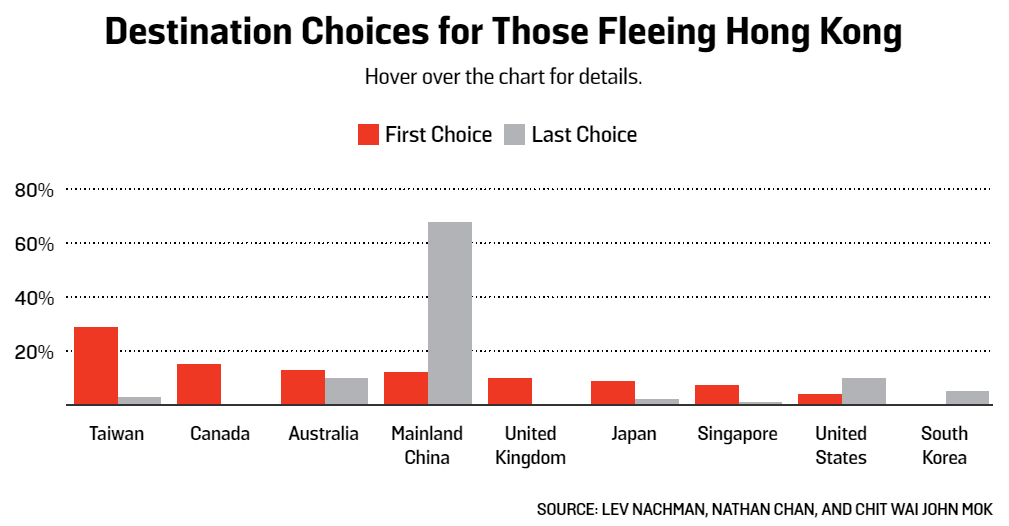
Hongkongers are nonetheless more concerned about the national security law. In a survey done by Foreign Policy magazine on 890 Hong Kong residents, about half of the respondents said they were considering moving out of the city.
Source: Foreign Policy
29% of them consider Taiwan the top destination, with Canada and Australia completing the podium (15% and 13%, respectively). 12% are considering moving to the Mainland.
Only 10% are taking the UK into consideration, despite plans by the British government to offer the right of stay to 3 million BN(O) holders, as we reported last week.
Europe Takes No Harsh Stance
Europe hesitates to make strong statements on Hong Kong (such as offering refuge), as this would put it on a collision course with Beijing and could backfire in other dimensions of the relationship.
France and Germany are lobbying the EU to ban exports of police equipment to Hong Kong, and they are also pushing the EU to offer long-term refuge to political activists and to provide grants to Hong Kong students.
Nonetheless, no strong statements were issued criticizing the Mainland’s actions out of fear that if they categorized the actions as oppressive it would jeopardize economic relations with China.
Germany, in particular, has a special trading relationship with Beijing. Nonetheless, it has in the past offered asylum to Hong Kong protesters without large political statements.
In 2017, Ray Wong and Alan Li, two Hong Kong activists, were granted asylum in Germany. However, news of this decision only surfaced in 2019, so as to not target China directly.
An institution that did take a clearer stance was, once again, the European Parliament. The EP president and the leaders of the political groups argued the EU is open for dialogue but that, if China does not show progress to withdraw the law, “the EU will consider taking appropriate measures”.
Five Years of 709
These discussions coincide with the five year commemoration of the ‘709 Crackdown’, when over 300 human rights lawyers and defenders were arrested in China.
The German Council Presidency and the EEAS issued statements commemorating the crackdown (the EEAS does it annually), calling to release the detained, and to respect their fundamental rights.
The two statements come days after Xu Zhangrun, a professor at Tsinghua University, was arrested for his criticism aimed at the top Chinese political leadership. Xu, one of the better-known critics of the CCP, published critiques aimed at the party, including a February essay that decried Xi Jinping’s handling of the virus, as well as a collection of essays in June. On July 11, news emerged that Xu was released and had returned home.

TAKEAWAYS
► THE POWER OF GESTURES
As it appears from the survey from Foreign Policy, the EU is unlikely to be one of the top destinations for Hong Kongers fleeing the city, who seem to prefer countries that already have significant Chinese ethnic minority groups, such as Australia and Canada. However, the EU’s response on Hong Kong and support for Hongkongers is a highly political and important matter. It is also not only about helping those fleeing persecution. This could be attempted by applying a low-key approach as Germany has in the past. It is also about a message of the EU’s stance when it comes to human rights and rule of law breaches.
The response will surely be watched closely in Beijing, which may interpret it in a wider context, as the leadership is likely anxious about the possibility of a joint response by democratic countries. This comes in the context of the three-day trip by Robert O’Brien, President Trump’s national security adviser to Europe to discuss China policy starting on July 13 and the upcoming proposal of an EU response on Hong Kong set to be presented by German Presidency on the same day.
A sign of Beijing’s uneasiness was China’s Foreign Minister Wang Yi’s speech on July 9 addressing the China-US Think Tanks Media Forum,in which he noted that the US-China relationship “is facing its most serious challenge since diplomatic relations were established”. It is a considerable development given that this acknowledgement came from a top official.

READ MORE
China passes national security law on Hong Kong, but creates more inflows - CNBC (Weizhen Tan), Jul 6
Hong Kongers Lean Toward Taiwan for Emigration as Beijing Chokes City - Foreign Policy (Lev Nachman, Nathan Kar Ming Chan, Chit Wai John Mok), Jul 8
Global allies step up retaliation for China crackdown in HK - Financial Times (Michael Peel, Joe Leahy, Ben Hall), Jul 9
Trump national security adviser heading to Europe for talks on China - Politico (Daniel Lippman), Jul 11
2. Huawei Developments in EU’s Three Biggest Telecom Markets
Huawei’s status in the EU’s largest telecom markets is slowly becoming clearer. Most likely we are looking at no ban in Germany, a phasing out in France, and uncertainty in Italy.
► In Germany, Deutsche Telekom is unlikely to ban Huawei in its 5G infrastructure. This falls in line with the preferences of Angela Merkel and the German Minister for Economic Affairs and Energy, Peter Altmaier;
► In France, the government did not ban Huawei, but it did encourage French companies to avoid its technology, in order to gradually phase out Huawei’s role in 5G infrastructure;
► In Italy, Telecom Italia excluded Huawei from its 5G core equipment tender, but Italian policymakers are split on the question of banning Huawei altogether.
Germany - Deutsche Telekom
DT, the largest telecom company in Europe—which operates in over 50 countries, including 17 member states, and serves 184 million clients—has a complex relationship with Huawei.
The German telecom giant is also the largest shareholder of American operator T-Mobile. According to some estimates, Huawei provides 65% of DT’s base stations and antennas, and is working to upgrade its 4G radio access networks.
Last week, news emerged that Deutsche Telekom bolstered its strategic partnership with Huawei in May 2019. The partnership implied that Huawei would bear any costs induced by US restrictions and offer DT a “care-free package” that also acts as a show of Huawei’s reliability in the face of sanctions.
In turn, DT maintained that Huawei was “key for our 5G plans” and internal documents described a potential Huawei ban as an “armageddon”.
Similarly, Huawei commissioned its Chinese equipment makers to prepare emergency stocks of spare parts in countries where DT was operating - Germany, Poland, Czech Republic, the Netherlands, and Austria.
A parliamentary coalition in the Bundestag criticized the German government (which still holds a 32% share in Deutsche Telekom) for prioritizing a Chinese company over the warnings of German security authorities. Criticism came from important voices such as the SPD economic policy spokesman, Bernd Westphal, German Foreign Minister Heiko Maas, and CDU heavyweight Norbert Röttgen.
The German federal government has still not issued legislation in accordance with the EU’s 5G toolbox. The government asked its three largest telecom providers—Deutsche Telekom, Vodafone, and Telefonica—to wait for a decision.
However, all three already use Huawei equipment, and the latter two have ignored the government and officially announced Huawei as a partner in rolling out 5G technology.
T’s partnership comes in the context of Merkel’s political calculation on the country’s relationship with China, which we will dive into in the next news bite.
France - Phasing Out
On July 5, the head of the French cybersecurity agency ANSSI declined to institute a total ban on Huawei technology, but encouraged operators to opt for alternatives.
This has important implications for those who already use Huawei equipment, such as Bouygues Telecom and SFR, two of France’s four biggest operators.
For cases where Huawei is already used, authorizations will be granted for 3-8 years, after which the operators concerned will have to gradually phase out their agreements with Huawei.
Operators with no current tie to Huawei will be barred from adopting their equipment.
Italy - TIM is Certain, the Government Isn’t
On July 9, Telecom Italia (TIM), biggest Italian telecom, excluded Huawei from a tender on its core 5G equipment, which will be built in Italy and Brazil.
The decision was motivated as part of its “suppliers’ diversification policy”, although Huawei could still be invited to rejoin the tender in Brazil later on.
The Italian government is also considering excluding Huawei from the 5G network, with the newspaper La Repubblica announcing that the proposal was brought up informally by Economy Minister Roberto Gualtieri and Defence Minister Lorenzo Guerini.
However, the Italian government is divided on the issue, as the two parties forming the coalition government have taken divergent stances. Overall, the Democratic Party prefers a ban, while the Five Star Movement has been dismissive of security dangers.
The CCCEU’s Reaction and the UK
On July 9, the China Chamber of Commerce to the EU declared itself “perturbed” by the measures taken by some EU countries on the 5G toolbox.
The CCCEU accuses these member states of not using evidence-based technical criteria and of targeting “many excellent Chinese multinationals”, citing Huawei and ZTE.
Similar statements were raised towards the UK, after the British government moved to limit Huawei’s role in building 5G technology. PM Boris Johnson said he would give an update to parliament by July 22 on how to proceed with the phasing out, while Huawei is requesting an urgent meeting with the PM.
Liu Xiaoming, the Chinese ambassador to the UK, retaliated, saying: “We want to be your friend. We want to be your partner. But if you want to make China a hostile country, you will have to bear the consequences”.

TAKEAWAYS
► THE COMMISSION WANTS TO MOVE FORWARD
The Commission is eager to speed up 5G implementation and employ it as a key driver of post-pandemic economic recovery also aimed at digitizing the European economy. In late June, it adopted a 5G regulation related to small antennas, which help deliver “high-capacity and increased coverage, as well as advanced connection speeds”. The Commission called on member states to not put administrative hurdles in the way of a fast rollout of 5G infrastructure.

READ MORE
How US restrictions drove Deutsche Telekom and Huawei closer together - Politico (Laurens Cerulus), Jul 6
„Telekom schuldet uns eine Erklärung“: Koalitionspolitiker kritisieren Abhängigkeit von Huawei - Handelsblatt (Moritz Koch, Stephan Scheuer), Jul 7
France won't ban Huawei, but encouraging 5G telcos to avoid it: report - Reuters (Michel Rose, Jan Harvey), Jul 5
Italian government split over Chinese 5G tech adoption - Formiche (Otto Lanzavecchia), Jul 9
Boris Johnson set to curb Huawei role in UK’s 5G networks - Financial Times (Sebastian Payne, George Parker), Jul 12
The CCCEU position on EU and member states enforcing 5G security toolbox - China Chamber of Commerce to the EU, Jul 9
3. The EU-China Diverge - Centralization and Open Strategic Autonomy
As Brussels policy-making circles plan to make the EU less dependent on third countries in critical sectors, Beijing announced it will further centralize its economic recovery by relying on state-owned enterprises.
► On July 8, China announced a three-year (2020-2022) plan that would enhance the role played by state owned enterprises in the economy;
► More and more top EU politicians have adopted the term “open strategic autonomy” to symbolize an EU that is both open to the world and realistic about its interests;
► A Trade Policy Review was launched by DG TRADE in mid-June to reassess the EU’s trade policy in the context of China’s rise, US isolationism, and the pandemic-induced economic contraction.
SOEs Get A Boost
SOEs played a critical role in the pandemic response, providing PPE and ensuring the smooth operation of utilities. The central government has now decided to also grant them a central role in the post-pandemic economic recovery over the next three years.
The announcement was made in the SOE action plan for 2020-2022 endorsed by a meeting of the Central Comprehensively Deepening Reforms Commission, headed by Xi Jinping himself.
According to a report by Xinhua on the meeting, SOEs are “an important material and political foundation for socialism with Chinese characteristics” and “the key pillar and force for the party’s rule and the country’s revitalisation”.
The primary motives are related to fending off the economic challenges posed by the pandemic, as well as US economic decoupling.
The decision goes against expectations by the EU for China to adopt a more free market economy and to gradually reduce the monopolistic influence of SOEs in critical sectors of the economy.
Companies from the EU, US, and Japan have long complained that SOEs receive plenty of state support, despite having a dismal return on assets of just 0.7%. Some local governments hope joint ventures will bridge the gap, but it is unlikely that this will resolve problems with inefficiency.
According to official data, China has around 130,000 SOEs, with 97 of them especially important. They are industrial conglomerates that report directly to SASAC, and include the China National Petroleum Group, State Grid, and China Mobile.
Excluding state-owned banks and other financial institutions, Chinese SOEs have combined assets of 210 trillion yuan (US$29.9 trillion), of which 80 trillion yuan is owned by the central government (the rest is owned by local governments).
Open Strategic Autonomy
The idea of “open strategic autonomy” is gaining more traction in Brussels, attaching a dose of realism to the EU’s commitment to a multilateral global order.
The term is not synonymous with protectionism. Rather, as MEP Iuliu Winkler put it (as noted in our July monthly report), it is about promoting trade diversification, in order to uphold a free and fair global trading system.
It is “open”, in the sense that it commits the EU to global cooperation and to free and fair competition. On the other hand, it is “strategic”, because it takes a pragmatic view on how the EU should use its power to shape the international system.
The principle has seen many supporters across the highest EU echelons, including HR Josep Borrell, who has argued that open strategic autonomy will allow the EU to defend its interests, by itself if necessary. Further support for the idea came from the, Commissioner for Competition, Margrethe Vestager, and Trade Commissioner Phil Hogan
Trade Policy Review
On July 6, Trade Commissioner Hogan met with the European Parliament International Trade Committee to hear the MEP’s views on the Trade Policy Review launched on June 16.
The Trade Review seeks to address the undermined multilateral, rules-based global order, which has been challenged by the rise of China, as well as by the United States’ retreat from its leadership role.
The Review is also a response to the economic crisis caused by the pandemic, which is expected to make the EU economy contract by 7.4%, while global trade is expected to drop by 10-16%.
Hogan stated the EU needs its “trade and commercial engines to be firing on all cylinders” in order to allow for a swift, sustainable, green, and digital recovery.
Importantly, Hogan acknowledged the world has changed from the last Trade Review published five years ago, but argued the EU “must use [its] influence to shape that change” if it wants to maintain its role of global leadership.

TAKEAWAYS
► THE UNLIKELY CAI
SOEs played a crucial role in containing the virus and manufacturing PPE during the zenith of the pandemic in China. Now, they have also been designated to be the main economic drivers of the post-pandemic recovery. In turn, the EU is seeking more ‘open strategic autonomy’, which means economic securitization of the block. Consequently, Chinese companies (particularly SOEs), inhibited by legislation on FDI screening and foreign takeovers, will have less investment options in the European market.
In such circumstances, a CAI agreement reached during the German Council presidency seems unlikely. The EU side conveyed its stance that, within CAI negotiations, China needs to level the playing field, since the EU market is already open. The EU and China are further diverging in their expectations of each other (which were supposed to be settled in CAI negotiations). China is showing clear signs that it will not pursue SOE market reform and the EU is arming itself to protect the single market, which in turn hurts Chinese interests, making Beijing more defensive. An agreement seems far from within reach.

READ MORE
China approves plan to boost prominence of state firms, despite complaints from trade partners - South China Morning Post (Frank Tang), Jul 8
EU Strategic Autonomy: Opening Up? - American Institute for Contemporary German Studies (Peter S. Rashish), Jul 7
Introductory remarks by Commissioner Phil Hogan at the European Parliament's INTA Committee meeting - European Commission, Jul 6
4. Germany’s China Policy Reexamined - Merkel, Critics, Dependency
The pandemic has highlighted Germany’s hesitation to tackle sensitive issues related to China, fearing economic backlash from its largest trading partner (outside of the EU).
► Angela Merkel’s China policy of commitment to maintaining positive ties with Beijing drew criticism from different leading German political figures;
► Sino-German economic relations have grown exponentially since 2008, which have created a rhetoric of German dependence on trade with Beijing;
► However, this dependence should be understood not only in light of Germany’s higher tradeflow with the Visegrad 4 and the internationalization of German companies, but also on the relocation of ICT work to China.
The Sino-German Economic Relation
With a trade volume of €206 billion, the Sino-German trade relation is Germany’s largest (other trade within the EU). Maintaining this good relationship has been important for Merkel.
Since Merkel became Chancellor 15 years ago, German exports to China have risen fivefold, including through the dire times of the 2008 global financial crisis, when trade with China saved the German economy from collapsing. In this context, Merkel reiterated on July 7 that ties to China are “of strategic importance”.
German businesses operating in China share this sentiment. After Merkel’s visit to Beijing in September 2019, Joe Kaeser, the head of Siemens, said: “If jobs in Germany depend on how we deal with controversial topics, then we shouldn't add to indignation, but rather carefully consider all positions”.
Merkel Criticized
Amid the pandemic and the developments in Hong Kong, Angela Merkel’s stance on China has been a subject of increased criticism in Germany from different political groups.
Norbert Röttgen, a main voice in the CDU and the head of the Bundestag foreign affairs committee, accused the Merkel cabinet of promoting self-censorship, after the ministry of foreign affairs advised Germans in Hong Kong to not speak out against the national security law.
Nils Schmid, the foreign policy spokesman of the Social Democrats, called Merkel’s stance “behind the times” and said her belief in a China that will change through trade is “out of date”.
The German Social Democrats added to the criticism, issuing a position paper which calls for human rights and the rule of law to be an “elementary component of all areas of German and European cooperation with China”.
MEP Reinhard Bütikofer (Greens/Germany), the EP chair of the delegation for relations with China, said Merkel does not understand that the dialogue pursued ten years ago with China is not suitable for Beijing’s development as an “increasingly totalitarian regime with a claim to hegemony”.
Irrespective of such tendencies, the German auto sector has been pushing for closer ties with China. Over the past five weeks, Volkswagen, BMW, and Mercedes took decisive steps to establish joint ventures and deepen existing partnerships that would allow them to enter the battery and electric vehicle market in China.
What Sort of ‘Dependency’?
At the current time, EU-China trade relations stands at a trade volume of almost $400 billion in goods, complemented by European FDI in China, as well as technology transfers and know-how.
China views some countries as more strategic than others. In terms of political and economic relations, Janka Oertel argues “Germany remains the key player for Beijing within the EU”.
For Germany, trade with China has been particularly important, especially since 2016, when trade with China overtook, in volume, trade with the US.
This shift ignited a wave of euphoria in the German media, which employed it to dismiss Donald Trump’s isolationist policies and to tout China as replacing the US in promoting free trade and globalization.
Is It Dependency At All?
According to a study by Zhu Yi, a researcher at the Institute of China Studies at the University of Heidelberg, German media reinforces a narrative that the country has become dependent on trade with China, a stance that may not be true.
As Chinese companies turned from partners to competitors, large German companies and associations warned against “too much dependence on the Chinese market”, as was expressed in a position paper by the BDI in 2018.
Amid the pandemic, the EU’s dependence on medicine produced in China further exacerbated narratives of overreliance on China, with the main German newspapers calling to reassess the dependence on global supply chains in critical sectors.
However, the picture of China as Germany’s largest trading partner is only partially true. If the EU single market is taken into account, Germany’s trade volume in 2018 with the Visegrad Four (Czech Republic, Hungary, Poland, Slovakia) totaled €294.6 billion, which was higher than the €199 billion with China.
In addition, a 2019 study on Germany’s value-added exports to China revealed that “more than 97 percent of the total economic value added does not depend on exports to China”. In fact, even if exports to China had not happened, Germany’s nominal economic growth would have still hovered around 30%.
Furthermore, the often touted narrative of the German auto sector’s dependence is more complex. For example, Volkswagen’s profits in China (€4.6 billion) do not fully account for its overall profits. This is because Volkswagen is reinvesting its profits into the Chinese market, in order to finance its investment plan; this makes Volkswagen less a German and more a transnational company.
In addition, a 2015 study by the Bertelsmann Foundation found that China needs Germany more than vice versa. That is because China imports from Germany most of the machinery used in its strong exports industries. While slightly outdated, the study shows an important dynamic.
German comparative dependency on China should not be overestimated. In fact, Germany is by far more tied to the €777 billion in German exports to EU countries, a figure that is seven times higher than the trade on the Berlin-Beijing axis.

TAKEAWAYS
► THE CORE DEPENDENT
The outlook on China in the EU seems to be shifting over the last few months. Janka Oertel (Director of the Asia Programme / ECFR) argued that in Europe “in the balance between challenge and opportunity, China has moved much more to the challenge camp than the opportunity camp” and Mikko Huotari (Executive Director / MERICS) stated that "Partnership with China is no longer the default position."
But even if other member states have taken some steps to limit the weight of their relations with Beijing, Germany remains an actor big enough to tip the balance. If Berlin decides ‘business as usual’ should remain the norm (as Volkswagen, Daimler, and Mercedes seem to already believe), it is hard to envision a meaningful change in the EU’s China policy.
Nonetheless, questions remain whether Germany’s dependence on trade with China is not a self-fulfilling prophecy. Whatever decision Germany takes, it will inevitably affect multiple EU members, whose economies are highly interlinked with the country. For things to change, German politicians would first have to closely reassess the reality of their alleged dependency and provide the impetus to limit the constraints that this reality creates on the country’s foreign and domestic policy on China. As Germany has just assumed the presidency of the Council, even more importance will be attached to the course it opts to take. The German proposal for an EU response on Hong Kong that is to be unveiled by Heiko Mass on July 13 is definitely an important signal to watch out for. But another interesting signal was the decision of the German MFA to change the flag of Republic of China to a white flag on its website in the “Taiwan” section.

READ MORE
Merkel comes under fire at home for China stance - Financial Times (Guy Chazan), Jul 7
A social democratic policy on China – assertive, rule-based and transparent - SPD, Jun 30
How Dependent is Germany on China? - Echo-Wall (Zhu Yi), Jun 10
5. A Compromise Proposal for EU’s Recovery Fund and MFF
On July 10, European Council president Charles Michel issued a compromise proposal for the negotiations on the Next Generation EU and the EU budget (‘MFF’) for 2021-2027.
► The NextGen EU recovery fund would be maintained at the threshold of €750 billion proposed by the Commission, but the MFF would be slightly reduced;
► Dutch PM Mark Rutte, one of the key voices opposing the proposal, implied he is ready to negotiate, but did not clearly articulate his stance on the compromise;
► Rule of law emerged as one other contentious topic, as Hungary protests inclusion of such a conditionality.
Michel’s Compromise
In an effort to reach an agreement before the European Council meets on July 17, Charles Michel published a compromise proposal on July 10.
His proposal maintains the €750 billion recovery fund proposed by the Commission (‘Next Generation EU’), which is split into €500 billion in grants and €250 billion in loans.
Michel budged on the 2021-2027 EU budget (MFF - multiannual financial framework), which would be reduced from €1.21 trillion to €1.074 trillion.
Somewhat ironically - given the Commission’s geopolitical aspirations - the biggest cuts are proposed is the EU’s external and development spending. With an expected cut of €4.7 billion.
Net contributors (such as the ‘Frugal Four’) would still receive rebates on their contributions, in the form of lump sums, while the EU would also maintain powers to create new sources of revenue from taxes on plastic waste, carbon footprints, and digital transactions.
An additional €5 billion Brexit Adjustment Reserve would be created, to aid countries and sectors most affected by Brexit. At the same time, Michel was criticized by researchers for cutting €5 billion from the research program Horizon Europe (which may not necessarily be linked to the Brexit Fund).
Opinions on the Proposal
Dutch PM Mark Rutte signalled he is ready to negotiate by saying he will leave “his Chopin biography at home”, a reference to the European Council in February, when he brought the book to show he wasn't expecting a deal to be struck. However, he did not express clear support for the proposal.When asked about dealing with combined pressure from other EU leaders, Rutte said he is “not made of marzipan”.
It seems a deal during the European Council is rather unlikely. People familiar with the negotiations said anonymously that “there’s still a long way to go”, with Angela Merkel also indicating she finds it difficult for an agreement to be struck on July 17.
On July 9, the 19 eurozone countries elected Irish finance minister Paschal Donohoe as the President of the Eurogroup. He is tasked to find consensus on an agreement for the recovery fund and for the MFF 2021-2027.
Rule of Law
Commissioner for Values and Transparency Věra Jourová argued for a further layer of conditionality, stating that “the rule of law should be the condition for distribution of EU money.”
The idea was echoed by the European People’s Party, which stated the “EU is not a cash machine for countries that disregard fundamental rules”.
The proposal would directly impact Hungary (but also Poland, which has just narrowly reelected President Andrzej Duda from the ruling Law and Justice party). Viktor Orban said he will veto any proposal to include the rule of law as a conditionality: “there will not be an economic restart, there will not be a budget, there will be drawn-out debates”.
Angela Merkel suggested last week it is more important to first settle on a sum before deciding on conditionality: “For funds to be associated with the rule of law at all, funds are needed in the first place”.
Her statement drew criticism, particularly from EPP MEP Daniel Caspary, who threatened the European Parliament will veto the deal if it does not solve the rule of law issue.

TAKEAWAYS
► BETTING BIG OR STAYING SAFE?
The idea raised by Jourová and the EPP, among others, on the rule of law is slowly turning into a big gamble. Negotiations on the budget are already expected to slow down due to disagreement from the Frugal Four, so adding conditionality on the rule of law at this stage would truly amount to a “go big” decision.
On the one hand, this would signal that the new Commission is not willing to allow breaches on fundamental values, which has been a constant headache for the Juncker Commission. On the other hand, the fact that Merkel does not support the initiative shows she subscribes to a strategy of waiting out populist governments, perhaps out of fear that harsh punishment will lead them to seek Brexit-like avenues.

READ MORE
Factbox: EU's Michel lays out compromise proposal on bloc's COVID stimulus - Reuters, Jul 10
Overview of Michel's proposal, Jul 2020
Rule of law a must before getting EU money, Jourova insists - Euractiv, Jul 7