EU-China Briefing - 6 July 2020
YOUR WEEKLY SHOT OF EU-CHINA NEWS
BY FLAVIAN BERNEAGĂ AND GRZEGORZ STEC
1. Hong Kong National Security Law Enters Force
On June 30 Hong Kong adopted a controversial national security law, which has been under preparation since the Two Sessions.
► The law is tougher than anticipated. It will be enforced by a Mainland state-backed agency with powers to take over cases and operate outside of Hong Kong’s legal jurisdiction;
► Multiple countries moved to take retaliatory measures, but contradictory positions emerged at the UN Human Rights Council, with 53 countries defending the law and 27 condemning it;
► The UK is moving forward in offering the right of residence to Hongkongers with BN(O) status. This has been met with pushback from Beijing.
The Law Explained
Under the new legal framework, Mainland authorities are given effective jurisdiction over cases related to broadly defined national security cases in Hong Kong, both inside and outside China.
The main offences (separatism, subversion, terrorism, and collusion with foreign countries) carry a maximum life imprisonment sentence. The wording is ambiguous and leaves room for interpretation.
A Committee for Safeguarding National Security, operating without legal accountability, will monitor schools, corporations, NGO’s, and businesses in secret, while a local police unit will gather intelligence and investigate cases. Neither will be subject to local law enforcement.
Importantly, under Article 38, the law extends to offences committed outside the Hong Kong Special Administrative Region “by a person who is not a permanent resident of the Region”.
While the breadth of the law is aimed at covering, most likely (and questionably), the Hong Kong diaspora. But in theory, any foreigner arriving in Hong Kong who falls under the criminal charges can also be arrested, extradited to the mainland, and charged.
The law also applies to businesses in Hong Kong. If found in violation of the law, the respective company may be issued a fine and have its operations suspended or its business permit revoked.
International Responses
In a UN Human Rights Council statement on June 30, a divide formed on opinions on the national security law: 53 countries endorsed the Mainland’s actions, while 27 condemned them.
Following the statement at the UN, more than 20 other countries provided statements of support for China. Among others, they stressed the law is a matter of national sovereignty for China and made calls for ‘de-politicizing’ human rights issues.
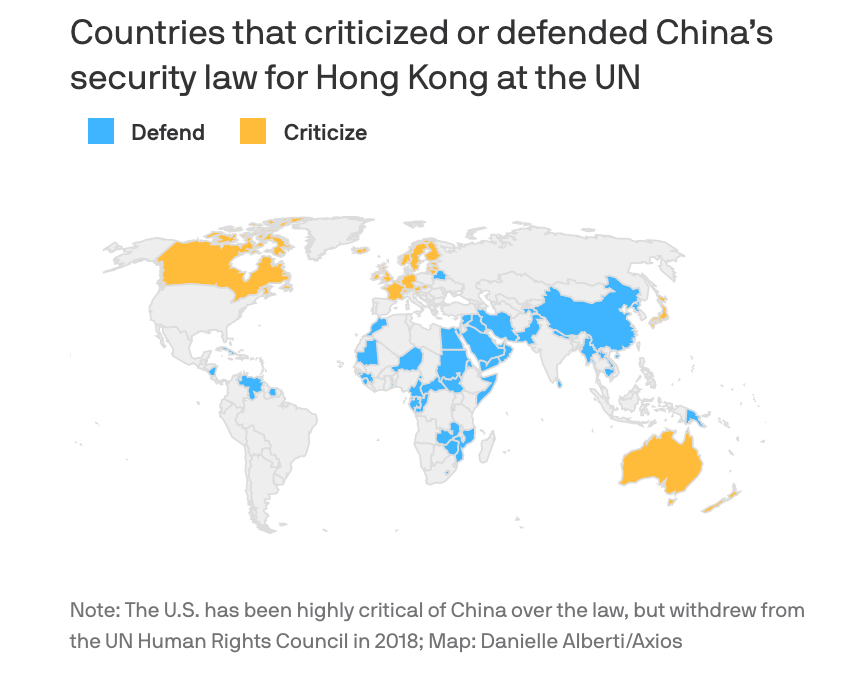
Source: Axios
The IPAC issued a statement calling on governments to reassess their relations with China, to offer protection to Hongkongers fleeing persecution, and to ask the UN to send a special envoy to Hong Kong.
The IPAC statement follows its recent stance on findings of a report by IPAC advisor Adrian Zenz, on forced sterilizations and abortions among Uyghurs in Xinjiang.
In the United States, the Commerce Department suspended preferential treatment and export license exceptions for Hong Kong, with the expectation that this will seriously affect Hong Kong’s re-exportation prowess.
Also, the State Department banned military equipment and technology sales to Hong Kong, just one week after it imposed visa restrictions on Chinese officials who backed the legislation.
In Canada, Justin Trudeau suspended the existing extradition treaty, which marked the first country to break law enforcement links with Hong Kong. He further issued a travel advisory and announced a ban on exports of sensitive military equipment.
UK’s Citizenship Promise
In the United Kingdom, Boris Johnson vowed to honour his promise of offering 3 million BN(O) holders relocation rights and a path to citizenship, as we reported in early June.
Johnson: “We made clear that if China continues down this path, we will introduce a new route for those with BN(O) status to enter the UK [...] with the ability to live and work in the UK, and thereafter to apply for citizenship, and that is precisely what we will do now”.
China retorted by saying the UK will “bear all the consequences” and arguing the measure is a breach of the agreements between the two countries. This comes just days after China argued the Sino-British declaration was a mere historical document without any legal meaning.
If China won’t acknowledge the citizenship scheme, those holding it will be considered Chinese nationals solely upon returning to Hong Kong and will be exempted from British consular services. (The case of Swedish citizen Gui Minhai sheds light on how Beijing might handle this.)

TAKEAWAYS
► CHINA SPLIT
The list of countries that supported China’s national security law and the list of signatories of a UN letter in July 2019 that supported China’s detention camps and “vocation education centres” in Xinjiang are both dominated by developing countries, predominantly from Africa and the Middle East. Those in opposition to China are from North America, Europe, and Australia.
Beijing’s influence in the developing world seems to be growing compared to the broadly-defined West. While these developing countries are expressing independent choice, this rift on China presents yet another challenge for Ursula von der Leyen’s “geopolitical Commission”. Recall that before the pandemic hit, von der Leyen, Charles Michel, and 20 Commissioners went to Addis Ababa to express the EU’s wish for a stronger partnership with the African Union. The UN voting pattern shows part of the challenge ahead.

READ MORE
You, yes you, are subject to Hong Kong’s new security law - Politico (David Wertime), Jul 2
The 53 countries supporting China's crackdown on Hong Kong - Axios (Dave Lawler), Jul 3
How Should Democracies Respond to China’s New National Security Law for Hong Kong? - ChinaFile, Jun 30
2. EU’s Response on Hong Kong
EU member states and institutions voiced consistent concerns about the law, but have not yet adopted a clear line of action in respons:
► 15 member states condemned the law within the UNHRC statement on June 30;
► The German Presidency of the Council implied the law would alter relations with China, but did not indicate what this might entail;
► The European Parliament launched an Informal Hong Kong Watch Group, comprising 5 MEP’s.
The Immediate Reactions
Member states, the EEAS, and the European Commission independently condemned the national security law, which drew criticism from China’s mission to the EU.
15 EU member states took a public stance at the UNHRC against the Hong Kong law: Austria, Belgium, Denmark, Estonia, Finland, France, Germany, Ireland, Latvia, Lithuania, Luxembourg, the Netherlands, Slovakia, Slovenia, and Sweden.
On July 1, HR Josep Borrell issued a statement that reiterated the EU’s concerns and vowed to “continue to raise its concerns in its dialogue with China”. However, the statement did not specify any actions the EU would take in response.
Similarly, Ursula von der Leyen expressed her belief that the EU must take a “confident and [...] united position”. She argued China also has an interest in maintaining Hong Kong’s status as “the most important hub for China’s economic exchange with Europe” and said the EU was cooperating with international partners on a response.
In reply, China’s mission to the EU stated the law is in alignment with the principle of “One Country, Two Systems”, and called on the EU to “abide by international law”, “stop meddling in Hong Kong”, and “stop interfering in China’s affairs”.
The German Council Presidency Response
The German Council presidency, through German Foreign Minister Heiko Maas, described the situation as “extremely worrying”. Maas argued that the EU’s relationship with China will be affected and called on the EU to take a “strong stand”.
Angela Merkel also expressed concerns over the “erosion” of Hong Kong’s autonomy and said she will continue bringing up the human rights issue in dialogue with China.
Nonetheless, Merkel drew some criticism for not offering special asylum rights to Hongkongers and for taking a passive stance by indicating she will limit herself to not standing in the way of a UN Security Council debate on human rights in China.
The European Parliament’s Response
On June 30, five MEP’s from five political groups and member states launched a Hong Kong Watch Group.
The 5 MEP’s are: Reinhard Bütikofer (Germany/Greens), Miriam Lexmann (Slovakia/EPP), Petras Austrevicius (Lithuania/Renew), Anna Fotyga (Poland/ECR), and Juan Fernando Aguilar Lopez (Spain/S&D).
Although the group is informal in nature, it plans to co-opt other MEPs across the political spectrum, and to work with political leaders from other democracies, including the UK Parliament and the US Congress.
The Group urged the EU to “show that this behaviour can and will not be tolerated” and that “it comes at a price”.
Bütikofer, the Chair of the China Delegation in the European Parliament, made an address in which he said “The Hong Kong we knew is dead” and he made calls to take China to the ICJ, send a UN special envoy to Hong Kong, withdraw Hong Kong’s trade privileges, sanction individuals that violate human rights, and offer a safe haven to those fleeing Hong Kong.

TAKEAWAYS
► WORDS, WORDS, WORDS
Expressing ‘grave concerns’ is a statement, but it does not amount to a policy, and the EU continues to steer clear of punitive measures over Hong Kong. The issue is indeed complex and requires close consideration, because it can decisively alter both Hong Kong’s future (for the worse) and relations with Beijing, so the Commission—having to consult with 27 member states—is somewhat justified in treading lightly.
However, time is short and the EU’s position as a global actor will be undermined if member states do not come to agreement on a common action. Both Borrell and Maas acknowledged this, as we detail in our next news bite. As Bütikofer put it some time ago: “we must show Beijing that if they don’t accept international law, that comes with a price”.

READ MORE
Declaration of the High Representative on behalf of the European Union on the adoption by China’s National People’s Congress of a National Security Legislation on Hong Kong - Council of the European Union, Jul 1
Merkel says Germany worried over ‘erosion’ of Hong Kong’s autonomy - South China Morning Post (Stuart Lau), Jul 3
Tweet by Miriam M. Lexmann on the launching of Hong Kong Watch Group by the European Parliament, Jun 30
3. Maas and Borrell on EU's Future Strategy
On June 29, German Foreign Minister Heiko Maas and HR Josep Borrell joined the ECFR annual meeting, pointing to the direction in which the EU will be heading in the coming months.
► Maas talked about how EU solidarity will nurture further European sovereignty, allowing the EU to act independently in policy areas in which member states have lost the power to shape global outcomes;
► In a blog post related to the meeting, Borrell urged a strategic culture based on realism that recognises the increasingly competitive international system;
► Both spoke of the EU’s need to have a single line of policy on China, in order to respond to its challenges and adopt a level playing field.
Maas - Solidarity and Sovereignty
Heiko Maas stated the German Council Presidency’s programme can be best described by two key words: solidarity and sovereignty.
He argued the two principles are “two sides of the same coin”, as a spirit of European solidarity would be conducive to a Europe that can defend its interests.
Maas pleaded that the Franco-German recovery agreement is a historic opportunity for solidarity that shouldn’t be squandered, and argued the German presidency wants to grant the EU more powers, which would allow it to function in a world where the “global balance is shifting rapidly – away from Europe.”
For Maas, European sovereignty is not about distancing the EU from Washington, but rather about letting Europe “pool its resources in areas where the individual states have long lost their ability to shape globalisation”.
A first step would be to analyse Europe’s technological, security, trade, and monetary dependencies, as well as prepare the Union for the outcome of the US elections in November.
A second step would be to orient Europe’s attention to the virus’ impact in poor countries in need of help. Maas said that if “democracies do not provide it, others will do – at a price that will in the long-term be significantly higher”.
Borrell - Strategic Autonomy
HR Josep Borrell talked of the EU’s need for “strategic autonomy” rooted in realism, that will allow the EU to become a world power along the lines of the US and China.
Borrell argued it is insufficient for Europe to self-categorize as a soft power. Instead, it must grasp the world in its complexities of competition, and “learn to speak the language of power’, just like the US, China, Russia, and Turkey do.
To achieve this, the EU should “avoid both nostalgia for a world that will not return and fatalism”. Instead, it should leverage its valuable bargaining chips (a single market, investment, research, and visas) in a better way, and further develop its security and defence capabilities.
Maas and Borrell on China
Both speeches contained references to actions the EU needs to take in order to adapt to the challenges posed by China.
Maas argued it is “indispensable for Europe to speak with a single voice to China”, which will prove essential in investigating the origin of the virus, and responding to the situation in Hong Kong. “For this reason”, he said, “we should reschedule the EU-China Summit as soon as possible”.
Borrell argued a more assertive EU stance will allow the EU to keep China accountable on its commitments to reciprocity, while also leaving room for cooperation “on issues where no global solution is possible without China”.
This comes one week after the ECFR study on the virus’ impact on EU citizens’ worldviews, which we summarized here.

TAKEAWAYS
► THE BEGINNING OF HISTORY
Backtrack to 2007, when Francis Fukuyama said the EU more accurately reflects what the world will look like at the end of history. The addresses by Maas and Borrell on the need for an increasingly realistic understanding of the world show how much we have drifted away from Fukuyama’s hopes.
The two speeches are an example of EU circles coming to terms with the fact that institutions meant to ensure a liberal democratic world are suffering a setback. This should not be perceived from a lens of defeatism or nostalgia (as Borrell advises), but should be grasped as the status quo of an increasingly chaotic global system.
The first step of a response ought to be the internal combustion that convinces member states they need to coordinate their efforts through the EU, if they still hope to set norms and values in the world.

READ MORE
Opening address by Foreign Minister Heiko Maas at the Virtual Annual Council Meeting of the European Council for Foreign Relations (ECFR) - Federal Foreign Office, Jun 29
The pandemic should increase our appetite to be more autonomous - European Union External Action, Jul 4
4. European Parliament’s Briefing on EU-China Relations - Overview
A document drafted by the European Parliamentary Research Service as briefing material for MEPs provides an encompassing and critical overview of EU-China relations in all policy areas.
► It asserts the pandemic has “amplified pre-existing political and economic challenges” and has created a need to respond to China’s disinformation campaigns, political influence, and economic coercion;
► The briefing then analyzes the relation from the four lenses of the Strategic Outlook: cooperation partner, economic competitor, negotiating partners, and systemic rival.
Cooperation Partner
The brief states that the EU and China cooperate in pursuing “effective multilateralism” and in upholding rules-based international order, but complains that China prefers “selective multilateralism”, with a different understanding of the world order.
Peace and Security - The EU and China converge on topics related to peacekeeping in Africa, stability in Afghanistan, and nuclear non-proliferation in Iran. However, this policy arena is marred by “fundamental ideological differences”, as the EU disagrees with China expanding its sphere of influence through the BRI and with China’s territorial claims in the East and South China Sea. As late as December 2019, China took a divergent path from the EU, in vetoing UNSC resolutions on Syria and Venezuela.
Climate Change - Both parties are committed to implementing the Paris Climate Accord, but the EU side has grown worried that China will not meet its emissions targets by 2030, as it has also not followed through with its promise to put in place a national emissions trading system modelled after the EU’s. Furthermore, the EU is worried that the pandemic has increased coal consumption, while discontinuing subsidies for renewable energies.
Sustainable Fishing - The EU and China cooperate on tackling overfishing, fishing in the Arctic, and ocean plastic pollution. However, China diverged in its WTO position about developing countries benefiting from fisheries subsidies. Most Chinese subsidies are capacity-enhancing (including fuel), one of the harmful subsidies the EU is attempting to remove.
Cooperation on Development in Africa - Both sides are committed to the 2030 SDGs and the Africa Renewable Energy Initiative, but they disagree on norms and values. China’s preferences for South-South cooperation (meaning between countries of the Global South) leaves out the EU, while the EU’s EU-Africa Strategy issued in March 2020 makes only one reference to China, stating that EU investment in Africa is almost six times higher than China’s (€222 billion vs. €38 billion).
Economic Competitor
Industrial Policy - The EU is concerned about China’s plans to become a global advanced tech leader by 2049 (pinned by the Made in China 2025 strategy) and moves that counter earlier promises to let the market play a greater role. Through its investments in R&D, China is catching up at three times the EU’s innovation performance growth rate. The impact on the EU is that fewer exports flow into China, while the EU is becoming more dependent on Chinese values chains and Chinese inputs for exports.
Lack of Market Access and Conditions Reciprocity - In 2019, China was the EU’s most trade-restrictive partner when it came to trade in goods, applying the most tariffs and the most ‘behind-the-border’ barriers, meaning non-tariff restrictions, such as technical barriers, subsidies, and overzealous regulations. Access in large sectors of the Chinese economy is dependent on equity caps, joint ventures, and forced technology transfers, while China has also benefited from international legal loopholes to apply large scale industrial subsidies supporting its own companies, especially SOEs. Issues also exist in intellectual property rights protection (China accounted for 60% of counterfeit goods detected by EU customs in 2018), foreign investment (China is the sixth most closed economy to FDI), and procurement (where China benefits from the EU open market, but restricts access to tenders in its own market). This year, the EU has taken important steps to curb the uneven playing field, through upgraded FDI screening legislation, a White Paper on foreign subsidies, and a decision by the EU to protect its strategic industries.
Security laws - The EU disagrees with Chinese cybersecurity legislation, which forces businesses in China to pursue data localisation and surveillance. The extracted data is accessible to the central government and can be used against EU interests, particularly when it comes to business information, trade secrets, or military secrets.
Research and Innovation - For the EU, China is one of the “least open science systems in the world”. Moreover, EU researchers drew attention to the dangers of knowledge leaks through exchange programmes and bilateral research programmes at Chinese universities. In the context of the pandemic, a lack of transparency hindered health cooperation, since Chinese government controls have sought to avoid references to China’s shortcomings in handling the virus.
Negotiating Partner
Deliveries and Outstanding Issues - In 2019, the EU and China finalized negotiations on an agreement on civil aviation safety and another on geographical indications. Nonetheless, negotiations remain outstanding on visa cooperation and combating illegal migration.
Rebalancing EU-China Investment Relations - More important negotiations are pending under the Comprehensive Agreement on Investment (CAI), which has been under talks since 2013 and is considered the most important instrument in balancing the playing field with China. The two sides still disagree on market access barriers in China, SOEs and transparency of state subsidies, and investment-related sustainable development provisions (specifically on labour rights, where China does not adhere to the main conventions of the ILO). Talks on the CAI have been slow because the uneven playing field requires the Chinese side to make comparatively more concessions than the more open EU, for which “substance prevails over speed”.
Connectivity Visions - The two parties sought to find convergence in the EU-China Connectivity Platform, which would see the building of transport corridors between Europe and China, including in the Balkans. However, they disagree on principles such as requirements of sustainability, transparency, or adherence to strict standards. While, in 2018, China has created a debt sustainability framework for BRI projects, its infrastructure projects still diverge from the ‘European Way’ of building connectivity.
Systemic Rivalry
Promotion of a Governance System - The EU is concerned about China promoting its system as a viable alternative to Western liberal systems, which has been more predominant since 2017 when, during the 19th CCP Congress, Xi Jinping promoted ‘Chinese wisdom’ as the cure for developing countries.
Reshaping UN - The EU is worried that Xi’s slogan of a ‘community of shared future of mankind’ is being repeatedly employed at the UN, which it perceives as a tool to accommodate Chinese thought into the international system. China has perpetually emphasized economic development over civil and political rights, and has stressed non-interference as a foreign policy priority when being questioned over domestic policy, a model for other non-democratic actors to follow. The EU is further worried that China has gained important leverage in the UN, by securing high-level positions in UN agencies and by filling a power vacuum in global governance left by the US.
China’s Alternative Institutions - China has established parallel structures that promote its ‘China solution’, starting with the Shanghai Cooperation Organization in 2001, and continuing with the Forum on China-Africa Cooperation, the Asia Infrastructure Investment Bank, the China-Arab States Cooperation Forum, the China - CELAC Forum, and the 17+1. These regional diplomacy structures add to a number of others which help Beijing shape regional and international norms, increasing China’s normative power.
Loans and development aid - Although Chinese lending has exceeded that of traditional lenders (i.e., the World Bank), China has not adhered to transparency standards and has opted for state-backed development lending, which also enhances its soft power credentials. This is particularly salient in Africa, where China is actively offering an alternative to EU principles of good governance.
Internet Governance and International Standardisation - China adopted a state-centred sovereignty-oriented approach to internet governance, which contrasts with the Western, liberal, multi-stakeholder bloc. As a result, China is pushing back on international standardization while promoting its own concepts of internet governance. Most recently, China submitted a proposal for new internet governance protocols, which determine how data passes through the Internet. China has also been keen to promote different technical standards (e.g. through the BRI and the Digital Silk Road), which have the potential to enhance economic dependence and sideline competitors using different standards.

TAKEAWAYS
► THE FIRST STEP
As the first step towards crafting a long-term strategy towards China is to acknowledge the situation, a high level assessment is needed of the complex EU-China relationship, which is well described through the four lenses of the Strategic Outlook. They constitute the backbone of how the EU perceives relations with Beijing.
The Parliament briefing—while focused on points of contention—is a good starting point for discussions on how to craft a more robust China policy, because it provides a comprehensive view of every aspect of the relationship. We strongly recommend sparing some time for this document.

READ MORE
European Parliament Briefing on EU-China Relations, Gisela Grieger (June 2020)
5. Privacy Challenge - Huawei, Bytedance, and GDPR
Over the past week, concerns emerged over the handling of data by Huawei and TikTok.
► A court in Düsseldorf ruled that Huawei breached privacy laws after it failed to provide its former manager with the data it collected on him;
► The Danish Data Protection agency opened an investigation on TikTok, to check whether it complies with GDPR rules on special protection for underage users.
Huawei - Germany
In early March, a German court ruled in favour of a former manager at Huawei, who asked the Chinese company to tell him “what data they had, what they had deleted, when they had deleted it and what data they still had on file”.
The court decided Huawei was in violation of all these requests, as well as failing to respect mandatory deadlines to disclose the information.
Huawei argued it had deleted all the files it had on the former manager, but it also refused to share how it manages its data, arguing the case is still ongoing.
After the passing of GDPR legislation, Huawei adapted its privacy policy and its end-user license agreement, but since the GDPR does not come with checks and audits, it is up to consumers to challenge alleged data privacy breaches.
This has opened a wider debate on whether the legislation properly protects the privacy of Europeans. In the past, the EU took adequacy decisions for US or Japanese companies, which allows them to transfer data in their home countries while increasing the EU’s privacy oversight and redress in those same countries.
However, this may prove almost impossible when it comes to China. Chinese companies transferring data to China will inevitably have to respect Chinese data law. This can create a major problem if the EU decides to restrict their operations for not upholding the GDPR.
Bytedance - Denmark, India, Reddit
Bytedance, TikTok’s parent company, has become the target of an investigation by Denmark’s data watchdog, the Danish Data Protection Agency.
The agency seeks to uncover whether TikTok is in line with GDPR standards on the privacy of underage users. In this case, the agency initiated a self-litigation case, because TikTok announced it will be moving the responsibility to safeguard the privacy of European users to its facilities in Ireland and the UK.
For context, recently a Reddit user, who claims to have reverse-engineered TikTok, has exposed that it collects a wealth of data well beyond what would seem necessary for the app’s operation. The harvested data is encrypted with an algorithm that changes with every update, so users don’t know how much data is collected.
Interestingly, these developments also come in the context of India banning 59 Chinese applications, including TikTok, citing threats to national security.

TAKEAWAYS
► LOOMING TROUBLES
The two cases can pose a great challenge for Huawei and Bytedance, two companies that had made significant breakthroughs in Western markets, compared to other Chinese corporations (e.g. Baidu, DiDi Chuxing). Importantly, the two cases come in the context of the general toughening of the EU line on cybersecurity and of the UK’s moves to eliminate Huawei from its telecommunication network.
As far as GDPR goes, these cases of personal privacy are covered (although they could very clearly benefit from additional powers to actively monitor cases of data privacy). However, if it turns out that Chinese companies are unwilling or incapable of respecting GDPR due to their domestic regulations, this could be another major point in an already heated debate on China’s cyber-challenge.

READ MORE
Huawei data flows under fire in German court case, Politico (Laurens Cerulus), Jun 29