EU-China Briefing - 29 June 2020
YOUR WEEKLY SHOT OF EU-CHINA NEWS
BY FLAVIAN BERNEAGĂ AND GRZEGORZ STEC
1. EU-US Bilateral Dialogue on China is a Go
During the Brussels Forum video conference on June 25, US Secretary of State Mike Pompeo agreed to join the EU-US dialogue on China suggested the week before by HR Josep Borrell.
► At the time, Borrell had pitched the idea of a dialogue, but Pompeo’s lack of interest made Borrell mention it was just a loose idea. This was a backtrack;
► Nonetheless, in a webinar for the Brussels Forum, Pompeo displayed unexpected interest in addressing challenges with China as “transatlantic partners”;
► The change of heart may be due to flak the Trump administration was taking because of John Bolton’s book, but also by the EU’s positions in its summit with China last week.
Borrell’s Suggestion Last Week
In a video conference with Pompeo on June 15, Borrell suggested initiating a transatlantic dialogue to tackle issues related to China.
The two exchanged views on China’s “growing assertiveness on many fronts”, but did not spend more than 20-25 minutes on the topic within a 3 hourlong call.
Borrell himself described that idea as “a suggestion that I put on the table during my conclusion, but nothing more than that.”
Pompeo Decides to Tango
Despite initially not displaying pro-dialogue sentiments, Pompeo surprised everyone during a webinar 10 days later, where he showed proactive support for the idea.
He stated that the US was “very interested” in the proposal from the beginning and said he is hopeful teams will be put in place in the upcoming weeks to sort out details.
While he said he did “not know exactly what final shape it will take,” Pompeo indicated the basis of a dialogue would be a “collective data set” that will help develop “a shared understanding of the threat posed by the CCP”. From there, the EU and US can check where they overlap in demands on China and take action.
Pompeo made it clear that he doesn’t want the dialogue to be “an outlet for energy with no action, but rather a catalyst for action”.
Adjacent Motivations
The change of heart may be owed to both domestic developments for the Trump administration and the EU’s stances in its summit with China last week.
During the EU-China Summit last week, the EU displayed its discontent on human rights, disinformation, and the uneven playing field. These topics were repeatedly mentioned by Pompeo as common causes for the EU and US in the webinar on June 25.
Similarly, the inconsistency described in John Bolton’s book—which blames Trump’s prioritizing a trade deal that would secure his re-election over crafting a coherent policy on China—led to factional feuding and irreconcilable policy goals in the US, between China hawks and free trade supporters.
EU leaders are not very thrilled about working together, given Trump’s past criticism of the EU, and would rather prefer to wait until after the US presidential election, rather than pushing for cooperation now.

TAKEAWAYS
► SIMILAR GOALS, DIFFERENT MEANS
The EU and the US agree about the challenge posed by China, but they disagree on how to respond, which means a joint response will be difficult to craft. Recall the insights that in December 2019, the EU supposedly politely declined US propositions of a similar type of transatlantic dialogue. At the time, EU officials tried to steer the conversation towards topical issues (i.e. trade, cyber), and avoid being sucked into the game of picking sides between Washington and Beijing. In the meantime, COVID-19 and the Hong Kong national security law made many European capitals rethink engagement with China, which has brought us to Borrell’s proposal and Margarethe Vestager (see News Bite 2) talking positively about working together with the US on the security of 5G.
Even so, don’t expect transatlantic cooperation about China to flourish overnight, even if a common challenge is known. Too many differences remain. For example, while both the EU and the US may disapprove of the situation in Hong Kong, Washington took steps that were decisively more antagonistic, i.e., imposing visa restrictions on selected Chinese officials. Also, Bolton’s book showed that Trump pleaded with Xi to settle on a favorable trade deal so he could win reelection. This will leave the EU reticent to collaborate with a US president who is simultaneously abrasive and transactional. Cooperation will likely emerge on targeted issues, following intense negotiations, and Brussels will be watching closely the November US presidential election, in order to make a decision on the degree of its cooperation with the US.

READ MORE
A New Transatlantic Dialogue by Michael R. Pompeo - US Department of State, Jun 25
The Biggest Obstacle to China Policy: President Trump - The New York Times (Edward Wong, Michael Crowley), Jun 18
The future of trans-Atlantic collaboration on China: What the EU-China summit showed - Brookings (Paul Gewirtz), Jun 26
2. Huawei Faces Increasingly Bumpy Road Ahead
Multiple states and actors have undertaken measures to restrict “high-risk” 5G providers, which deals important setbacks to Huawei’s attempt to enter European markets.
► In Belgium, the National Security Council adopted legislation that bans any high-risk vendors in the “core” and “backbone” elements of a 5G network. It would particularly imply equipment used around the European and NATO quarters in Brussels;
► One day after Mike Pompeo wrote a statement on the tide turning against Huawei, Margrethe Vestager said in a webinar that the EU and US should work together on the issue;
► In the UK, the House of Lords is backing a cross-party amendment that would cite human rights as a threshold for companies wishing to provide broadband infrastructure equipment. Ericsson declared publicly that it is ready and capable of replacing all of Huawei’s 5G equipment in the UK.
Belgium Takes No Risks
The Belgian government is set to issue important curbs on high-risk 5G equipment vendors. This decision suggests that Huawei would not be allowed to develop 5G infrastructure in areas where EU or NATO buildings are stationed.
Most importantly, no high-risk vendors will be able to offer their services in the core parts of the 5G network. In a similar vein, only 35% of the equipment used could come from high-risk providers.
The Belgian government followed the Commission’s 5G Toolbox, in which “high-risk vendors” means suppliers that may be subject to interference from a non-EU country. This may happen because of intelligence laws, government control, or lack of “democratic checks and balances”.
However, Huawei and ZTE already provide equipment for certain Belgian telecoms. As such, the law will provide them a window of five years to fall in line with the renewed standards. New 5G equipment will have to respect these rules from day one.
Vestager Calls for Cooperation with US
In a Brussels Forum webinar alongside US Senator Mark Warner, Commission Vice-President Margrethe Vestager made explicit calls for the EU and US to work on 5G matters together.
This came one day after Mike Pompeo said in a statement that Huawei is facing less business because countries do not trust high-risk vendors. Within that statement, he offered, among others, the examples of eight EU member states (Czech Republic, Poland, Sweden, Estonia, Romania, Denmark, Latvia, and Greece).
Vestager said the security of 5G networks is essential for digitalization and argued “we have to work together and push for the things that we believe in to be maintained and developed within our line of values”.
She expressed her wish that a future digital society will not be a surveillance state and pleaded that the EU and US “will have a much better chance of success [if they work] together”.
Troublesome UK
Huawei received the OK to build a massive chip factory in the United Kingdom, but it faces the prospect of being removed from the market.
On June 25, Huawei was approved to build a $1.25 billion (budgeted over 3 years) research facility in Cambridge as the international headquarters of its fiber optic communication business and chip research and manufacturing facility.
However, remember that at the beginning of June, Boris Johnson signalled he wanted full decoupling of Huawei from the UK telecom by 2023. Now, the House of Lords is backing a cross-party amendment to the Telecommunications Infrastructure Bill that would create a human rights standard for the installation of 5G technology in leasehold flats.
Also on June 25, Ericsson’s president Arun Bansal said that, in the scenario where the British government bans Huawei, his company (which is not considered high-risk) is ready to meet the demand, if needed.

TAKEAWAYS
► EUROPEAN AMERICAN ALLIES
Out of the eight countries that Pompeo mentioned, seven are NATO members and five are NATO members in Central and Eastern Europe (CEE). This is not a coincidence. The US has already become a central player in discussions on 5G in CEE and countries that feel strongly about NATO are also very likely to adopt memorandums and joint declarations that are not favorable to Huawei. Here are such documents from Estonia, Poland, and Romania. On the one hand, there is a legitimate connection between security threats and the belief in NATO, but this is adjoined by a pragmatic train of thought, which prioritizes NATO and relationships with the US over potential relationships with China.
► WAITING FOR PROGRESS ON THE TOOLBOX
Results on implementation progress of the toolbox should be reviewed by the end of June, but there have been no significant updates on the matter lately, signalling that the pandemic might have delayed the process.
Interestingly, though, in the meantime Hungary (which typically praises China for being an important economic power) included telecommunication challenges in its recent national security document, although we are unlikely to see any large debates or bans of Huawei (as we discussed with Tamás Matura). More specifically, the final pages of the new national security strategy’s chapter on China raised three important risks for Hungarian security services:
Rising Chinese influence in the Central European region
Chinese superiority in high technology
Chinese investment in critical infrastructure
It is hard to decipher if they were put there because Budapest is a result of the Commission’s recommendations or because American partners asked them to do so, but it is nonetheless a step Hungary had not taken before. We encourage you to listen to our conversation with Tamás.

READ MORE
Belgium to cut down on Huawei gear - Politico (Laurens Cerulus), Jun 25
Brussels Forum 2020 // A Conversation: Transatlantic Digital Policy with Democratic Values - German Marshall Fund, Jun 25
Peers could deliver knockout blow to Huawei involvement in UK's 5G network - The Telegraph (Christopher Hope), Jun 27
3. EU Calls Out China on Disinformation, But Many Questions Remain
Following the EU-China Summit, Ursula von der Leyen suggested that China is responsible for cyberattacks on essential services and the spread of disinformation.
► Healthcare services, hospitals, and research centers have indeed been the target of cyberattacks during the pandemic;
► China rejected the claims and requested the EU to present evidence, which the EU declined to do on the grounds of not divulging information on “security incidents”;
► Proving the source of disinformation is an uphill battle for the EU, which lacks the necessary budget and personnel to tackle the issue properly.
What We Know So Far
On June 22, Ursula von der Leyen said she pointed out to her counterparts that China has been the source of cyberattacks on hospitals in Europe during the pandemic, something which “cannot be tolerated”.
This comes after NATO members announced in early June that malicious cyber activities were directed against hospitals, healthcare services, and research institutes. It also comes after similar (albeit less direct) remarks by HR Borrell in April. In both cases, fingers were not pointed at any specific actor.
Throughout the pandemic, authorities from France, the Czech Republic, Germany, Spain, Slovakia, as well as from the WTO publicly decried large scale cyber attacks, including phishing and malware distribution, trojans, scanning activities, and distributed denial-of-service (DDoS) attacks.
Von der Leyen also criticized China for its disinformation campaign during the pandemic, accusing it of targeted influence operations, campaigns to portray the EU as weak in fighting COVID-19, and attempts to nurture social polarisation.
Her remarks fall in line with the joint communication on disinformation of the European Commission, which we reported about last week.
Before the announcement, Commission Vice-President Věra Jourová expressed her support for the announcement: “We have, for the first time, decided to name China in our report. I’m glad we did this because if we have evidence we must say it,” she said. “It’s time to tell the truth.”
China Disagrees
Chinese officials rejected von der Leyen’s claims on June 23, and asked the EU to provide proof as a basis for accusations.
A spokesperson for the Chinese Mission to the EU called von der Leyen’s comments “completely unacceptable” and reaffirmed China’s opposition to any type of cyberattack.
Nonetheless, a European Commission spokesperson declined to offer more details, citing the inability to disclose information on security incidents.
This has confused analysts, who argue von der Leyen made big claims without providing insights into where the incidents occurred, China’s role in these incidents, or how much coordination happened between the Commission and the member states.
No Money, More Problems
The broader issue seems to be that not enough resources are dedicated within the EU to fight disinformation.
The budget of the disinformation analysis branch of the EEAS (€6 million) will be depleted at the end of the year, and there are no current provisions from the Parliament to replenish it. More worryingly, the current budget is smaller than even the budgets of RT in Russia or CGTN in China.
Three Commission officials said more resources will be provided, but negotiations have not started and their final form will depend on member states’ approval. This is problematic, given that some states prefer to avoid pointing fingers at China.
When the EU sought to tackle Russian disinformation, member states negotiated for 2 years, because some countries did not want to break economic ties with Russia. Economic ties with Beijing are more important than those with Moscow, so this problem is likely to reemerge.
Two EU officials said the issue is even more complex now, since China does not employ the same tactics as Russia (state-backed media, covert operations). An EEAS head of unit indicated the EU should distinguish between propaganda and disinformation.

TAKEAWAYS
► CYBER-NATO
The EU is not the sole party worried by disinformation and cyberattacks from China, and that is good news for policymakers in Brussels. As indicated in News Bite 1, Pompeo mentioned disinformation as one of the main reasons why the EU and US should establish a dialogue on China. Furthermore, Jens Stoltenberg's remarks on NATO needing to reorient on the challenges posed by China further shows that the EU can establish cooperation partnerships with both the US and the UK within NATO, if it wants to compensate for its budgetary deficiencies. This would allow it to pool resources, share information, and establish a more streamlined response procedure to cyberattacks and disinformation. At the same time, it would likely provide NATO with renewed impetus and could convince Donald Trump that NATO is worth upholding. Understandably, working with the Trump administration on tackling disinformation will be difficult in itself, as the American President has been at the receiving end of criticism for spreading false information.

READ MORE
Von der Leyen: Chinese cyberattacks on EU hospitals ‘can’t be tolerated’ - Euroactiv (Samuel Stolton), Jun 23
China rebuffs EU warning on hacking hospitals - Politico (Laurens Cerulus), Jun 23
Political fight grows over EU response to China disinformation - Politico (Mark Scott), Jun 25
4. Changed Worldviews of EU Citizens after COVID19 - ECFR Study
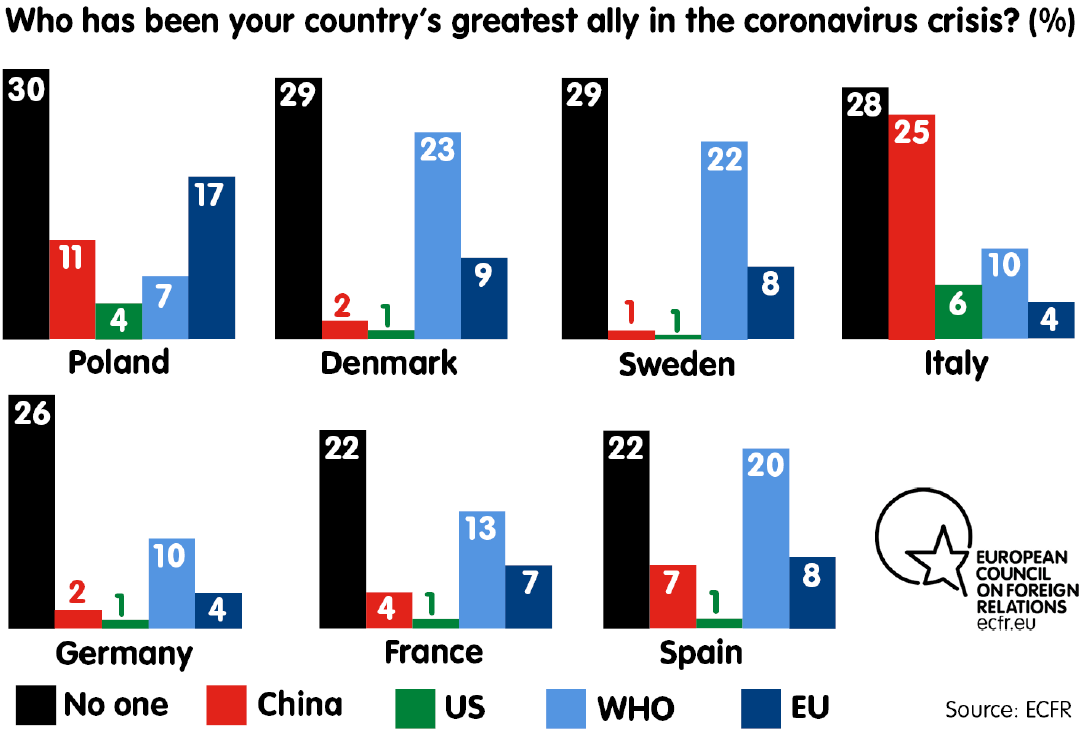
On June 24, the European Council on Foreign Relations issued a report on how the pandemic impacted EU citizens’ views on politics, society, and Europe’s place in the world.
► The study’s findings are organized into three widely held beliefs that are assumed to be common knowledge about COVID19’s impact and three typologies of mindsets;
► Rather than living through a Hamilton moment, the study argues we are in the midst of a Milward moment, where nation-states may want to flock together to seek protection;
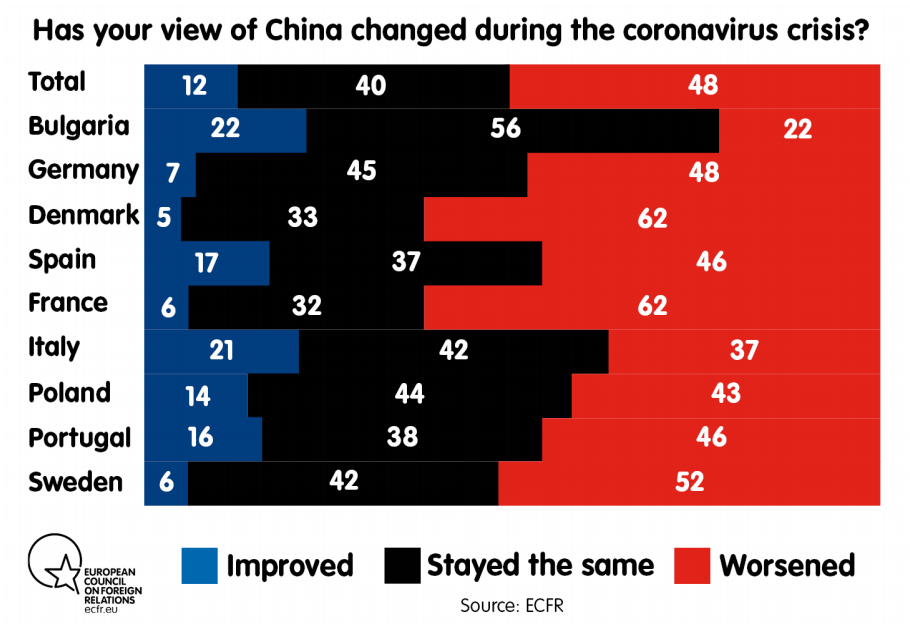
► Positive sentiments towards China have dropped steeply. More Europeans see China as a challenge, which comes with an underlying sentiment that the EU should be the entity tackling this issue.
Quick Details on the Study
The report, written by Ivan Krastev and Mark Leonard, studies the changes in EU public opinion on politics and society following the pandemic.
The study was done on 11,000 people coming from nine countries - Bulgaria, Denmark, France, Germany, Italy, Poland, Portugal, Spain, and Sweden, which encompass ⅔ of the EU’s population and GDP.
Previously, some posited that the virus gave impetus to more powers for the state, that it restored trust in experts, and that it empowered and widened the division between Euroskeptics and Europhiles. However, the study disproves these beliefs.
Three Illusions, Three Mindsets
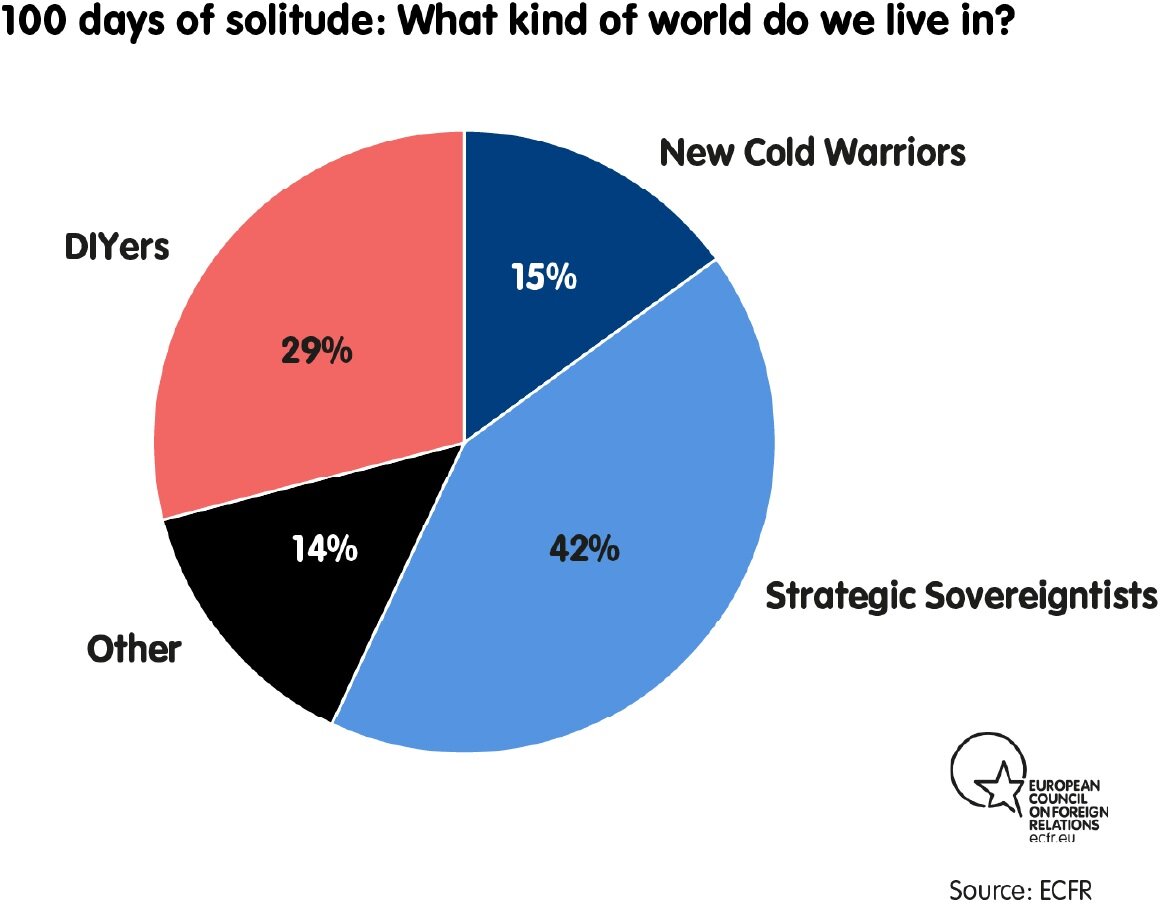
Results of the study grouped previously held beliefs into three categories (called illusions), and organized citizens into three camps depending on their mindset related to Europe’s role in the world: DIY-ers; New Cold Warriors; and Strategic Sovereigntists.
Illusion 1: The belief that the pandemic has caused the public to support a greater role for the state. This is debunked, as the virus has not changed voting attitudes on the role of the state and has not created new political cleavages.
Illusion 2: The belief that the crisis led to a surge of trust in experts. Only 35% of interviewees express positive attitudes towards experts, with the rest assuming they are intertwined in political manipulation and instrumentalization.
Illusion 3: The paradoxical belief that COVID19 has led to increases in popularity of both Euroskeptics and supporters of European federalism.
Nonetheless, the virus did not result in the same ethnicity-based nationalism as the migration crisis. Instead, a new wave of nationalism is based on country residence. At the same time, a significant number of people thought the EU responded poorly to the crisis.
When asked about Europe’s place in the world, particularly in relation to the US and China, respondents were grouped as:
DIY-ers: People who believe the post-COVID world is akin to the 19th century, with nation states having the capacity to follow their own interests outside of multilateral frameworks.
New Cold Warriors: People who see China as the major threat and look towards the US for 20th century-style protection.
Strategic Sovereignists: People who expect a deglobalized post-COVID world that will be split into blocs and regions. These people are ‘progressive protectionists’, who argue the EU will only remain relevant if it’s countries have greater powers and act together.
Strategic Sovereigntists form the majority (42%), with DIY-ers and New Cold Warriors getting 29% and 15%, respectively. The Sovereigntists comprise both former nationalists who understand there are two kinds of countries in Europe and former globalists who grew disillusioned with world politics dictated by Trump, Putin, and Xi.
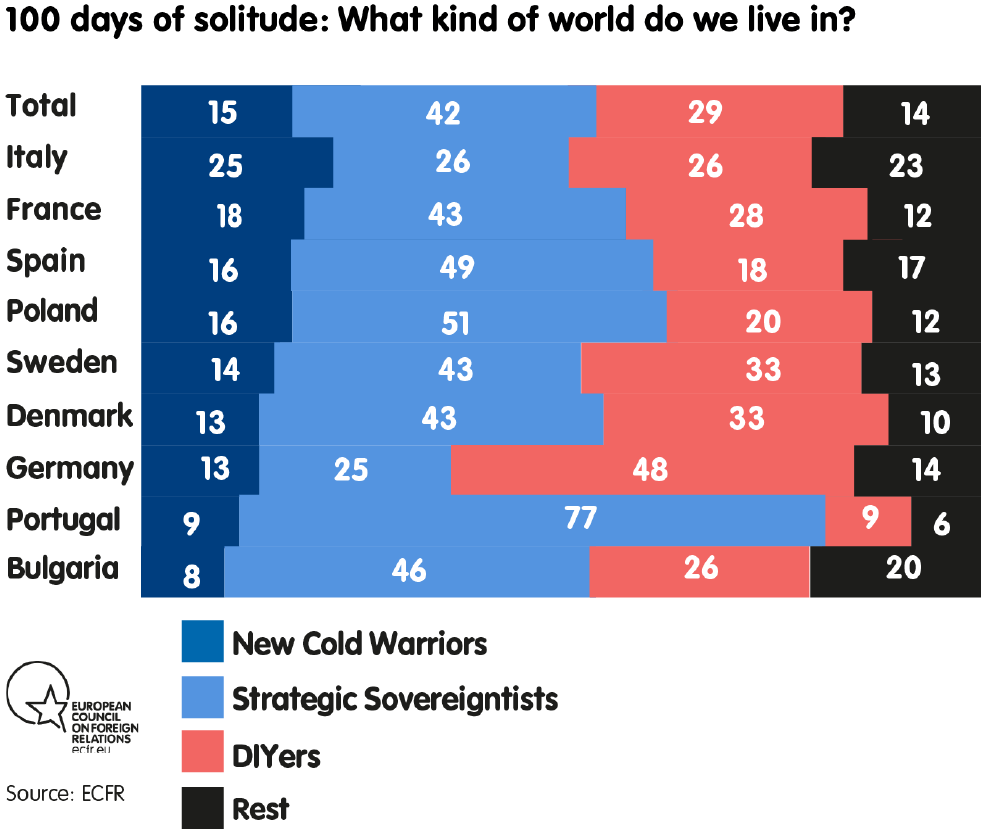
Interestingly, Germany is predominantly DIY-ers, while the strongest Strategic Sovereignty trend can be found in Portugal, Poland, and Spain.
Milward, Not Hamilton
While some have suggested we are in the midst of a Hamilton moment (a reference to the first US Secretary of the Treasury who mutualized the debt of former colonies after the US War of Independence), the study finds that countries instrumentalize the EU as a tool to protect the nation state.
The Franco-German agreement on a recovery plan was seen by some as a proto-federalization moment, but instead, strong national identities emerged, asking for protection from the state (not the supra-state).
However, the post-pandemic recovery still has the potential to be the launchpad for a United States of Europe. For this to happen, EU leaders must craft policy in a manner that displays Europe assuming back sovereignty and fending off challenges from both Beijing and Washington.
What About China and the US?
The COVID19 pandemic inflicted significant damage to China’s reputation in Europe, but a similar process has happened with the United States.
Over 50% of Germans and over 60% of French and Danish respondents said their opinion on China worsened, which they tie to the virus’ origin and the aggressive diplomacy and disinformation stemming from Beijing amid the pandemic.
Surprisingly, similar stats exist for the US. 64% of Spaniards, 65% of Germans, and over 70% of Danes and Portuguese have a worse opinion of the US. Aside from the catastrophic crisis response, this also seems to be linked to a broader question: If the US cannot solve its own problems, how can the ‘broken hegemon’ help anyone else?

TAKEAWAYS
► CHOOSE YOUR WORDS WISELY
The joint response to the crisis presents the EU with an opportunity to further boost the block’s integration. Nonetheless, leaders who would like to push for deeper integration would be better off understanding the public mood, which the ECFR study outlines in detail.
The most important aspect is to differentiate between what the study calls the Hamilton moment and the Milward moment. Much of the debate in past months has focused on the former US Secretary of the Treasury, Alexander Hamilton, and the parallels between the current situation and him mutualizing the debt of former British colonies after the American War of Independence.
The reality is that we are more in the midst of a Milward moment. This is a reference to British historian Alan Milward, who argued in the 1950’s that the European project helped national sovereignty recover (rather than undermine it). Instead of an idealistic belief in integration, the current mood appears to be a pragmatic one related to joint security in the face of common external challenges. Very realistically, if countries remain divided, they won’t stand a chance in the increasingly multipolar world.
That is also why we highly encourage you to read the full results of this very important study by ECFR.
► UNWANTED OPPORTUNITY?
Speaking of deeper integration, the first big hurdle is the stall in negotiations on the MFF and NextGeneration EU, as we covered in our last briefing. The opportunity to bring more competences for the Commission and maybe even change the treaties is gigantic, but such opportunity requires a level of political will that appears to be sorely missing from some EU leaders.
Macron and Merkel have undertaken large efforts to ensure that Frugal Four disagreement does not hinder a more ambitious final proposal. In this context, the German presidency could be considered the “right person at the right time”, because it can use its leverage as chair of the Council to steer the discussion on further integration. Even so, the task at hand is difficult and no matter how much lobbying comes from Brussels, Berlin, or Paris, it is ultimately up to all the leaders to realize that deeper integration is not just the liberal motto of Europhiles of a couple years ago but, instead, has become a pragmatic necessity.

READ MORE
Europe’s pandemic politics: how the virus has changed the public’s worldview - European Council of Foreign Relations (Ivan Krastev, Mark Leonard), Jun 2020
5. Germany About to Start Its EU Presidency - Goals Ahead
On July 1, Germany will be assuming for six months the rotating presidency of the Council of the European Union, time in which it will try to be “the motor and moderator of Europe”, according to Foreign Minister Heiko Maas.
► On June 24, Germany presented its presidency programme, which focuses on handling COVID-19 and its economic repercussions;
► The foreign policy focus of the programme will be on China, with an attempt to balance between economic cooperation and the EU’s demands on reciprocity and values;
► Angela Merkel said the EU must develop internal unity in order to craft a policy on China that is representative of its interests and values.
Taking Up the Chair
As Germany is gearing to take over the Council torch from Croatia, it announced its Presidency Programme and Trio Programme (alongside Portugal and Slovenia).
The central focus of its time in the chair, outlined in the Trio Programme, will be overcoming the COVID-19 pandemic, meaning “the virus must be curbed, the European economy must recover and social cohesion in Europe must be reinforced”.
At the same time, finding consensus on the EU economic recovery fund and the 7-year budget will be Germany’s most important urgent task, so that the final drafts will be approved by December 2020.
The programme also highlights Germany’s focus on climate change and digitalisation (“the great transformation processes of our time”). This falls in line with the Commission’s wish to have a green and digital economic recovery after the pandemic.
Programme on China
Relations with China is the foreign policy priority of the programme. In a draft of the Presidency Programme seen by Reuters on June 15, Germany adopted a tougher stance on its expectations from China.
Specifically, the draft of the programme signals that Germany wants to work with China for “more reciprocity in all areas”. Similarly, it indicates “the China policy of all EU institutions and member states should be united and balanced and be oriented towards long-term common EU interests and values”.
This reference to “values” is particularly important, since it was not present in earlier versions of the draft. Its introduction comes in the context of the Hong Kong national security law controversy and the European Parliament resolution on Hong Kong.
The document also mentions climate change and the establishment of a “greater level playing field in terms of competition” as objectives, but contains no mentions to human rights or democracy.
Merkel’s Take
In a series of interviews across multiple newspapers in Europe, Angela Merkel outlined a pragmatic approach to the German presidency’s strategy on China.
She warned that "the example of China shows that even an undemocratic state can be economically successful, which is a major challenge for our liberal democracies". Nonetheless, Merkel contended that China remains a partner in economic and environmental matters.
Merkel pointed out that the ‘end of history’ predicted in the 1990’s did not materialize: "we have not yet been able to furnish absolute proof that the liberal system is about to win the day", and alluded to the war in the Balkans, terrorism and the rise of ISIS, and, more recently, China’s rise as having dealt important blows to hopes of a liberal international order.
She re-stated that the EU wants to have a summit with China (originally scheduled for Leipzig in September 2020, but postponed until further notice, given the pandemic), but argued that the joint summit (which would see the 27 EU leaders meet directly with Xi Jinping) will force EU member states to ”develop a policy that reflects our interests and values”.
Asked whether the time has come for the EU to assume strategic autonomy, Merkel reaffirmed a commitment to transatlanticism, but asserted that Europe’s role needs to be more important, especially in the scenario of a US withdrawing from the role of world power.

TAKEAWAYS
► CAREFUL ASSERTIVENESS
The message coming from German official statements and the adjustment of documents is one of increasing assertiveness and recognising the challenge of systemic rivalry. Nonetheless, the EU is likely to continue with developing this response in an evolutionary, rather than revolutionary, manner.
The six months of German presidency will overlap both with the elections in the US in November and, potentially, the postponed Leipzig Summit (but not necessarily in Leipzig). These will provide new clarity on EU-China relations, mainly by showing if the EU will have to deal with four more years of Donald Trump in office. If that becomes the case, a transatlantic dialogue would be unlikely to result in much concrete action, and the drift between Washington and Brussels will likely widen, while relations with Beijing would be approached from a perspective of realistic cooperation. How much ‘realism’ will be injected into this cooperation will also depend on China.

READ MORE
German EU Presidency: Government sets priorities as ‘motor and moderator of Europe’ - Euractiv (Christina Goßner, Philipp Grüll), Jun 24
Programme for Germany’s Presidency of the Council of the EU is set - EU2020, Jun 24
'For Europe to survive, its economy needs to survive': Angela Merkel interview in full - The Guardian (Philip Oltermann), Jun 26