EU-China Briefing - 23 June 2020 (EU-China Summit)
YOUR WEEKLY SHOT OF EU-CHINA NEWS
BY FLAVIAN BERNEAGĂ AND GRZEGORZ STEC
1. EU-China Summit - All You Need to Know
On June 22, the EU and China held their 22nd summit, via video conference.
► The discussions were held between Commission President Ursula von der Leyen, European Council President Charles Michel, HR Josep Borrell, Chinese Premier Li Keqiang, and Chinese President/Secretary General Xi Jinping;
► Talks ended without significant points of convergence and, more importantly, without a joint communique or a foreshadowing of the EU-China Agenda 2025. The EU used the summit to espouse a tougher rhetoric on areas of contention, albeit without highlighting any potential punitive actions;
► The most important topics discussed included the Hong Kong national security law, disinformation stemming from China, and a level playing field on trade and investment.
Summit Buildup
The Summit, held after a three-month delay due to COVID-19, marked the first high-level encounter between the new EU leadership and President Xi Jinping.
The Summit came in the context of the EU considering reassessment of its relationship with China. Since March 2019, the EU-China relationship was given the label of, among others, of a ‘systemic rivalry’, and relations soured further this year, as mask diplomacy, wolf warrior diplomacy, and disinformation coming from China had a negative impact on the EU.
Two days before the Summit, the EEAS updated the EU-China Relations Factsheet. Half of the factsheet outlined the ongoing negotiation and cooperation on the CAI and on tackling the pandemic. The other half underlined EU demands on issues such as human rights, the rule of law, and climate change.
The Summit itself consisted of two calls. The first was a discussion between Michel, von der Leyen, and Borrell with Li Keqiang. The second was a discussion between Michel, von der Leyen, and Xi Jinping.
The Key Points
Discussions were marked by divergence and no joint communique or statement was produced (the last time this happened was in 2016, over Market Economy Status dispute).
Earlier, on June 9, during the 10th annual EU-China strategic dialogue with Chinese Foreign Minister Wang Yi, HR Josep Borrell indicated that an EU-China Strategic Agenda 2025 was potentially a key Summit deliverable.
Nonetheless, this did not turn out to be the case. The EU’s priorities likely shifted after a European Parliament resolution (drafted three days after Borrell’s meeting with Wang) called for the Hong Kong national security law to be a top priority in the Summit.
The EU used the Summit to send a clear message of its expectations in areas of the relationship where it wants to see improvement. Compared to recent months, the EU position was more streamlined and more assertive.
Ursula von der Leyen, in particular, adopted tougher rhetoric on the EU’s expectations, albeit without striking a confrontational tone.
The most important issues discussed were the Hong Kong national security law, common responses to the pandemic, climate change, concerns over breaches of human rights, and hopes that a Comprehensive Agreement on Investment can be finalized by the end of 2020.
Dependent on the development of global health conditions, EU leaders expressed their wish to organize a summit to replace the one originally planned for Leipzig in September, which would bring together the Chinese leadership with the heads of state and governments of the EU27.
In Details
China Needs to Step Up the Game
Ursula von der Leyen indicated the EU-China relationship is quintessential to global politics, but adopted an assertive stance in saying that China’s commitment to cooperation needs to be mutual, reciprocal, and, in a few instances, rise “to match” that of the EU. In that sense, she indicated that the 22nd Summit was only a starting point from which the relationship may develop.
“We are able to discuss all these issues with China, but – I must say – the most important was and remains that we must make progress. [...] Progress implies cooperation by both sides, implies reciprocity, and implies trust” ~von der Leyen
Systemic Rivalry
Compared to Josep Borrell’s indication last week that the definition of “systemic rivalry” is not fully clear, Ursula von der Leyen left no room for interpretation in outlining what the 2019 Strategic Outlook’s term implies.
"That means there are two very different systems, very different views on values.” ~von der Leyen
Disinformation
The EU pointed out there have been cyberattacks focusing on hospitals and computing centres that originated in China. Similar sources were tracked to be behind streams of disinformation, and the EU made it explicit that such actions were unacceptable.
“We have seen cyberattacks on hospitals and dedicated computing centres. Likewise, we have seen a rise of online disinformation. We pointed out clearly that this cannot be tolerated.” ~von der Leyen
CAI and a Level-Playing Field
The EU observed that, since last year’s summit, no considerable compliance has emerged in China’s commitments to a balanced trade and investment relationship. EU leaders called on China to be more ambitious in these matters, and determined that, if China upholds its promises, a deal on the CAI could be reached by the end of 2020.
“In order to conclude the investment agreement, we would need in particular substantial commitments from China on the behaviour of state-owned enterprises, transparency in subsidies, and transparency on the topic of forced technology transfers.” ~von der Leyen
WTO
Calls were also made for China to come back to the negotiating table and engage in meaningful reform of the World Trade Organization, especially on matters related to industrial subsidies. The EU indicated the WTO is the only appropriate medium in which global trade matters can be discussed between the two.
“This [WTO] is the relevant framework where we have to work together on the topic – and it is a difficult topic – but this is the framework, which we have to establish to have common binding rules we agree on.” ~von der Leyen
Hong Kong
EU leaders indicated to their Chinese counterparts that the Hong Kong national security law does not fall in line with the Basic Law, and that it seriously undermines the “One Country, Two Systems” principle, which also jeopardizes Hong Kong’s autonomy. Cooperation with G7 partners on the matter was reiterated, but both von der Leyen and Michel stopped short of outlining detailed punitive measures to be taken in order to deter Beijing from adopting the legislation.
“We also conveyed that China risks very negative consequences if it goes forward with imposing this law.” ~von der Leyen
Human Rights
Von der Leyen and Michel reiterated that the EU’s stance on human rights is not a policy area that is negotiable, and brought up Tibet and Xinjiang as cases where human rights ought to see improvement. They also brought up the detainment of Gui Minhai, Michael Kovrig, and Michael Spavor as individual cases important to the EU. The two expressed hopes that a Human Rights Dialogue will take place in China later this year, once global health conditions allow it.
Climate Change
The EU acknowledged China’s determination to project itself as a leader on the climate crisis, but urged Beijing to live up to its commitments and respect the thresholds of the Paris Climate Agreement. The two EU leaders shared their hopes that decarbonisation will become central to China’s green transition, and linked the matter to the role of the European Green Deal in the EU-China Strategic Agenda.
“China has repeatedly projected itself as a leader on global climate issues and China is indeed on our side on this. However, being a leader brings responsibility to follow up with actions.” ~von der Leyen
International Issues
EU and Chinese leaders also shared opinions on a set of international issues, ranging from the Iran Nuclear Agreement, Afghanistan, the Korean Peninsula, and the strategic feasibility of a peaceful South China Sea for the sake of international maritime transports.
China’s Account
As opposed to the EU focus on differences, the Chinese side adopted a stance that sought to highlight areas of convergence.
An article on Xinhua posted shortly after the Summit iterated Xi Jinping’s statements to EU leaders. Xi argued China is “an opportunity, not a threat” and “a partner, not an opponent”.
The Chinese side stressed that China and Europe hold no major conflicts of interest, and pledged to further pursue the reform and opening up process. Similarly, it calls on the two sides to seek common ground, reconcile differences, and be the “dual engine” of the world in the economic recovery following the COVID-19 pandemic.
In a starkly different conciliatory note, Xi said “China and the EU are the world's two main forces, two main markets, two main civilisations. What we advocate, what we are opposed to, what we collaborate on, carry global meanings."

TAKEAWAYS
► TOUGHER LINE, BUT STILL NO STICKS
The EU used the Summit to deliver a much stronger statement than we have heard from HR Josep Borrell over the last few months. That there was neither a joint communique, nor an Agenda 2025 means that the EU stood its ground this time. It must have been a recent decision to not push for a joint communique as, after the EU-China strategic dialogue on June 9, Borrell mentioned the Agenda 2025 as the key potential deliverable. On disinformation, von der Leyen referred to the fact that the source of it is clear. Regarding Hong Kong, she pointed at G7 allies and made a reference to potential consequences, which most definitely is an improvement from Borrell’s explicit refusal at the end of May to join a statement made by the EU’s Western allies or add punitive measures to the agenda. To some, this may seem too little, especially since the European Parliament showed beyond doubt that it wants Hong Kong to be a top priority. Nonetheless, this constitutes meaningful change, and multiple small steps like this are conducive to broader shifts over the long-term.
Did the Summit push China into a corner? Definitely not. Did it deliver specific, detailed measures? Once again, no. However, the ball was most surely pushed into China’s court and the pressure is now on Beijing to step up cooperation and demonstrate that it is serious about its relationship with Brussels. This is a very clear step-up from Borrell’s rhetoric and it should be treated accordingly.
Whether it is a sign of real change in the EU’s approach to China remains to be seen. The recent push to implement the goals of the 2019 EU-China Strategic Outlook, namely on tariffs on Chinese subsidies in third countries and the White Paper on foreign state-aid, suggest a change in actions is also brewing (unless it simply stops at the fortification of the EU market). In conclusion, no tectonic change was registered, but the lack of a joint communique and the EU-China Action Plan 2025 indicates an adjustment of course for the EU ship.
► REVISITING THE PAST TO LEARN ABOUT THE FUTURE
Much of the “new quality” stemming from the EU’s statement is that it expects China to start delivering on the commitments it made last year. Pushing for what we agree on sounds like a start.
As von der Leyen put it, “it is time to accelerate on the very crucial areas of our relationship, to deliver on the important commitments from the last Summit and address our concerns on reciprocity and the level playing field.” Until early May, the only policy area of the 2019 Strategic Outlook that was successful was issuing joint recommendations for the rollout of 5G networks. With the White Paper and the decision on trade subsidies in third countries, the Commission is decisively moving to further deliver on its promises in the Outlook.
This is a good time to review which points of the strategic outlook remain undelivered, as this may guide the Commission if it really wants to become more assertive.

READ MORE
Remarks by President Charles Michel after the 22nd EU-China summit, European Council, Jun 22
Statement by President von der Leyen at the joint press conference with President Michel, following the EU Leaders' videoconference on coronavirus of 23 April, European Commission, Jun 22
EU-China – A strategic outlook, European Commission and the High Representative, Mar 12, 2019
2. EU’s Rhetoric on Hong Kong Toughens Ahead of EU-China Summit
Over the past week, the EU’s position on the Hong Kong national security law became more focused on condemning a rule of law breach.
► The EU released a joint statement with the G7, and HR Josep Borrell suggested forming a transatlantic bilateral dialogue, focusing on China’s ambitions and assertiveness;
► The European Parliament passed (by an overwhelming margin) a resolution condemning the actions in Hong Kong, while also calling for the matter to be a top priority at the EU-China Summit;
► In response, China categorized the European Parliament’s vote on Hong Kong as interference, and proceeded to issue new details of the national security law.
Alignment on Hong Kong
In two instances in the past week, HR Josep Borrell showed growing alignment between the EU’s position on Hong Kong’s national security law and the positions of its allies in the G7, including the US.
On June 15, Borrell exchanged views on China’s “growing assertiveness” with US Secretary of State Mike Pompeo during a high-level video conference. He suggested holding a bilateral dialogue focusing on the challenges created by China’s actions, including “the situation in Hong Kong”.
Nonetheless, Borrell said he and Pompeo only dedicated 20-25 minutes of their three-hour long conversation to talk about China and the bilateral dialogue was an idea he only losely suggested towards the end of the talks.
Also on June 15, Germany added new language to an official document with its plans for the presidency (which it will assume on July 1). The new draft includes a focus on “values” (omitted in the previous draft), which may suggest greater emphasis on democracy, human rights, and Hong Kong autonomy.
On June 17, HR Borrell joined the foreign ministers of the G7 countries in issuing a statement that underscored their “grave concern” with China’s imposition of the national security law in Hong Kong and urged China to “re-consider this decision.”
The statement stresses the rule of law breach, by arguing it contravened the “legally binding, UN-registered Sino-British Joint Declaration”.
European Parliament Vote on Hong Kong
On June 19, the European Parliament voted overwhelmingly in favor of a resolution that categorized the national security law as a breach on Hong Kong’s autonomy.
With a tally of 565 votes in favor, 34 against, and 62 abstentions, MEP’s indicated the EU should sue China at the International Court of Justice. You can check how each MEP voted here (pages 338-339).
MEP’s also urged the EU to push for a UN special envoy to deal specifically with the situation in Hong Kong. More importantly, it asked the Council and the EEAS to make Hong Kong a “top priority” in the upcoming EU-China video summit on June 22.
MEP’s also called for using economic leverage to promote human rights, including human rights clauses in trade deals and CAI, as well as speed up process on establishing a European equivalent of ‘Magnitsky Act’
China’s Response
As the EP vote was happening, the National People’s Council sorted out some details of the final draft of the law.
Most importantly, a Commission for Safeguarding National Security will be created. The Hong Kong Chief Executive will chair it, and 9 other high-ranking Hong Kong officials will be its members. The Police and the Department of Justice will also set up units dedicated specifically to national security.
Hong Kong’s top official will have powers to choose which judges sit on national security cases, and mainland Chinese security organs will be able to “exercise jurisdiction" over cases that “jeopardize national security under specific circumstances.”
However, the draft did not shed light on defining the four most important national security crimes: secession, subversion, terrorism, and collusion with external forces to endanger national security.
China’s top legislative body will meet again next week, after already having had its bimonthly meeting last weekend, in an effort to pass the national security law faster, even if a full public draft is not ready. Important details have not yet been set out.
On June 20, You Wenze, a Spokesperson of the Foreign Affairs Committee of the NPC, criticized the European Parliament resolution, saying it distorts facts and employs human rights as a disguise for Hong Kong autonomy.
You said China is fully complying with the Basic Law (Hong Kong’s mini-constitution), and argued the Joint Declaration has no legal salience, meaning the UK has “no sovereignty, governance, or supervision” over Hong Kong, directly contradicting the G7 statement on Hong Kong.

TAKEAWAYS
► VOTING PATTERNS FOR MEPs ON HONG KONG RESOLUTION
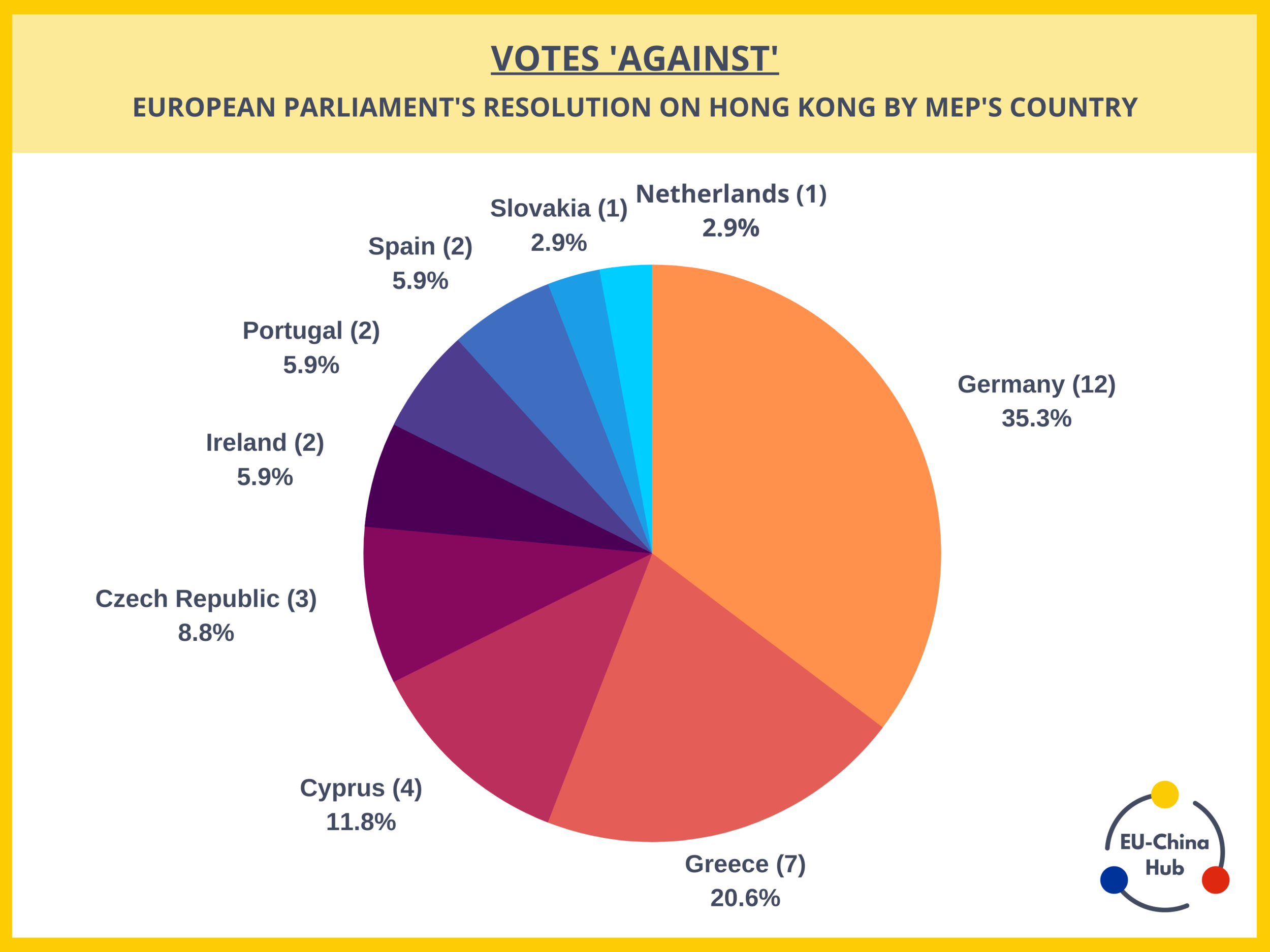
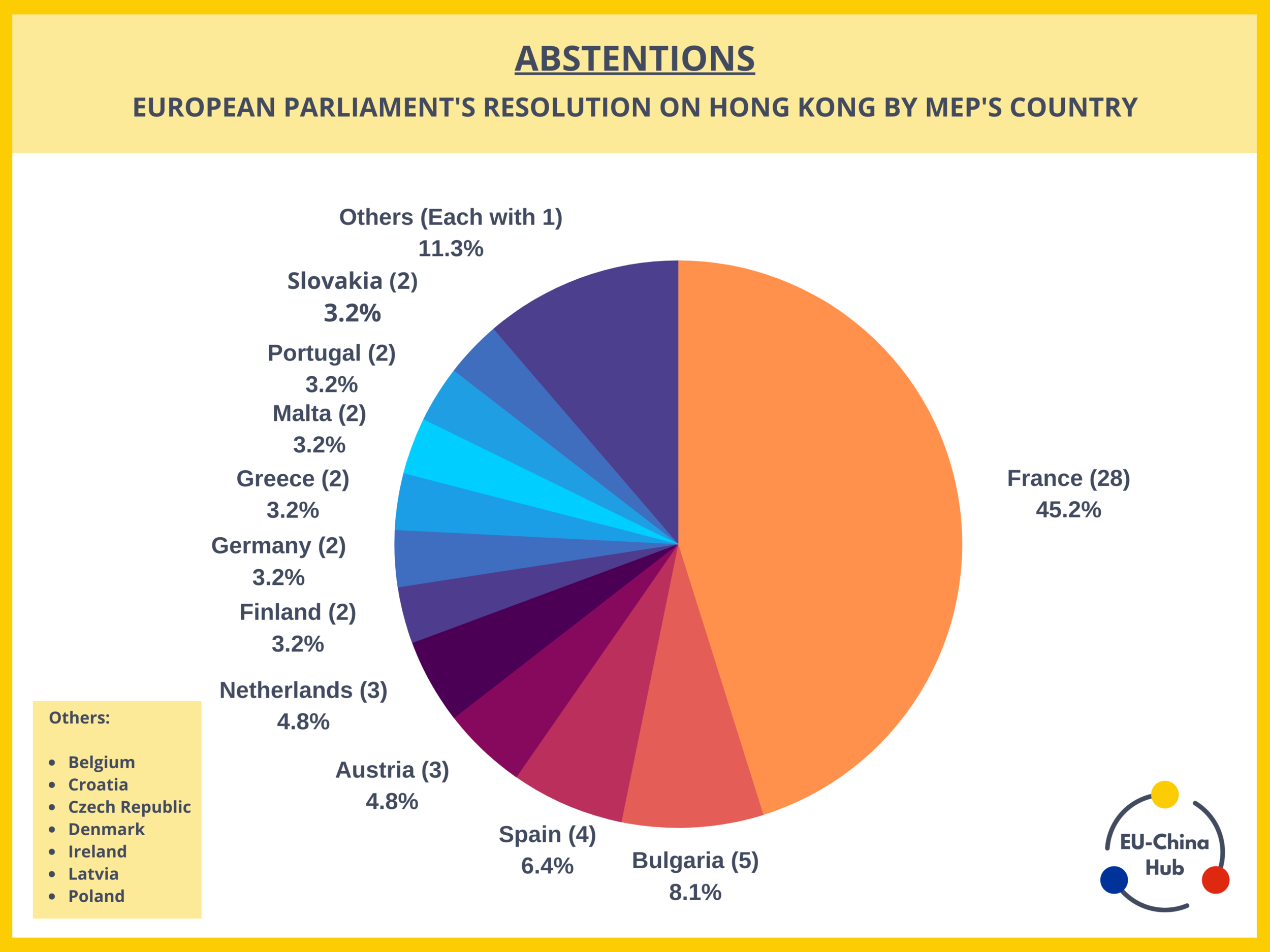
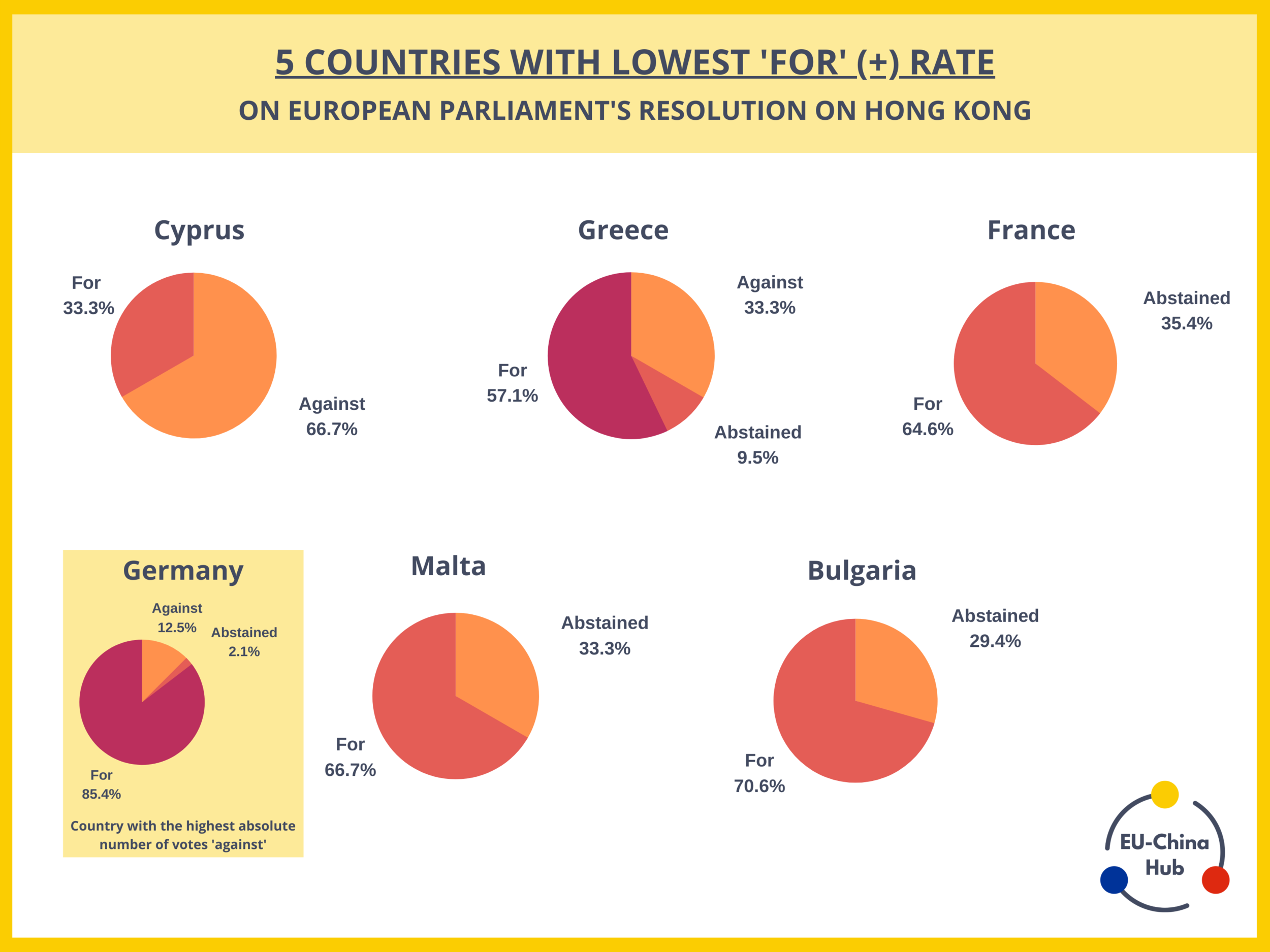
The Parliament vote on the Hong Kong national security law on June 19 outlined interesting dynamics. The country with the highest share of MEP’s voting against the resolution was Cyprus, where only 2 out of 6 MEP’s voted in favor. Greece also stood out, as one third of its MEP’s voted against the motion. Also we see that 35% of French MEPs abstained, and 12.5% of German MEPs voted against (although 85.4% of German MEPs still voted in favor).
However, it appears that the European Parliament’s data (pages 338-339) does not paint a full picture. For example, 5 Hungarian MEPs did note vote at all, despite appearing to be present in the room for other resolutions.
It is also important to note a clear political divide, as 85% of MEPs voting against the resolution and 71% of those that abstained hailed from the far-right political grouping Identity and Democracy or from left/far-left Confederal Group of the European United Left/Nordic Green Left, which, for example, includes Greek MEPs affiliated with Syriza.

READ MORE
G7 Foreign Ministers’ Statement on Hong Kong - European Union External Action, Jun 17
MEPs call on EU to consider lawsuit against China over Hong Kong - European Parliament, Jun 19
全國人大外事委員會發言人就歐洲議會通過涉港國安立法決議發表談話 - XinHua Net, Jun 20
3. EU Fortifies the Common Market Tackling Foreign State Subsidies
On June 17, the European Commission issued a White Paper addressing foreign subsidies. This comes after last week, in the build up to the EU-China Summit, the Commission made a number of moves to securitize the single market against distortions related to, among others, China.
► The White Paper comprises Three Modules that scrutinize and address market distortions in the acquisition of EU companies and in EU public procurement. It also calls for further suggestions on the matter;
► This comes against the background of the EU imposed tariffs on China’s third-country subsidiaries that exported to the EU on Beijing's behalf;
► The move came on the same day that China lost a WTO dispute with the EU on its Market Economy Status.
Anti-Subsidy Gamechanger
On June 17, the European Commission unveiled a much expected White Paper that seeks to address distortions to the European Single Market caused by foreign subsidies.
The Commission acknowledged there is a “gap analysis” in the current legislation. In other words, foreign subsidized companies are not subject to equal scrutiny as their EU counterparts.
The new rules will be added to already existing legislative frameworks on mergers, state aid, foreign investment screening, and trade defence instruments.
The pillars of the proposal are the so-called Three Modules:
Module 1 is an instrument to investigate situations in which a foreign subsidy may distort the EU single market.
Module 2 is an instrument specifically tackling subsidies that support foreign companies in taking over EU companies.
Module 3 is an instrument addressing negative impacts of foreign subsidies on EU public procurement procedures.
Public procurement plays a particularly important role, as the new instrument will prevent low-balling by non-EU governments.
Margrethe Vestager, the EU’s Commissioner for Competition, said no specific country is targeted.
Nevertheless, the policy is angled towards, among others, China, who has invested massively in the past half decade on projects ranging from the port in Piraeus to the controversial takeover of a jewel of German robotics company KUKA.
The White Paper is now up for public consultation until September 23, 2020.
No Safe Haven for Distortive Practices
On June 15, the European Union slapped a landmark tariff on a third-country subsidiary that exported on China’s behalf.
The tariff was applied on two Egyptian exporters of glass fiber fabrics, who were in fact subsidiaries of China Jushi Co. and Zhejiang Hengshi Fiberglass Fabrics Co.
The two Egyptian companies were located in the China-Egypt Suez Economic and Trade Cooperation Zone, labelled as part of the Belt and Road Initiative.
China said the tariff goes against the “authority of the WTO”, but the European Commission found that resources were pooled to also serve the interests of the two Chinese companies.
The EU is gearing up for two other trade investigations that it alleges are linked to China, one on glass fiber reinforcements from Egypt and the other on stainless steel from Indonesia.
China Loses WTO Dispute Against EU
On June 16, China allowed a WTO dispute with the EU on China's status as a market economy to lapse, one year after it lost an adjacent interim ruling against the EU.
Market economy status (MES) is a broadly defined term but, in this context, it would signify that other WTO members could no longer impose tariffs on China, on anti-dumping grounds.
The case started in 2016 and was a matter of interpreting the 15-year transition period for China after joining the WTO. China argued that it would be granted MES automatically after 15-years, while others interpreted that they could determine whether anti-dumping subsidies are still necessary.
Within this period, WTO members employed the “surrogate country” method, which allowed them to determine whether exports prices were unfairly low by comparing them to domestic prices in a third country, and attach tariffs when appropriate.
China spent four years fighting the issue at the WTO, but declined to extend the procedure. This gives the EU more certainty in imposing high tariffs on artificially low exports.

TAKEAWAYS
► FORTIFYING
The White Paper on Foreign Subsidies, while one of the deliverables of the EU-China Strategic Outlook 2019, should not be understood as a solely anti-Chinese tool (recall the controversy in March when Donald Trump met with the boss of German vaccine manufacturer CureVac to make a vaccine solely for the US). Even so, Chinese subsidies and FDI have made many in Brussels and Berlin fret and fidget, particularly after the ‘wake up call’ of the flurry of Chinese M&As in 2016, when policymakers faced the reality of both increased low-balling on public procurement and Chinese companies supported by cash flow generated by easy credit from Chinese state banks. This made the EU initiate an entire discourse on “leveling the playing field”, which has been a core element of the CAI, the Strategic Outlook, and almost every other aspect of relations.
However, the trend for China, as we reported last week, is a path towards “One Economy, Two Systems”. While market principles are lauded in selected sectors of the economy, the most important sectors are solely dedicated to SOEs, with market access being visibly limited in them. As such, the EU is moving to level the playing field on its side. The White Paper is only one of the elements meant to ensure that foreign companies operating in the EU face the same requirements as their European counterparts.
► A SHIP WITHOUT A CAPTAIN?
The White Paper comes at a time when the future leadership of DG TRADE is uncertain. The Paper is likely to extract pushback from China and this coincides with the challenge of failed EU-US negotiations on digital taxes (an OECD-coordinated effort to agree on how to tax the profits of global digital companies). On the other hand, digital taxes are an important component of the recovery fund—with the Commission wanting to tax companies with a turnover of more than €750 million—and form a core component of the MFF for 2021-2027. Washington walked out of negotiations last week and accused the EU of treating US companies unfairly, but EU officials said they will push forward with digital taxes nevertheless.
Managing pushback will require strong negotiation skills, but Phil Hogan, the Commissioner for Trade, may be out of action. Hogan was recently proposed for the top WTO position, which he did not publicly refuse. To get enough votes, he will need US support, which creates a conflict of interest given the EU-US disagreements surrounding the Digital Tax. Furthermore, if he were to depart from the Berlaymont, that would trigger a reshuffle that leaves the Commission overall weaker to the blowback from both Washington (over digital taxes) and Beijing (over the White Paper and tariffs on third-country subsidiaries).
► BIG CLOUD, LITTLE RAIN
The EU’s anti- foreign subsidy White Paper seeking to further securitize the block’s domestic market comes in the context of Brussels’ fears of a flurry of takeovers of European companies by Chinese actors while the EU fights the corona-crisis. We discussed this in detail in our briefings in April.
However, according to the findings of the Rhodium Group, unlike after the Global Financial Crisis of 2008/2009, this time the Chinese investors “stay home”. The high debt levels, tighter liquidity, and ramped up restrictions on outbound investments that followed the spike of China’s foreign investments in 2016 all limit the capacity and eagerness of Chinese investors to invest abroad, including in Europe. The data from Q2 of 2020 suggests that the average value of transactions happening each month in the January-May period dropped from $12 billion in 2018 to $1.3 billion in 2020. On top of that, increased securitization of the European market suggests that Chinese investments in Europe in 2020 may indeed be very limited.

READ MORE
White Paper on leveling the playing field as regards foreign subsidies, European Commission, Jun 17
China’s Market Economy Statusand the European Interest, ECFR (François Godement), Jun 2016
European Commission Regulation on Egyptian subsidiaries of Chinese companies, European Commission, Jun 15
Who’s Buying Whom? COVID-19 and China Cross-Border M&A Trends - Rhodium Group (Thilo Hanemann, Daniel H. Rosen), Jun 18
4. No Progress on MFF and Recovery Package
On May 19, a European Council video conference provided no meaningful breakthrough on economic recovery negotiations between EU member states.
► Member states disagreed on the size of the recovery package, the distribution method (grants or loans), the distribution criteria, additional EU taxes, and rebates for net contributors to the EU budget;
► In view of the stagnation, the European Central Bank (ECB) warned that Europe’s economy is in a “dramatic fall”, while the European Parliament (EP) pleaded for new sources of revenue for the EU;
► EU leaders now enter a phase of intense negotiations, with a (rather ambitious) objective of reaching a deal by the end of July.
Snail’s Pace in Negotiations
In a video conference held on June 19, EU heads of state and governments failed to reach an agreement about the concrete elements of a budget and recovery plan.
Quick Memento. In late May, the European Commission issued a proposal for a €750 billion economic recovery fund and a €1.1 trillion budget for the 2021-2027 period. €250 billion would be loans, repaid jointly by member states, between 2028-2058. The budget component also asks for the addition of new taxes, particularly on carbon emissions and on multinational companies.
All that emerged from the June 19 meeting was a reaffirmation of existing disagreements on: the size of the initiative; whether it should be distributed as grants or loans; and whether rebates would be offered to countries that contribute more to the EU budget than they take out.
Disagreement rose also over “own resources”, which, in Brussels talk, means adding new sources of revenue to the EU budget. The Commission wants contributions to the budget to go up to 2% of Gross National Income, as opposed to the current level of 1.2%.
More worryingly, even countries that gave their OK to the proposal in the past argued the Commission’s proposal lacked appropriate details on conditionality and on allocating money to the hardest-hit economies.
ECB and EP Put in their Two Cents
The European Central Bank and the European Parliament indicated they want the agreement to increase EU competences, and they want the deal done fast.
Most importantly, ECB President Christine Lagarde stated the EU economy is in a “dramatic fall” and that EU leaders ought to reach an agreement quickly, before markets lose confidence.
She estimates the EU economy will shrink by 8.7% in 2020, with a quarter-to-quarter decline of 13% in Q2. She also said she expects the economy to recover by 5.2% in 2021.
Lagarde indicated the worst has not yet passed for the labour markets. The current 7.3% unemployment risks rising all the way to 10%, with severe implications for youth unemployment in particular.
The European Parliament indicated on June 19 that it wants the final agreement on the budget to allocate new sources of revenue for the Commission, so as to finance both the recovery instrument and the MFF for 2021-2027.
A Deal by July?
European Council President Charles Michel indicated the EU is shifting into negotiation mode, with hopes that a deal could be reached by the end of July.
In that sense, Charles Michel is elaborating plans to hold two summits: one in mid-July and one by the end of July, to bridge the gaps.
The urgency is not shared by Dutch Prime Minister Mark Rutte, who argued there is no need to hurry, since an agreement is unlikely to be struck during the summer.
On the other hand, Spanish Prime Minister Pedro Sánchez and Italian Prime Minister Giuseppe Conte argued that reaching a deal too late will be conducive to a recession.
Nonetheless, EU officials and diplomats speaking anonymously do not find it possible to reach an agreement by July, suggesting “every member state has raised some issues”.
Indeed, 10 out of 27 countries entered this European Council with grievances and it does not seem like interests converged after June 19. The countries in question are the usual Frugal Four (Austria, Denmark, Netherlands, Sweden), the Visegrad 4 (Czech Republic, Hungary, Poland, Slovakia), alongside Finland and Estonia, which have also shown they are not fully happy with the current proposal.

TAKEAWAYS
► FOCUS SHIFTS ON RUTTE
At the beginning of talks on a recovery fund, the self-ascribed figurehead of the Frugal Four appeared to be Austria’s Chancellor, Sebastian Kurz. However, the fact that Mark Rutte found no harm in not having a deal by the end of summer has re-focused attention on his role as the potential dealmaker. It is for this reason that Emmanuel Macron is taking a personal visit to the “tiger’s cage” (well, The Hague) to convince Rutte to change his mind. Macron is betting on his relationship with Rutte being more entrenched than the one between Rutte and Merkel (recall that Rutte’s party is part of the Renew Europe political group in the European Parliament, which was Macron’s idea). On top of that, the two also have a shared interest in helping Air France-KLM, a Franco-Dutch company, survive the economic crisis. If Macron manages to bring Rutte on board, convincing the other Frugals (Austria, Denmark, Sweden) will be a bit easier.

READ MORE
In budget summit, EU leaders live up to low expectations - Politico (David M. Herszenhorn, Jacopo Barigazzi, Maïa De La Baume), Jun 19
The EU’s recovery fund proposals: crisis relief with massive redistribution - Bruegel (Zsolt Darvas), Jun 17
ECB's Lagarde urges quick EU recovery plan as economy in 'dramatic fall' - The Guardian (Jan Strupczewski, Gabriela Baczynska, Andrius Sytas, Kevin Liffey), Jun 19