EU-China Briefing - 15 September 2020 - Summit Special
YOUR WEEKLY SHOT OF EU-CHINA NEWS
BY FLAVIAN BERNEAGĂ AND GRZEGORZ STEC
Click & Read:
1. Systemic Rivalry Becomes More Apparent Before the Video Summit
As the EU and China geared for their video conference, questions on systemic rivalry have received more attention.
► Ahead of the Video Summit pressure was building up on European leaders to raise issues related to “systemic rivalry” in their meeting with Xi Jinping;
► Chinese Ambassador to the EU Zhang Ming published an op-ed in which he urged European leaders to abandon sentiments of systemic rivalry;
►Nonetheless, the most recent actions on China’s behalf suggest the rivalry may further deepen.
Maintained Pressure
After Wang Yi was confronted about Hong Kong and Xinjiang in nearly every country he visited two weeks ago, it has been expected that Xi will face similar criticism during the videoconference.
Remember that already during the EU-China Summit in July, von der Leyen warned of “very negative consequences” if China did not retract the national security law.
Since then, the EU has taken a set of measures in response. A coordinated package decided on in July instituted a ban on goods capable of “internal repression, the interception of internal communications or cyber-surveillance”. In addition, the EU said it would consider extending asylum rights for Hongkongers, while France and Germany suspended extraditions to the city.
Ahead of the video conference, topics associated with systemic rivalry also featured in a joint press release following discussions between HR Josep Borrell and François-Philippe Champagne, his Canadian counterpart, that took place on September 10. The two talked about the need to keep urging China to respect human rights, the rule of law, and norms on trade, investment, science, and technology.
Also on September 10, a group of 4 MEP’s signed a letter to Michel, Merkel, von der Leyen (and Macron!), urging them to “meaningfully address” human rights violations against Uyghurs and Hongkongers.
A day later, a group of 63 MEPs addressed a formal letter to Michel, von der Leyen, and Merkel, asking them to bring up “China’s human rights atrocities” at the video summit.
On behalf of the EPP’s Foreign Affairs Committee, MEPs Radosław Sikorski and Iuliu Winkler denounced China’s poor performance in meeting its international commitments and affirmed that “systemic rivalry has become the overriding paradigm” in EU-China relations.
Echoing similar sentiments, EPP Chairman Manfred Weber said on September 14 that “China is behaving more like a rival than a partner” and suggested that recovery funds should not be used towards “Chinese interests”.
On September 14, Handelsblatt and Le Monde published an article signed by nine MEP’s and China experts, which argues China’s abrasive policy on Taiwan and lack of respect for the “One Country, Two Systems” formula in Hong Kong call for the EU to reassess its stance on the “One China” Policy.
In that line, the EU should deploy multiple measures including developing closer ties with Taipei by opening a wide-range of dialogues (including on peace, security, and stability), open dialogue with top Taiwanese officials, push for closer economic ties, and support Taiwan’s membership in multilateral institutions.
“Europe’s strategy must not be revisionist. We support the preservation of the status quo. Our logic must be based on a dialectic: since the PRC has seriously endangered this status quo by its recent actions, Europe must also change its policy on the Taiwan question, in order to help preserve stability.”
Through that, “Europe must make it clear to China that if the latter turns towards the use of force, it runs serious risks, in particular that of a political and economic break with European democracies.” [Translated from French - we encourage you to read the whole article]
The nine signatories are MEPs Reinhard Bütikofer, Nathalie Loiseau, Radosław Sikorski, Raphaël Glucksmann, Petras Auštrevičius, former MEP Elmar Brok, former German Ambassador to China and Japan Volker Stanzel, as well as experts François Godemen (Institut Montaigne) and Hanns Maull (MERICS).
Zhang Ming Thinks Otherwise
Conversely, a pre-conference op-ed by Ambassador Zhang Ming pleaded for a return to the pre-systemic rivalry narrative of comprehensive strategic partnership.
Titled “The EU should recognise the benefits of its partnership with China”, the op-ed argues the EU and China are “partners that present opportunities”, not “rivals that pose threats”.
In this line, Zhang dismissed the EU’s “systemic rivalry” concept saying that “Differences in our social systems and development paths are not obstacles to dialogue and cooperation; still less do they support the argument that either China or the EU should be viewed by the other side as a systemic rival.”
Evoking “mutual benefit” and “win-win cooperation”, the Ambassador urged against viewing the bilateral relation through the lens of geopolitics or ideology, and reminded the EU of the time it cooperated with China in 2008 to tackle the global financial meltdown.
Based on that, he called on the EU to revert to the comprehensive strategic partnership narrative: “It is for the sake of stronger cooperation that we must get our perceptions right. If we see each other as comprehensive strategic partners, cooperation will not be an expediency that works for now and for short-term gains, but a strategic choice that works in the long term and produces win-win results.”
As examples of such potential “results”, Zhang suggested finalizing negotiations on the CAI, and concluding the EU-China 2025 Agenda (which the EU has attached to a successful outcome on the CAI).
Just do as I say, don't do as I do
But Beijing’s actions don’t quite help its case for building up the strategic partnership with the EU.
On September 11, a meeting between Chinese Foreign Minister Wang Yi and his Russian counterpart Sergei Lavrov ended with a mutual promise to cooperate on tackling disinformation. This was a rather odd commitment from the EU’s perspective, as it has previously accused both countries of engaging in disinformation practices.
One day before the video conference, an editorial in the Global Times struck a protectionist tone, arguing the EU-China relation is “simple, because Europe has no other option except for strengthening pragmatic cooperation with China”.
The editorial emphasized the negative effects of Donald Trump’s politics, but in doing so, it also claimed that Europe’s tough stances on China are nothing but a “show” it needs to stage “to follow the general trend in the West”. The article also presents Europe’s tough China policy as a result of its lack of independence from the US.
Also, between 21-26 September, China will join Russia, Iran, Belarus, Myanmar, Armenia, and Pakistan in a set of military drills coined “Caucasus 2020” that will see China provide its latest transport aircraft to deploy wheeled vehicles and light weaponry.

TAKEAWAYS
► DIPLOMATIC MISCALCULATION
Brussels’ patience with Beijing is starting to run low, as chances to end negotiations on the CAI by the end of 2020 appear slim, and China is not likely to budge either on issues related to “systemic rivalry” or on those related to its economic model. On top of that, China has been increasingly shaping its messages towards the EU with overconfidence and an imagined position of power. Whether it is Zhang Ming’s softer-style appeal to strategic cooperation or the borderline insulting Global Times article, the rhetoric in both show that Beijing may be seeing Europe as a weak player, “guided by anti-China American forces”, ergo one that could be just as easily pushed into a hierarchical relationship with China.
Instead, the more Beijing pushes the fewer chances it has to downplay the rivalry and to emphasise competition, thus continuing down a counterproductive diplomatic hole. We may be nearing a dangerous point, in which wolf-warrior diplomacy becomes a wolf-warrior mentality.

READ MORE
Europa muss seine China-Politik ändern, Handelsblatt (Reinhard Bütikofer François Godement Hanns Maull Volker Stanzel), Sep 14
The EU should recognise the benefits of its partnership with China, SCMP (Zhang Ming), Sep 12
China-Europe bond can withstand US meddling, Global Times, Sep 13
2. EU-China Video Conference - All You Need to Know
On September 14, the EU and China held their leaders-level videoconference, attended by Charles Michel, Ursula von der Leyen, Angela Merkel, and Xi Jinping.
► Just before the summit, the two sides signed an important bilateral agreement on GI’s (geographical indications);
► Top of the agenda were negotiations on the CAI, climate change, cooperation amid the COVID-19 pandemic, and human rights. No major breakthroughs were achieved, but the outcomes seemed more concrete than those following the June Summit;
► The European and Chinese readout once again differed considerably with Xinhua reporting on Xi’s 4 “insists” for peaceful co-existence, enhanced multilateralism, dialogue, and cooperation.
Baby Steps?
As a result of the bilateral agreement, which was first concluded in November 2019, 100 European GI’s in China and 100 Chinese GI’s in Europe will be protected from imitation.
The agreement is expected to be enforced in early 2021 and, within four years, it will expand to an additional 175 GI’s. Under the agreement, high-quality European agricultural products would benefit from easier market access into China as well as better protection within the Chinese market.
GI’s represent an important part of the EU’s trade policy, with 40,000 of them currently around the world.
What Was Discussed?
The conference has not featured major breakthroughs, but allowed the EU side to appear more united and to voice a more assertive message towards Beijing. The press briefing was opened by President Michel stating that: "Europe needs to be a player, not a playing-field".
Division of Labor
The EU side seemed to have delegated topics of discussion between the three leaders, with Michel touching on human rights and COVID-19, von der Leyen on digital and CAI, while Merkel focused on climate change and wider cooperation.
Leipzig Summit
The two sides agreed nonetheless on an in-person EU27-Xi summit in Brussels, which will likely happen after the German presidency.
This means that the agenda-setter will be Brussels rather than Merkel’s Berlin. This could suggest a more assertive agenda.
Human Rights
The EU side expressed concerns over the Hong Kong national security law, the postponement of Legislative Council elections, and the treatment of ethnic minorities.
Importantly, the EU raised questions about the Swedish citizen Gui Minhai, as well as Canadian citizens Michael Spavor and Michael Kovrig, all of whom have been detained in China.
Though lacking a strong pushback on these matters, EU leaders did display a position of unity, and managed to convince Xi to meet them for a Human Rights Dialogue later in 2020. Also, Xi reportedly remarked that sending independent observers to Xinjiang may be possible.
CAI and trade
Both parts displayed political will for finishing CAI negotiations by the end of 2020. The EU also said progress was done on rules for SOEs, forced technology transfers, and subsidy transparency.
On the other hand, von der Leyen stressed that “more work was urgently needed” on rebalancing market access (particularly, on agri-food, financial services, and the digital sector) and on sustainable development.
In fact, as this graph shows, we are far from the approval of CAI, let alone its ratification. As per von der Leyen, “China has to convince [the EU] that it is worth having a Comprehensive Agreement on Investment”.
The EU also raised points about China’s commitment to reform the WTO, as well as its industrial and high tech overcapacity.
Climate Change
The EU called on China to enhance its carbon emissions reduction commitments and to set a domestic goal for climate neutrality. It also urged Beijing to limit its reliance on coal-fired power plants and stop financing their construction abroad. This is important, as 50% of global CO2 comes from China’s coal plants.
Potential room for cooperation comes from China’s development of a domestic emission trading system. In this context the EU could contribute its expertise.
The two also agreed to establish a High-Level Dialogue on Climate, while the EU expressed its support for the 2021 Biodiversity conference in Kunming.
COVID-19 Response
The two sides agreed to boost research on treatment and vaccines, while China’s G20 efforts to support the economies of low-income countries was branded as “essential” by the EU.
Sweet Talk
If EU leaders (particularly von der Leyen, less so Merkel) publicly took a more assertive stance, Xi preferred to talk about cooperation.
According to a read out by Xinhua, Xi talked about the “four insists”: peaceful coexistence between different political models; openness and cooperation through the double circulation economy; multilateralism through the UN-led international order; and dialogue & consultations.
The Chinese side also emphasized cooperation, lauding the GI agreement, as well as the mutual decision to establish a High-Level Dialogue on Digital and Climate.
On the sensitive topics of Hong Kong and Xinjiang, Xi simply stated “there is no universal human rights path”, arguing China will not accept teachings on human rights and that the EU should focus on its own problems.

TAKEAWAYS
► WHAT'S NEW?
Just as expected, the video conference did not ease the way for any breakthroughs on the CAI or systemic rivalry, but that doesn’t mean it lacks value.
First of all, the EU maintained an assertive tone, demanding that China present concrete results rather than general statements. Ursula von der Leyen was by far the most assertive of the EU3, arguing EU-China economic cooperation ought not be taken for granted. She said that, since the CAI is about “rebalancing the symmetry”, not “meeting halfway”, it is China’s duty to convince Europe that the CAI is worth negotiating. She also pointed out multiple other issues in which the EU wants China to follow up on its commitments such as implementation of G20 principles on AI. On top of that, the EU side managed to create a united European message. What was lacking, though, was a concrete action plan. This would be particularly helpful to measure China’s adherence to its commitments.
Next step? The European Council of 24-25 September. Michel plans to discuss EU unity on China with the 27 leaders. In other words, the unity that we saw on Monday has to extend now to all corners of the Union
► SOUR OUTLOOK
Despite the more assertive and united European style of communication with China, it is hard to imagine a major breakthrough in the relationship on the horizon. CAI is limited by the different economic visions and Xi’s adherence to Marxist political economy and the emerging concept of dual circulation. Similarly, given the intensification of China’s campaigns against its minorities, it is hard to imagine progress on human rights. Similarly, important challenges remain in regard to digital cooperation, as we discuss in a news bite below. On climate, serious questions have been raised about whether China can really be a partner for the EU.
All in all, the relationship doesn’t look promising, particularly given the growing uneasiness about China among the European public. Let’s not underestimate the fact that such sentiments can guide a pushback by parliaments with a role to play in the progress of EU-China relations. For example, the European Parliament will be part of potential ratification of CAI (providing that an initial agreement can even be reached). Still vdL remarked that after the June Summit on CAI there was progress on CAI with China negotiators at a high-level. Applying pressure does seem to have some effect, but relations are on course for more souring.

READ MORE
3. EU and China Hold First-Ever High-Level Digital Dialogue
On September 10th, the first EU-China High-Level Digital Dialogue was held, mere days before the EU-China high-level videoconference.
► Chaired by Commission Vice-President Margrethe Vestager and Chinese Vice-Premier Liu He, the dialogue focused on ICT, AI, product safety of articles sold online, and digital taxation;
► The Dialogue was held three days after China announced an initiative on global data security, which is meant as a response to the US’s ‘Clean Network’ program;
► The Digital Dialogue was bound to be complex. Below we offer you six instances in which the EU and China pursue different goals in the domain of digital tech.
Four Days To Little Leipzig
This was the first time a High-Level Digital Dialogue took place, thus joining other frameworks, i.e., High-Level Trade and Economic Dialogue.
Vestager and Liu were joined, on the EU side, by Commissioners for the Internal Market (Thierry Breton), for Innovation, Research, Culture, Education and Youth (Mariya Gabriel), and for Justice (Didier Reynders), and on the Chinese side by Vice Ministers Wang Zhijun, Wang Lingjun, Huang Wei, and Liao Min.
The two sides sought to find overlap on socio-economic digitalisation, to foster cooperation, and also to avoid a future potential fracture in relations.
According to anonymous EU diplomats, Liu made credible promises to review China’s policies on product safety and research reciprocity, and seemed overall to take the EU’s concerns seriously.
Nonetheless, the two sides are unlikely to agree on much. The EU was apparently “caught by surprise” by China’s data security initiative (next section), and Vestager also raised EU concerns over disinformation and cybersecurity, as well as the use of digital technologies in the surveillance of minorities in China.
FYI: This is not the only digital cooperation format between the EU and China. Since 2009, the Commission has organized an annual Information and Communication Technologies Dialogue with China. Similarly, the Commission and the EEAS have co-chaired an annual EU-China Cyber Task Force since 2012. Moreover, the topic constantly spills over into EU-China trade and research dialogues.
The topic should not be treated lightly: digital policies are closely tied to European innovation. In this context, it is worth noting that China has been the EU’s second most important partner within Horizon 2020, contributing initiatives on agriculture, biotech, sustainable urbanisation, surface transport, and aviation.
Appearances of Coincidence
On September 8 (two days before the Digital Dialogue), Chinese Foreign Minister Wang Yi announced a global data security initiative.
The initiative proposes a global policy that would ban tech firms from introducing backdoors in products and services, which allows them to illegally obtain users’ data. Moreover, it calls on parties to not engage in large-scale surveillance of other countries or illegally acquire information on foreign citizens.
This is very much a response to the ‘Clean Network’ announced by the US in early August. To that end, Wang denounced the unilateralism of “some individual countries” who are “throwing dirty water on other countries under the pretext of cleanliness”.
On top of that, Beijing once again called on parties to respect “cyber sovereignty”, meaning countries should have full rights over what flows in their own Internet.
Liu He also briefly brought the initiative to the discussion table at the Digital Dialogue, despite it not being on the agenda initially.
The Bumpy Road Ahead
Despite the “constructive atmosphere” of the Dialogue, hurdles in wider EU-China relations regarding digital and innovation show the challenge of making digital cooperation work. Below a few examples.
On AI, the EU fully rejects China’s usage of it in discordance with human rights and the rule of law. Case in point, during the Digital Dialogue, Vestager reminded her Chinese counterpart that China had signed on to the G20 principles of AI.
On financing commitments, China has not held up its part of the deal on Horizon 2020. As of April 2020, China contributed to only 60% of EU-China co-financed projects, meaning €130 million less than it committed in 2015.
In spite of improved legislation on intellectual property, China remains a top priority for the Commission’s list of IP concerns. This is particularly important, as 82% of EU exports rely on sectors dependent on IP and more than 80% of the counterfeit goods intercepted by the EY come from China.
Issues also exist on data-sharing reciprocity and on data privacy. The EU’s GDPR is 180 degrees apart from Chinese cybersecurity laws, with plenty of provisions for national authorities. Case in point, TikTok is currently under scrutiny by the European Data Protection Board.

TAKEAWAYS
► SYSTEMIC RIVALRY PROBLEM
Digitalization—despite the urgency attached to it within the Next Generation EU recovery fund and according to draft guidelines for conclusion of the upcoming EUCO—cannot be divorced from its political and values-based implications. China’s global data security is another example of a framework that would support authoritarian regimes changing the Internet into their Internet. The unchecked national authority over cyberspace is particularly controversial in the wake of the impact of social media on displaying police brutality in Minsk and Hong Kong.
Another ethics-based question regards the possibility that EU-China joint programmes provide Beijing with useful info on the military use of technology. One example is that China’s BeiDou navigation system was developed through know-how derived from the EU’s Galileo satellite system project. This is in addition to the human rights abuses in Xinjiang and Hong Kong (and, more recently, Inner Mongolia) facilitated by high-quality facial recognition programs and omnipresent surveillance technology. The EU must tread carefully, lest it not facilitate actions that it will end up “gravely condemn[ing]” later on. Pragmatism is needed, but caution is of essence.

READ MORE
EU-China: Commission and China hold first High-level Digital Dialogue - European Commission, Sep 10
China-EU relations: Liu He, Margrethe Vestager hold 'constructive' talks on global digital security - SCMP (Stuart Lau), Sep 10
Top EU officials to China: Surveillance of minorities breaches G20 principles - Politico (Nicholas Vinocur), Sep 10
4. His Way - Borrell Defines “Sinatra Doctrine”
An article recently written by HR Josep Borrell on the ‘Sinatra Doctrine’ is worth a closer examination, in light of the September 14 video conference.
► In the article, Borrell provided a detailed definition of the doctrine that emerged in June, which was equivalent to a strategic statement for the EU amidst US-China rivalry;
► Borrell also provided a critical assessment of China becoming more expansionist and attempting to remodel the international order;
► The Sinatra Doctrine suggests the EU needs to incline towards (though not align with) the US, but maintain dialogue and cooperation with China on all possible fronts, while building internal unity in regards to China and external cooperation ties with like-minded actors.
Context and Timing
The article echoes arguments previously made by Borrell, regarding the EU's position amid the Sino-American rivalry and the block’s need to “learn to speak the language of power.”
For Borrell, the EU ought to display unity (as opposed to 27 individual views) in dialogues with Beijing while trying to avoid “becoming entrenched between the US and China”.
The High Representative rejected a new Cold War, emphasising the need for an assertive but pragmatic approach towards China rather than an ideological one. In this line, he highlighted the need to engage Beijing on issues such as pandemic preparedness, climate change, and effective multilateralism, but his piece features a critical assessment of China.
For Borrell, 2020 is a “key year” for EU-China. The geopolitical landscape calls for a rethink of relations and, despite the pandemic, exchanges between EU and Chinese leaders have been much more frequent this year. However, increased cooperation has been stalled by the lack of progress on CAI, Chinese refusals to a level playing field, and controversies surrounding Beijing’s wolf-warrior diplomacy.
Borrell on China
The article also features the HR’s highly critical assessment of China’s military and economic expansionism, as well as its attempts to remodel the international system.
Borrell argues that Beijing seeks to readjust the current international order and fill the vacuum left by US isolationism. The new order does not imply establishment of ‘Pax Sinica’, but rather a “selective multilateral system with Chinese characteristics”, where the economy is prioritized over civil rights.
China’s strategy to that end is multifaceted and includes undermining unfavorable aspects of international law (e.g., by reducing funding for human rights initiatives within the UN) and deploying new narratives for the global order - such as the “community of shared destiny”.
In achieving its goals, China takes a particular approach, as “Chinese realpolitik is based on creating faits accomplis: the patient, discreet accumulation of advantages on the ground.”
In this context, Borrell also highlights the growing technological and military capacity of China, as well as its actions in the Pacific and South China Sea.
According to the HR, Xi Jinping’s China has abandoned Deng Xiaoping’s rejection of superpower status and is now focused on establishing groundwork for this position through a multifaceted strategy of faits accomplis.
Sinatra Doctrine Defined
Given China’s growing assertiveness, Trump’s unilateralism, and overall Sino-American rivalry, the EU needs to craft its own path of action that defends its values and interests by not taking sides (too much) and focusing on building the EU’s strategic autonomy.
The ‘Doctrine’ has two pillars: maintaining cooperation with China on matters that absolutely require global coordination (such as pandemic planning, climate crisis, reforming multilateralism, etc.); and enhancing EU sovereignty, for instance through developing digital sectors and securitizing the single market.
Borrell makes an appeal for EU-China relations to never become a “black or white” deal, as they will “inevitably be complicated”, given China’s status as both an increasingly assertive challenger of the international order and as a core economic actor within that same order.
As such, EU actions should rest on three pillars: countering Chinese disinformation; opposing China’s “cherry-picking” multilateralism; and pushing for China to provide a level playing field for EU companies in its market.
While advocating for independence between the US and China, Borrell also remarked that the US remains a closer ally through history and shared values. This means that the overall importance of transatlantic cooperation (i.e., within NATO) is not questioned.
Most importantly, Borrell thinks the EU needs to act united, instead of pursuing independent bilateral relations with China. Moreover, it must rethink narratives that assume its economic dependence on China. In this context the HR specifically referred to examples related to Germany and its exports to China.
Importantly, Borrell is also arguing for the EU to seek “cooperation with countries that champion effective multilateralism and the primacy of international law.”

TAKEAWAYS
► OKAY, BUT HOW?
The fact that Borrell returns to the ‘Sinatra Doctrine’ shows the commitment to developing a distinct EU response to Sino-American rivalry and to turn it into a more concrete policy, which is also a reaction to China’s rise making the international order more difficult to sustain in its current form. Borrell’s piece features a sober assessment of China’s modus operandi on the international stage and a reiteration that the complex nature of EU-China relations and China’s position on the global stage means that cooperation, economic competition, and systemic rivalry are bound to co-exist.
However, as was the case with the EU-China Strategic Outlook, Borrell’s piece doesn’t answer which of those aspects takes priority, pointing at the overall complexity of the relationship. This leaves all the paths open for the EU, but it is unclear where exactly they are supposed to lead. The most difficult question remains unanswered: How do we go about building this dualistic stance on China in a way that actually brings results?
So far, the most important answer has been “unity”, both internal within the EU and with like-minded democracies that seek to uphold multilateral, international order based on the rule of law. To that end, the European Council meeting happening next week is supposed to put forward proposals related to boosting the EU's unity on China. Moreover, the EU may intensify its efforts to create a third block outside of the US-China rivalry that undermines the international order described above. Just take a look at what Borrell said at an EU-ASEAN talk on September 12: “You will find in the European Union always a trustworthy, reliable and predictable partner. We have no hidden agenda. Only a clear and public agenda, which is to defend the rules-based international system, and ensure that every human being can enjoy the security and rights we sometimes take for granted.”
But internal unity has been quite a challenge. For additional info on that subject, we suggest the new ECFR study - The new China consensus: How Europe is growing wary of Beijing.

READ MORE
The Sinatra Doctrine: Building a United European Front - Institut Moantaigne (Josep Borrell), Sep 9
The new China consensus: How Europe is growing wary of Beijing - ECFR (Janka Oertel) Sep 7
5. European Court of Auditors’ Report on Chinese FDI into EU Highlights EU’s Mistakes
On September 10, a report by the Court of Auditors provided a look at China’s investment strategy in Europe, complete with risks and opportunities and an assessment of the EU’s and member states’ responses.
► The report found a total of 18 risks and 13 opportunities associated with Chinese FDI in Europe;
► The findings were complicated by incomplete methods of monitoring investments and the lack of communication between member states and the EU;
► Notably, the report highlighted how 15 member states violated EU regulations when signing the BRI agreements with China without prior consultation with the Commission.
Tsk, tsk, tsk
The report marks the first occasion when the European Court of Auditors (ECA) looked into the risks of China’s investment in the EU.
The ECA is an independent external auditor that helps out the Commission with the EU budget, and which drafts reports on EU finances. As such, it audits revenues and expenditure, checks for corruption or fraud in accounting for EU funding, and drafts policy recommendations for the Commission.
In the report, the Court outlined China’s “divide and rule” investment strategy, defined risks and opportunities to be drawn from Chinese FDI in Europe, and reviewed the measures established by the EU and members states to mitigate the risks.
Better Check Your Blindspot
The lead auditor, Annemie Turtelboom, expressed frustration with insufficient transparency and insufficient monitoring of Chinese investments, which she said raises a question of whether the EU is not “driving blind” towards China.
The Court gathered data from Eurostat, as well as from private sources compiled by DG TRADE and the JRC. In turn, Eurostat’s data comes from declarations by member states and non-EU countries, but these are often fragmented and incomplete, making it difficult to get an objective and complete picture.
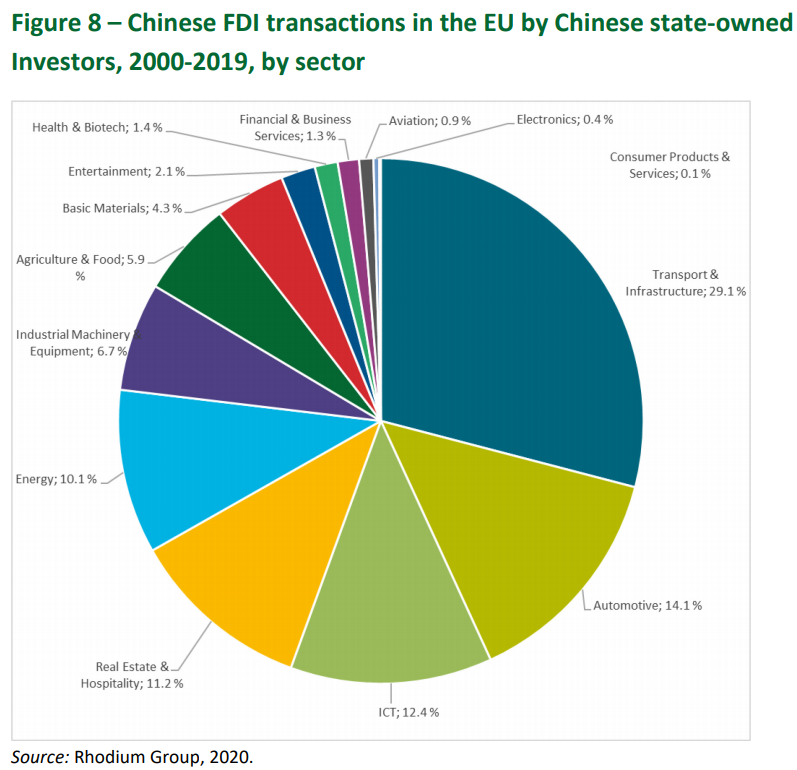
Based on Eurostat’s 2018 data, 3% of FDI flowing into the EU comes from China, totalling €202 billion, with Luxembourg and Netherlands—both favorable tax environments—being the largest recipients. The top 3 receiving sectors from 2000 to 2019 were transport and infrastructure; automotive; and ICT.
Echoing frequently raised opinions, Turtelboom complained that BRI projects have “no publicly available inventory” and there is no “inventory on member state contributions” to BRI financial institutions.
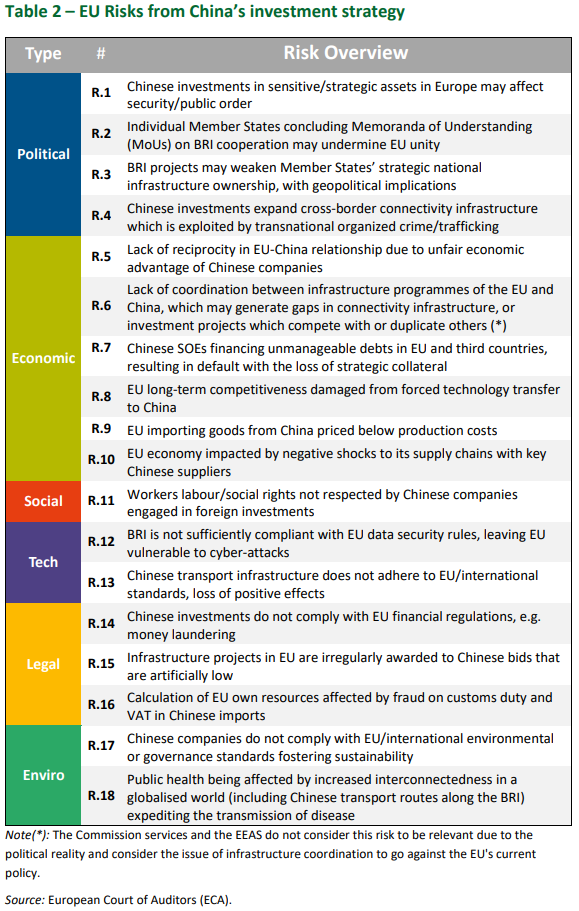
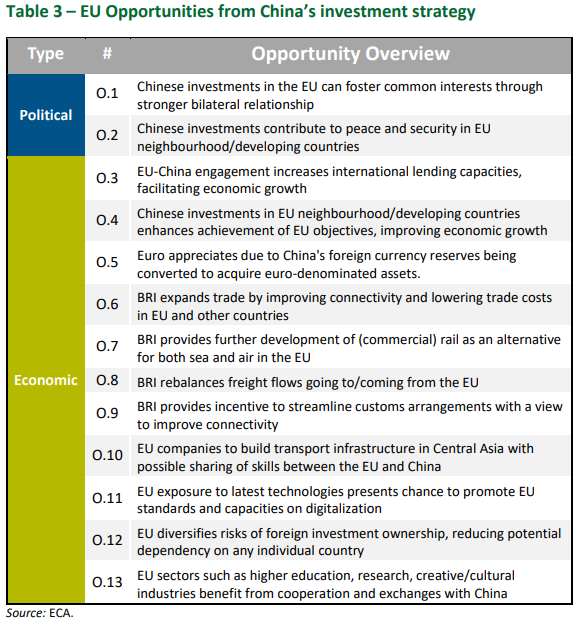
While acknowledging Chinese FDI does come with some opportunity, the report nonetheless emphasized 18 associated risks, ranging from lack of reciprocity to the undermining of EU unity.
Importantly, while most of the benefits have an economic nature, the Court goes a long way to show how Chinese FDI could have a variety of negative implications on political, legal, environmental, and technological matters.
EU & Member State Responses
As far as EU responses go, we should look at 3 main strategic documents:
Elements for a New EU Strategy on China (2016)
With 47 actions, this document is the basis for current EU-China relations. It reminds member states that bilateral agreements with China need to safeguard EU interests.
Connecting Europe and Asia - Building blocks for an EU Strategy (2018)
With 17 actions, this document outlines the EU’s wider Asia strategy
EU-China – A strategic outlook (2019)
With 10 actions, this is the latest EU strategic document on China. It seeks a more level playing field and it acknowledges the changing economic realities worldwide.
Out of the total of 74 actions from the 3 documents above, 34 are actions the EU must undertake on its own, 38 are bilateral actions that the EU and China must undertake jointly, whereas only 2 require unilateral action by China.
These actions sometimes target areas where the EU lacks full competences, which means implementation is often dependent on cooperation and coordination between the Commission and member states.
Another challenge stems from the 2019 Strategic Outlook not coming with a financial assessment, meaning the 10 actions highlighted in the Outlook were to be financed through existing EU programmes. This created instances where EU funding was used to finance projects falling under the Chinese investment strategy.
The Court also highlights how the 10 actions of the 2019 Strategic Outlook are the only actions being actively monitored, and not the 2016 and 2018 ones.
As for Member State responses, they have largely followed national interest.
The Court found that, for the past 5 years, member states have been violating a 1974 Council decision that stipulates that member states ought to inform the Commission of ‘cooperation agreements’ with third countries that have an economic or industrial nature.
For example, the report describes how 15 member states have breached EU rules by signing on to BRI deals, without prior consultation with the Commission.
The 15 are: Bulgaria, Croatia, Czech Republic, Estonia, Greece, Hungary, Italy, Latvia, Lithuania, Luxembourg, Malta, Poland, Romania, Slovakia, and Slovenia.
This secrecy towards the Berlaymont, coupled with the untransparent terms of BRI projects and other Chinese investments, makes it very difficult to monitor these bilateral agreements, let alone share data and coordinate appropriate responses.

TAKEAWAYS
► MEA CULPA
A good chunk of the report builds the case that the primary problem is not related to actions by Beijing, but to the fact that member states do not act in unity. It is clear the Commission needs to institute more efficient mechanisms to monitor investments and to hold member states accountable (the recent White Paper and the FDI screening mechanism are first steps to that end) but, ultimately, it is up to the member states to help mitigate the risks associated with Chinese investments.

READ MORE
European Court of Auditors (ECA) | European Union - Europa.eu
Review No 3/2020: The EU's response to China's state-driven investment strategy - European Court of Auditors, 2020
EU nations breaking rules in bilateral trade deals with China - Euractiv (Samuel Stolton), Sep 10
China’s influence in Europe — by the numbers - Politico (Cornelius Hirsch), Sep 14