
EU-China Briefing - 7 September 2020
YOUR WEEKLY SHOT OF EU-CHINA NEWS
BY FLAVIAN BERNEAGĂ AND GRZEGORZ STEC
1. Wang Yi Wraps up His European Tour - Final Stop and Sum Up
On September 1, Wang Yi arrived in Berlin, where he finished his diplomatic mission in Europe that had previously taken him to Italy, the Netherlands, Norway, and France.
► Wang met with German Foreign Minister Heiko Maas, who conveyed German concerns over Hong Kong and Xinjiang, and supported the Czech visit to Taiwan;
► On the day of Wang’s visit, Germany announced its strategy for the Indo-Pacific region, a clear sign of Berlin’s wish to diversify from reliance on China;
►Overall, the messages Wang shared during his trip did not resonate well with Europeans; everywhere he went, he was met with questions and concerns about China’s actions.
Final Destination: Germany
Wang Yi’s European tour came to a close in Germany, where he met with Foreign Minister Heiko Maas and President Frank-Walter Steinmeier, but not with Chancellor Angela Merkel.
Maas adopted an assertive attitude, calling on China to uphold the “one country, two systems” principle, to allow for free and fair elections in Hong Kong, and to permit a UN observer mission to investigate the “reeducation camps” in Xinjiang.
Maas told Wang that German “concerns about the effects of the national security law have not been allayed”, to which Wang retorted by saying China does “not want any foreign interference in Chinese society”.
While Maas and Wang met, exiled Hong Kong activist Nathan Law, supported by IPAC, coordinated a protest in Berlin against the security law. He decried Germany’s appeasement policy on China, calling it “really, really useless”.
During a meeting with German President Frank-Walter Steinmeier, Wang outlined 6 points for EU-China relations, which included completing the CAI and 2025 Agenda ASAP, building a green partnership, strengthening cooperation on the digital economy, and supporting international organizations.
Germany’s Turn Towards the Indo-Pacific Region
On September 1, Germany became the 2nd EU country (following France) to adopt a strategy on the Indo-Pacific region.
Berlin explained its decision by highlighting the “importance of the [...] region in both economic and political terms”; this is Germany’s second most important export destination outside of Europe.
The core underlying reasoning here is Germany’s intention to diversify its supply chains and structure of exports to scale down reliance on China. Within the strategy, the main directive appears to be closer relations with ASEAN and Southeast Asia.
The strategy also has implications for “systemic rivalry”, as the paper talks about “intensified cooperation with those countries that share our democratic and liberal values”.
Importantly, the strategy was developed using a cross-ministerial approach, which signals a more comprehensive strategy than a wide-range one. The intent may be to improve the links between political and economic goals.
Overview of Wang’s Trip
Wang Yi was not able to win hearts and minds in Europe, with his visit having the opposite effect.
Andreas Kluth captured the essence of reception of Wang’s visit saying: “Wang showed up hoping to hear the softer tones to which he’s accustomed from Europeans, who remain more eager than the Americans to keep trading and doing business with China. Instead, he was surprised at the amount of resistance he was picking up underneath the formal niceties.”
During his tour, Wang faced criticism over China’s actions in Hong Kong and Xinjiang, was chided for suggesting that COVID-19 did not originate in China, and was rebuked by some policymakers (such as Maas) for his threats against the Czech Senate leader Miloš Vystrčil, who undertook a trip to Taiwan last week. We return to this point in the next news bite.
Moreover, even though Wang talked about signing the CAI, he did not outline any concrete market reforms China would make towards that commitment.
He relied instead on previously employed rhetoric on multilateralism, combined with criticism of Trump’s unilateralism. However, this rhetoric is no longer convincing for China’s European partners.
The warmest reception Wang received was in France, where his message resonated with French scepticism towards transatlantic relations and sentiment for developing Europe’s strategic autonomy narratives.
Wang also managed to get ‘elbow bump’ pictures with some of the European officials he met, a smokescreen that is useful for domestic consumption, but one that hides the decaying trust in China that is forming among European capitals.

TAKEAWAYS
► YOU BETTER START SWIMMIN’ OR YOU’LL SINK LIKE A STONE
In our takeaway on June 1, we argued that instead of truly offering Europe a new concept that would energize Sino-European relations in the Trump era, China has been relying on the age-old narrative of multilateralism and win-win cooperation which no longer sounds credible. Wang’s visit is another case in point that China does not currently provide any novel ideas to kick-start relations and seems not ready to make any practical concessions to Europe.
Beijing’s rhetoric may be based on a belief that Europe is bound to accept (with only minor adjustments) the outdated “win-win” offer, given the continent’s reliance on trade with China, needs to uphold access to China’s vast market. Moreover, China may believe that its offer remains for the multilateralism-focused EU a necessary counterbalance to the current US administration unilateral turn.
But while the elbow bump pictures, such as with Macron, help to create an “all is well” illusion for domestic audiences, they lack the substance that would back them up. Wang won no hearts, as he was chided about China’s actions in Hong Kong and Xinjiang, and he did not win any minds either, since he did not bring forward a proposal that would give renewed impetus to CAI negotiations.
With just a week until Xi Jinping’s video conference with von der Leyen, Michel, and Merkel, Wang Yi’s trip seems to have only solidified feelings of unease in Europe about a China that is unwilling to constructively address Europe’s concerns.

READ MORE
Germany's Maas calls for withdrawal of Hong Kong security law, DW, Sep 1
China is trying to mend fences in Europe. It’s not going well. Washington Post (Gerry Shih), Sep 2
EU-China Relations: Smoke, Mirrors and Reality, Institut Montaigne (François Godement), Sep 2
2. Reactions to Vystrčil’s Taiwan Visit - Threats, Support, and Criticism
As we reported last week, Czech Senate leader Miloš Vystrčil visited Taiwan between August 30 and September 4. This week, we are summing up the visit and reactions to it.
► Vystrčil was received warmly in Taipei, where he even delivered a JFK-esque line to the Taiwanese Parliament, saying he himself is Taiwanese;
► The visit resulted in negative reactions from Beijing, with the Chinese Ministry of Foreign Affairs issuing both warnings and threats;
► In Europe, following the threats issued by PRC’s Minister of Foreign Affairs Wang Yi, Vystrčil received support from the EU, France, Germany, Slovakia, and Slovenia. Ironically, he did not receive full support at home from the Czech government.
Vystrčil’s JFK Moment
Vystrčil’s visit featured a number of notable moments.
In an address to the Legislative Yuan (Taiwanese Parliament) on September 1, the Czech policymaker received an ovation after alluding to J.F. Kennedy by saying “我是台湾人”, meaning “I am Taiwanese”.
Taiwan President Tsai Ing-wen also presented Vystrčil with a medal of honour for Jaroslav Kubera, the former Senate leader who was supposed to undertake the Taiwan visit, but passed away in January 2020 and was replaced by Vystrčil.
The two sides agreed on 23 issues related to trade, scientific research, investment, education, and public healthcare. To follow up, the Czech government is expected to form task forces to implement these agreements.
Concomitantly with the visit, the Taiwan Ministry of Foreign Affairs released a new passport front cover. The new design significantly downplays the title “Republic of China” and has a larger font for ‘Taiwan’, suggesting further distancing from the Mainland.
The argument behind this change is that, during the pandemic, Taiwanese passport holders travelling abroad were often confused for Mainland citizens.
Discontent from Beijing
Chinese officials were not happy with the visit.
While in Germany, Chinese Foreign Minister Wang Yi said Vystrčil’s visit is a “public provocation” and argued he “crossed the line” when he chose to go to Taiwan.
Wang further accused Vystrčil of pursuing political self-interest and stated his actions undermined the basis of Sino-Czech relations, the “One China principle”. Wang threatened that Vystrčil “and the anti-China forces behind him” will “pay a heavy price”.
Wang’s threats were echoed by MFA Spokesperson Zhao Lijian, who urged Czech authorities to “eliminate the negative impact of this erroneous practice” and to avoid damaging bilateral relations.
Returning Wang and Zhao’s comments, Vystrčil said each country has its own way of understanding the One China principle, a comment which must have been even more poorly received in Beijing.
Richard Turcsanyi of the Central European Institute of Asian Studies says China lacks economic clout over Prague and is unable to do meaningful harm. Nonetheless, potential targets may be similar to past Chinese sanctions against Norway. In the case of the Czech Republic targets may include boycotting Czech beer or blocking operations of Czech companies in China, such as Skoda.
Friends Abroad, Disapproval at Home
Within the EU, Vystrčil received support from Berlin, Bratislava, Brussels, Ljubljana, and Paris, but the rest of the Czech political elite was not fully happy with his trip.
The Czech government did not support the trip, as we mentioned in the previous briefing. Nonetheless, Czech Foreign Minister Tomáš Petříček said that Wang’s threats were out of line and summoned the Chinese ambassador for explanations, as a result.
After the trip ended, Czech PM Andrej Babiš harshly criticized Vystrčil’s visit, calling the Senate leader a “diplomatic amateur”, and accusing him of involving himself in Czech foreign affairs, so as to gain a PR boost ahead of regional and senate elections.
Deploying even stronger language, Czech President Miloš Zeman called Vystrčil’s visit a “boyish provocation” and said that he will no longer invite the Senate speaker to foreign policy focused meetings (despite Vystrčil holding the second most important title in the country, according to the Czech Constitution.)
On the other hand, European reactions from outside the Czech Republic showed opposition to Chinese threats. German Foreign Minister Heiko Maas said “threats don’t fit in here”, in regards to Wang’s “heavy price” statement, while a French foreign ministry spokesperson said: “any threat to the EU’s member state is unacceptable”.
Czech Commissioner and European Commission Vice-President Věra Jourová said the trip helped Czech people “straighten their backs” towards China, while Slovak President Zuzana Čaputová and Slovenian PM Janez Janša said China’s threats were “unacceptable”.
Possibly leveraging the wave of positive reactions, President Tsai Ing-wen called, on September 2, for the EU and Taiwan to open negotiations on a bilateral investment agreement.

TAKEAWAYS
► UNDIPLOMATIC DIPLOMACY FUELS SYSTEMIC RIVALRY
To be sure, the Czech government was not on board with Vystrcil’s Taiwan trip and top Czech leaders accused him of trying to build his PR with the goal of nurturing his image as a potential future presidential candidate. Even so, Wang Yi’s threats helped to propagate a different interpretation of Vystrcil’s initiative: a symbolic display of the Czech Republic’s Havelian legacy, based on values-driven diplomacy.
Wang and Zhao’s statements, likely aimed at their domestic audience, could be categorized as the most recent examples of ‘wolf warrior’ diplomacy backfiring on China. Such threats are effectively alienating China in Europe, which is contrary to the objective of preventing a transatlantic alliance aimed at containing Beijing.
► THERE IS MORE WHERE THAT CAME FROM
In the context of Wang’s threats, take note also of a speech that Xi Jinping recently gave, on the 75th anniversary of the victory against Imperial Japan during the Second World War. Xi called for the Party to adhere to a “great spirit of resisting aggression”. This was likely a taunt to Donald Trump but, in a broader context, the speech seems applicable to the Czech case too.
In the speech, Xi talked about the five “never-allow” instances: never allow the distortion of the CPC’s history; never allow the distortion of socialism with Chinese characteristics; never allow a separation between the Party and the Chinese people; never allow an individual or force to impose their will on China through bullying; and never allow any force to jeopardize peaceful life and right to development.

READ MORE
Wu hails 23 tangible feats of Czech delegation visit, Taipei Times (Lin Chia-nan), Sep 4
Czech senate president channels JFK in ‘I am Taiwanese’ speech, SCMP (Linda Lew), Sep 1
Wang Yi: Those Who Challenge The One China Principle Will Pay Heavy Price, Chinese Ministry of Foreign Affairs, Aug 31
Germany and France stand up for Prague in light of China's threats, Euractiv (Aneta Zachová), Sep 2
3. Yang Jiechi Visits Greece and Spain - Mission Unclear
If Wang Yi’s tour focused on Western Europe, Beijing sent another major diplomat, Yang Jiechi, to perform similar damage-prevention work in Southern Europe, right after Wang’s trip ended.
► Yang may not currently be as well-recognized as Wang Yi, but he is one the CCP’s top diplomats and a close aide of Xi Jinping;
► Yang’s first stop was Greece, where the talks featured trade, investment, Cosco’s stake in the port of Piraeus, and Greek-Turkish tensions in the Mediterranean;
► The second stop was Spain, where Yang likely tried to defend Huawei’s presence in the Spanish 5G rollout.
Who is Yang Jiechi?
As an interpreter and diplomat, Yang has been involved in the PRC’s and CCP’s foreign policy for the past 42 years, focusing on Sino-US relations and gradually becoming one of Xi’s top advisors.
Yang’s portfolio focused on the US. He was posted to Washington three times, in 1983-87, 1993-95, and 2001-2005, the last time as ambassador to the US. Afterwards, he served as the Minister of Foreign Affairs, between 2007 and 2013.
Yang’s expertise has been especially valued since Xi came to power: he is now the director of the Central Commission for Foreign Affairs, a small leading group, presided over by Xi, which sets the foreign policy agenda of the CCP.
It is worth noting that when Xi visited Greece and Spain in the last two years, Yang was present in both delegations.
Visit to Greece
Greece until recently, has been regarded as one of China’s main partners in Europe, through the successful BRI story of the Piraeus port.
Chinese SOE Cosco has held a majority 51% stake in the port since 2016, with the percentage expected to rise to 67% by 2021. The extra 16% in shares was agreed to during Xi’s visit last year, when it was agreed Cosco will invest €600 million more in the port.
That being said, Greek economic dependence on China shouldn’t be overblown, as Turkish actions in the Mediterranean make Athens currently prioritize security over investments.
Yang met with Greek Prime Minister Kyriakos Mitsotakis, who hoped to talk more extensively about the tensions with Turkey. However, Yang did not give any sign of support, relying instead on vague rhetoric about “peace and stability in the region”.
This is important, as Greece relies on the US and EU to ensure the security of its waters, a promise China cannot offer.
Visit to Spain
After Athens, Yang undertook a trip to Madrid, where he met with Spanish PM Pedro Sánchez and Spanish Foreign Minister Arancha González Laya.
An important context to Yang’s visit are the 5G plans of Telefonica. Spain’s largest telecom operator (and Europe’s 4th largest) announced earlier in the year that it plans to reduce reliance on Huawei equipment.
On that front, chances of Chinese success are slim. According to Mario Esteban of the Elcano Royal Institute, Spain’s strategic choices lie with Brussels and Washington. If Madrid found itself having to choose between these latter two or China, Beijing would be in the losing position.
During the meeting González Laya expressed her support for the “one country, two systems” principle in Hong Kong, called for international observers in Xinjiang, and reiterated that Spain favors freedom of navigation and overflights in the South China Sea.
Similar to Wang Yi, Yang underlined the expectations to finalize CAI negotiations by the end of 2020, but did not provide any offers or promises of market reform.

TAKEAWAYS
► WHAT WAS THE PLAN?
Yang’s importance on matters of foreign affairs raises the question of why he was not sent to deal with China’s key economic partners in Western Europe. It could have been because Yang had previously come to Athens and Madrid on diplomatic visits, but it could also be because Beijing was hoping to extract more support from Southern Europe.
The visits had a very broadly-defined mission of keeping EU countries from getting hawkish on China but, aside from that, it is hard to say whether both Wang and Yang had tangible tasks to accomplish in Europe. Hold these visits in mind in case Sino-Greek and Sino-Spanish relations take interesting turns in the coming months. For now, it is hard to say whether Yang’s mission has borne any fruits.

READ MORE
Top Chinese diplomat Yang Jiechi to visit Greece and Spain this week, SCMP (Stuart Lau), Sep 1
Greek PM calls on Ankara to stop provocations, start talks, Kathimerini, Sep 4
Meeting between Minister for Foreign Affairs and Director of Central Foreign Affairs Commission of Chinese Communist Party, Yang Jiechi, Spanish Ministry of Foreign Affairs, Sep 3
4. Borrell’s Geopolitical Vision and China’s Geopolitical Practice
On August 29, HR Josep Borrell published an article in Le Journal du Dimanche in which he outlined Europe’s challenges with China, Russia, and Turkey.
► Borrell argued that these three countries seek to shift global rules along the lines of their “great empires of the past”;
► A report by the Australian Strategic Policy Institute (ASPI), published on September 1, provides a case in point for the increasingly coercive character of Chinese diplomacy over the past decade;
► Tackling this challenge implies coalition-building on the side of countries affected by China’s growing coercion.
Empire-Sized Ambitions
In the article, HR Borrell noted the challenge of the rise of “new empires”, exemplified by China, Russia, and Turkey.
He classified these three countries as “sovereigntists”, stating they have three traits in common:
they are sovereigntists on the outside and authoritarian on the inside, implying sovereignty of the state, not the people
they perceive the world in terms of unreachable areas of influence , where only they have the power to make decisions
they want to reorganize the global order because the current one no longer serves their desire to revive past imperial ambitions
because of the focus on the state, they ignore fundamental rights and block civil societies from growing (such as, for example, China’s actions in Xinjiang and Hong Kong).
While the multilateral approach of the EU may have had the upper hand in previous decades, the tables have turned, leaving Brussels with no choice but to become more geopolitical and speak the “language of power”.
Recall that these points are not completely new. Borrell talked about them as early as February 2020.
China’s ‘Language of Power’ - Coercive Diplomacy
In the context of Borrell’s points, it is worth examining China’s “language of power”. The study by the Australian Strategic Policy Institute highlights 152 cases of Chinese coercive diplomacy since 2010, noting a sharp increase in cases since 2018.
Out of the total, 100 analysed cases were directed against 27 countries and the EU, while 52 were aimed at private companies.
“Coercive diplomacy” was defined as “the use of threats of negative actions to force the target state to change behaviour”. This is achieved through both economic measures (sanctions, investment restrictions, tourism bans) and non-economic measures (arbitrary detentions, restrictions on foreign travel, and state-issued threats).
In coercive diplomacy, China leverages its status as the largest trading partner for two-thirds of the world and uses it to protect its interests, for example in regard to 5G, Xinjiang, Tibet, and criticism over the handling of COVID-19.
The graphs below indicate that state-issued threats, trade restrictions, and tourism boycotts were the most popular methods used (Figure 5), but they also display a concerning increase in cases of coercive diplomacy since 2018 (Figure 1).
Figure 5: Cases of coercive diplomacy used by the CCP against foreign governments, by category
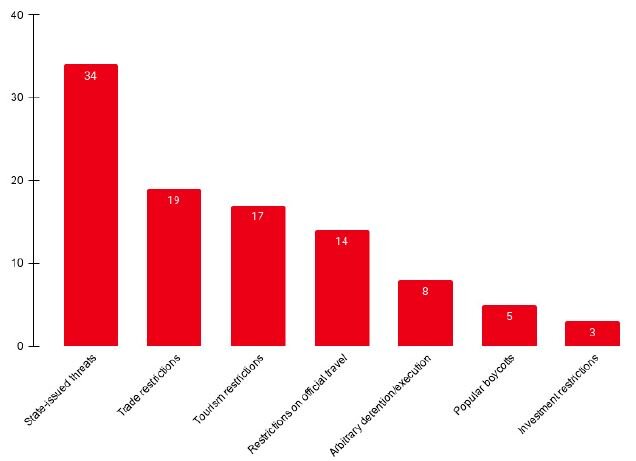
Figure 1: Cases of coercive diplomacy used by the CCP, by year, 2010 to 2019
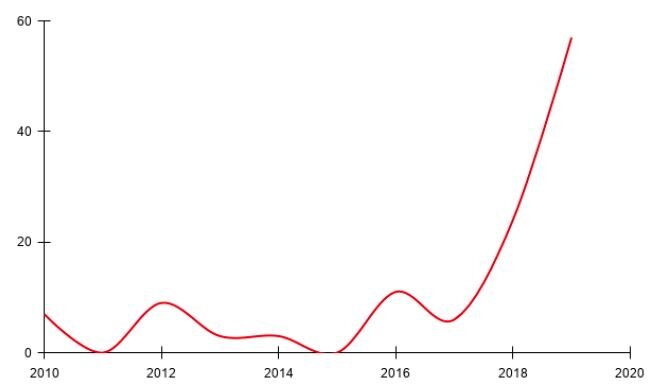
"Figure 1 shows a sharp increase in the number of recorded cases from 2018 onwards. Although it isn’t possible to show the full dataset for 2020, within the first eight months there were 34 recorded cases, which equates to more than half of the number recorded in 2019." Quoted from the report.
Taken by region, Europe gets the ‘first place’ in number of cases of coercive diplomacy (29), followed by Australia and New Zealand (20) and North America (19). Cases in the developing world, where China has earned plenty of backers, were either slim or inexistent.
In 2020 China became particularly more defensive, as it responded with coercive diplomacy to critics of the Hong Kong national security law and to those who accused it of mishandling the outbreak of COVID-19. In some cases it also used PPE deployment as a bargaining chip.
The Remedy: Make Friends!
The study highlights that, to uphold global stability and counter China’s coercive diplomacy, countries must engage in coalition-building.
This implies that countries affected by coercive diplomacy should spread awareness about China’s tactics and coordinate joint pushbacks through international formats.
For example, the study argues the Five Eyes should adopt a collective economic security measure akin to NATO’s Article 5. This would allow them to rapidly issue joint responses on coercive measures deployed by China.
Similarly, the study advises governments to develop economic, foreign, and trade protocols with private businesses that have been affected. If these businesses are targeted, the dispute could then be treated as a state-level discussion.

TAKEAWAYS
► FLOCKING TOGETHER
There are two key points in this news bite. One, the EU has to adapt to the shifting geopolitical landscape and, in Borrell’s words, has to learn to speak with the “language of power”. Two, Beijing’s increasingly coercive diplomacy, exemplified also by ‘wolf warrior rhetoric’, can only be countered by building coalitions.
Taken together, these bring us back to obvious, yet not so straightforward solutions: crafting further European unity on China and seeking alliances with like-minded actors, so that Europe has the right tools to respond to Chinese coercion. While this may be easier said than done, recent developments leave room for hope.
The fact that Germany and France both now have strategies addressing the wider Asia-Pacific region is a significant step forward. On top of that, we have seen other countries (Sweden, Netherlands, Slovakia) build their own China strategies. As more EU countries define their strategies towards China and Asia more clearly, it will become easier for the EU to develop a common stance and establish joint mechanisms to respond to China’s coercive diplomacy.
Borrell’s dream of a geopolitical Union is not as far-fetched as some may argue.

READ MORE
Europe in the face of the new empires, EEAS (Josep Borrell), Aug 30
The Chinese Communist Party's coercive diplomacy | Australian Strategic Policy Institute, Australian Strategic Policy Institute (Fergus Hanson, Emilia Currey, Tracy Beattie), Sep 1
5. New Campaigns Target Minorities and Signal Another Party Purge
In the context of Wang Yi being questioned about human rights in almost every capital he visited, it is necessary to look into the overall increased intensity of campaigns targeting ethnic minorities in China.
► In Inner Mongolia, protests began over a decision by the provincial education department to switch the teaching language of three main courses from Mongolian to Mandarin;
► On a similar note, Xi Jinping called for renewed political-ideological education in Tibet to tackle “splitism” and "plant the seeds of loving China”;
► As we told you last week, homogeneity under Xi’s rule is also a goal within the Party, as a new purge targeting potentially dissenting CCP members is in the making.
Protests in Inner Mongolia
According to the new ‘bilingual education’ initiative, Mandarin will gradually replace Mongolian in the teaching of three courses in the first 9 years of education: language and literature; morality and law (politics); and history.
In the current format, every Inner Mongolian student is granted 6-7 hours of schooling in Mongolian per day, with one hour of Mandarin schooling added in third grade. Under the proposed changes, Mandarin would completely supplant Mongolian for the three courses by 2022.
In the short term, this poses job security threats to teachers and educators. In the long-term, this policy will reduce Mongolian language literacy in the province.
A similar project done in Xinjiang between 2004-2006 created a purely Mandarin-based education system down to kindergarten, sometimes even in rural areas.
Local state media promoted the initiative, arguing it is a “concrete manifestation of love for the party and country”.
As a result of these decisions, Mongolian parents and students began to demonstrate against the bilingual education policy. Parents refused to send their children to school in protest, leaving many schools empty.
In return, Chinese police began arresting protesters, a task facilitated by the fact that Mongolian schools previously spent millions of yuan on surveillance systems, complete with facial recognition technology, which offered clear pictures of protesters to the police.
“Splitism” Obsession
Speaking at the 7th Central Symposium on Tibet Work, Xi said the recent clashes on the border with India in June call for a solidification of border defences.
The Symposium is China’s most important forum on Tibet policy and it is the first time it was held since 2015.
But the motives behind calling the Symposium may not necessarily pertain to India. A Xinhua report of the Symposium did not mention border security at all and instead focused on the need to fight local separatism.
Xi’s speech indeed took aim at building an “impregnable fortress” that would educate the locals to refuse “splittism”. As such, Xi argued Tibetan schools and Tibetan Buddhism need to adapt to socialism and Chinese characteristics.
To that goal, repression tactics previously employed in Tibet (and in Xinjiang) are being used once again. Under claims of ethnic unity, the CCP moved in June to destroy Tibetan Buddhist prayer flags and to restrict Tibetan Buddhist monasteries.
Not unlike Xinjiang, the final goal appears to be to “sinicize” Tibet and to establish a hierarchy in which religious faith falls below allegiance to the Party and the country.
New Purge Is Being Brewed
Homogeneity-guided campaigns do not only target ethnic minorities, they are also employed internally within the CCP.
As we told you last week, Xi Jinping offered a new flag to the police force in a symbol-induced ceremony which indicated the police force was now under the direct control of the Party.
The shift is believed to have implications within the CCP too. Wang Xiaohong, one of Xi’s close allies and a vice-minister for public security, published an article last week in which he warned that “two-faced people” in the police force who only pretend to obey the party (which likely means obey Xi) will be removed.
The fact that Wang mentioned “two-faced people” is important. In Party talk, it was often used during Xi Jinping’s anti-corruption campaigns in 2013 as a metaphor for the party’s discipline and unity.
One other word used by Wang is “rectification”, which echoes a resurgence of Mao’s Yan’an Rectification Movement. That movement began in the 1940’s and served to purge all of Mao’s political opponents.
The recurrence of these two words has thus led to fears that a new round of purges within the CCP is being planned, a development that would be much easier with the most recent plans announced on high-tech supervision of police officers and judges.

TAKEAWAYS
► PATTERN OF ANXIETY
As China’s more assertive foreign policy has been getting increased attention, it is worth observing the parallel radicalisation in domestic politics by the Party, with Inner Mongolia and Tibet being only the latest examples.Similarly, as with parts of ‘wolf warrior diplomacy’, campaigns targeting minorities that enforce homogenization and demand complete allegiance to the CCP do not constitute patterns of strength and confidence, but rather patterns of anxiety. It is particularly visible in targeting the Inner Mongolian population, which has been regarded by the Chinese authorities as a “model minority”, well-integrated in the Han-dominated Chinese society.
The inner-Party push for single-mindedness and purges of Xi’s opponents form a disturbing pattern, which shows further ideologization of the CCP and growing cult of personality. In a time of greater geopolitical volatility, cracking down on internal debates may lead to greater miscalculations or decisions guided primarily by ideology. Overall, it appears that Xi’s China is radicalizing on all fronts.

READ MORE
Bilingual Education in Inner Mongolia: An Explainer, Made in China Journal (Christopher P. Atwood), Aug 30
Xi says China to step up efforts to fight 'splittism' in Tibet, Al Jazeera, Aug 30
China officials run for cover as Xi Jinping prepares another brutal purge, Nikkei Asia Review (Katsuji Nakazawa), Sep 3