EU-China Briefing - 21 September 2020
YOUR WEEKLY SHOT OF EU-CHINA NEWS
BY FLAVIAN BERNEAGĂ AND GRZEGORZ STEC
1. Von der Leyen’s First State of the Union - Overview
On September 16, Ursula von der Leyen (vdL) delivered her first State of the Union speech since assuming the office of the European Commission’s President.
► Within 79 minutes, she made promises on multiple key issues, including COVID-19, the EU Green Deal, digitalization, migration, and promoting anti-racism and LGBT rights;
► On external affairs, she pleaded the EU should intensify its efforts in shaping the future international order, and made remarks about the Balkans, Africa, Turkey, and China;
►She argued that relations with Beijing are both strategic and challenging, resulting in a complex relationship that encompasses both rivalry and cooperation.
No Promise Left Unmade
VdL had a composed, but energetic speech that catered to the most important European Parliament political groups: EPP, S&D, Renew, Green.
In response to COVID-19, the Commission President called for a European Medicines Agency, a European Centre for Disease and Prevention Control, and an Agency for Biomedical Advanced Research and Development.
She committed to reducing CO2 emissions by at least 55% by 2030, announced 30% of NextGenEU will be raised through green bonds, and pledged 37% of it to EU Green Deal projects, such as hydrogen, green buildings, and charging points.
VdL also pledged a migration pact to replace the Dublin Regulation, announced 20% of NextGen EU will go towards digitalization, declared she will appoint an anti-racism coordinator, and criticized anti-LGBT zones as amounting to “humanity free zones”.
Interestingly, her SOTEU contained starkly different wording than her confirmation speech in November 2019. On Wednesday, she talked more about opportunity, crisis, fragility, and recovery.
The Fragile World of Tomorrow
VdL characterized the current crisis as an opportunity to craft change, arguing the EU “has the vision, the plan, the investment” to implement it.
She argued for strong international organizations (mentioning the UN, WHO, WTO) that help to preserve multilateralism, but also pledged her support for the reform of these institutions.
On Africa, VdL stated the EU and AU “are not just neighbours, [they] are natural partners”, further arguing Africa will play a key role on climate, digital, and trade matters.
She called Turkey an “important neighbour”, but noticed that “while we are close together on the map, the distance between us appears to be growing”, thus condemning actions against Greek “legitimate sovereignty rights”.
VdL also touched on the elections in Belarus, saying they were “neither free nor fair” and said its people ought to be able to decide their future.
SOTEU on China
VdL argued the EU-China relationship is “simultaneously one of the most strategically important and one of the most challenging we have”.
She stressed that “there is no doubt” that Europe and China “promote very different systems of governance and society”, but argued that, nonetheless, relations can improve if China honors its environmental and market access commitments.
Recall how during the Summit, Xi Jinping said the EU has its own problems and should not lecture China on human rights? Von der Leyen appears to have answered in the SOTEU by arguing that while Europe has its issues, “criticism and opposition are not only accepted but legally protected.”
She implied that the EU’s sluggish human rights responses are due to member states delaying policies in the Council (blaming, in turn, the EU for being slow). VdL urged the member states to “be courageous and finally move to qualified majority voting – at least on human rights and sanctions implementation”.
In the context of human rights, von der Leyen specifically mentioned Xinjiang and Hong Kong, arguing it is the EU’s duty to “call out human rights abuses”. In her final comment on China in the speech, vdL mentioned that a long-awaited proposal for a European Magnitsky Act will be put forward by the Commission.

TAKEAWAYS
► FIRST IMPRESSIONS MATTER
Less than a year after assuming office, this was Ursula von der Leyen’s first State of the Union speech. It was one of the longest SOTEU speech in recent times, only surpassed by Juncker’s speech in 2015 during the migration crisis. Understandably, the length came with lots of commitments, as vdL seemed to have made ambitious pledges to all stakeholders: about the EU Green Deal, digitalization, migration, China, and so on. In part, this is sweet-talking to the Parliament, whose cooperation is needed to approve the budget but, on a deeper level, the topics she talked about constitute the EU’s most pressing problems. This shows she has a good grasp on what legislative files ought to be prioritized. Still, decision-making is the art of compromise, a feat particularly true in Brussels: even if Parliament is happy, the Council will need to be equally content.

READ MORE
State of the Union Address by President von der Leyen at the European Parliament Plenary - European Commission, Sep 16
Ursula von der Leyen’s State of the Union speech — compared - Politico (Cornelius Hirsch), Sep 16
State of the Union speech - Building the world we want to live in: A Union of Vitality in a World of Fragility - European External Action Service, Sep 16
2. Beijing Defends Its Actions in Xinjiang, EU Considers Stepping Up Creation of European Magnitsky Act
During the EU-China Summit on September 14, Xi Jinping extended an invitation to European observers to visit Xinjiang in order to see the “real situation”.
► Also, on September 17 China published a white paper, which claimed that facilities in Xinjiang are re-education camps that help the state in alleviating poverty;
► Understandably, the invitation was met with skepticism, since previous official visits to Xinjiang by international observers were both carefully orchestrated and limited in scope;
► In her SOTEU, von der Leyen mentioned Xinjiang in relation to the Commission’s decision to create a European Magnitsky Act for sanctions against human rights violations.
China’s Line
Xi’s invitation at the video conference was doubled down by Foreign Minister Wang Yi and Spokesperson Wang Webin.
The two stated China will “always welcome friends from all over the world, including the European side, to visit Xinjiang and see with their own eyes the real situation there”.
Nonetheless, Wang Webin said China opposes “any investigation with the presumption of guilt”, raising questions whether the visit could truly lead to an independent investigation.
Particularly so, as EU officials were previously invited in March and November 2019 to visit Xinjiang, but declined on the ground that the visit came with conditions that undermined the visits’ raisons d'être, i.e., forbidding discussion on human rights and forbidding meetings with Xinjiang CCP head Chen Quanguo.
In a white paper published on September 17 titled “Employment and Labour Rights in Xinjiang”, Chinese authorities argued its policies in Xinjiang constituted nothing but “employment-oriented training on standard spoken and written Chinese, legal knowledge, general know-how for urban life and labour skills”.
The paper argues almost half of the 1.3 million Uyghurs ‘enrolled’ in these programs every year came from poor areas in South Xinjiang, implying that training was a “social service to improve people’s livelihood and alleviate poverty”.
Skepticism All Over
The honesty of the white paper was questioned, but experts treated it as further proof of forced labour taking place in the Xinjiang camps.
Adrian Zenz, a researcher on Xinjiang and Tibet, and an IPAC expert called it “unlikely” that the 1.3 million workers truly went through training. Instead, he argued, they were much more likely to have been subjected to forced labour.
Zenz did point out that the paper said the Xinjiang labour force increased from 11.3 million workers to 13.3 million between 2014-2019, a number not made public previously. This matches with the crackdown on Uyghurs that began in 2017.
In July, a coalition of civil society organisations and trade unions called for an end to forced Uyghur labour. The coalition’s findings show that 84% of Chinese cotton comes from Xinjiang, as so does 20% of the cotton bought worldwide, with many Uyghurs being subject to forced labour.
On that note, Swedish clothing company H&M announced on September 15 that it will cut ties with Xinjiang-based yarn producer Huafu Fashion, over allegations that the producer was connected to practices of Uyghur forced labour in some of its factories.
On a similar note, the foreign affairs committee in the British House of Commons launched an investigation into minority oppression in Xinjiang. Its scope is to determine how the government can prevent UK companies from being entangled with factories employing Uyghur forced labour in Xinjiang.
European Magnitsky Incoming
In the portion of her SOTEU speech related to China, von der Leyen pledged a European Magnitsky Act (HR Borrell suggested calling it the ‘Navalny Act’) to respond to human rights abuses, including in Xinjiang.
The Magnitsky Act is the public name of a 2012 US law that imposed sanctions on Russian officials involved in the death of Sergei Magnitsky. The act later became applicable globally in human rights violations.
According to a senior EU diplomat speaking under anonymity, the proposal of the Act can be expected in the coming few weeks.
If the EU was to follow in the footsteps of the US Magnitsky Act, it could go after the assets of human rights violators and ban them from traveling or from using the global financial system.

TAKEAWAYS
► RIVALRY BOOST IN THE MAKING
One of the promises that got von der Leyen a round of applause from the MEP’s present for her SOTEU was her pledge to push for qualified majority voting on foreign affairs matters (or, as she said it, “at least on human rights and sanctions implementation”). Not coincidentally, this pledge was followed by the promise of a European Magnitsky Act. The QMV and the European Magnitsky Act have real potential to be mutual proxies for each other. Given the international environment (Hong Kong, Xinjiang, Belarus, Navalny’s poisoning), a European Magnitsky is now more salient. To breach unanimity obstacles on a European Magnitisky, QMV is required: the two could come as a package.
However unlikely, for von der Leyen, getting both of them implemented would be a huge success, and would testify to a pattern of successful crisis-induced policy-making that did not quite develop under the crises that occurred during Juncker and Barrosso’s stints.
If the Act comes through and is applied to China too (namely on Xinjiang and Hong Kong), it will further highlight systemic rivalry on human rights. Beijing would likely not take that kindly.

READ MORE
China’s white paper on Xinjiang ‘may point to forced labour claims’ - SCMP (Linda Lew), Sep 18
Borrell: EU should shame Russia with 'Navalny Act' - EUObserver (Andrew Rettman), Sep 16
How the EU plans to take on human rights abusers - Axios (Zachary Basu), Sep 17
3. Pompeo Moves to Solidify US-EU Cooperation on China
By the end of September, Josep Borrell and Mike Pompeo are expected to hold their first US-EU Dialogue on China, plans for which were initially announced in late June.
► On top of this, Mike Pompeo has also scheduled official visits to Italy and Greece, one month after Wang Yi and Yang Jiechi undertook similar trips in Rome and Athens;
► Pompeo will also visit the Vatican, at a time when the city-state is in talks of renewing a deal with China (although it has also been subjected to cybersecurity attacks from China);
► In the meantime, countries in Central and Eastern Europe continue to support the United States’ strategy on Huawei.
US-EU Dialogue on China
The US and the EU are expected to hold their first Dialogue on China by the end of September, in a background of increased EU-China systemic rivalry.
An anonymous diplomat stated Borrell will formally propose the initiative to the EU27 foreign ministers when they meet on September 21, with the Dialogue expected to take place on a regular basis.
Recall that Borrell pitched the idea of a Dialogue in a call with Mike Pompeo in June, but the latter did not initially display active interest. The change of mind on his part coincides with a change of approach on how to respond to China in Washington, best exemplified by Pompeo’s “Communist China and the Free World” speech.
For Beijing, this Dialogue is not good news. In the past month, Wang Yi, Yang Jiechi, and most recently Xi Jinping have appealed to the EU to “resist” US calls for cooperation against China.
When in Rome
Pompeo has also scheduled visits to Italy and the Vatican by the end of September, which comes mere weeks after Wang Yi’s official visit in Rome.
In Italy, Pompeo will likely want to talk about the Trieste port, which has awarded pilot projects to the China Communications Construction Company (CCCC) as part of the BRI. Notably, five CCCC subsidiaries were sanctioned by the US in August for their involvement in the South China Sea developments.
Despite signing the BRI in March 2019, Italy has been reassessing its ties with Beijing over the last year. In the most recent development, on September 15, the Italian Minister for European affairs, Vincenzo Amendola, stressed that Italy’s trade with China can only happen through the medium of EU-China trade, since trade competences reside with the European Commission.
In the Vatican, Pompeo will likely touch on the Vatican-China deal on the appointment of bishops. The two-year deal (which is very controversial, partially due to its secrecy) was signed in 2018 and is now up for renewal.
However, mistreatment of Catholics has continued in China. Priests in Jiangxi province were placed under house arrest, while priests in Yujiang were banned from engaging in religious activities after they refused to join the “patriotic church”.
Recall that in early August, US cyber company Recorded Future alleged that it knew Chinese hackers were behind a series of cyberattacks on the Vatican’s computer network.
On September 15, Recorded Future claimed it had proof of these cyberattacks, which sought to also track communications between the Vatican and the diocese in Hong Kong.
Pompeo is also expected to undertake a visit in Greece on September 28, where he will visit Athens, Thessaloniki, and the NATO base in Crete. This will come just weeks after Yang Jiechi’s visit to Greece.
CEE Is On Board with US’ Huawei Strategy
As Pompeo is preparing to win hearts and minds in Southern Europe, recall that many countries in Central and Eastern Europe already align with the US on 5G matters.
On September 15, Huawei failed to obtain a security clearance from the Czech National Security Office, which prompted Huawei to request stopping the review process and consider asking for a lower level of verification. Nonetheless, this does not equate to a ban on Huawei working with Czech operators to build the 5G network.
On September 8, Poland released a draft cybersecurity law that categorizes operators into 4 groups, based on their risk. The assessment criteria looks at the level of dependence the company has on a non-EU or NATO government, and also checks if human rights are respected in the country the company comes from.
the law would constitute one of the harshest European responses to Huawei yet. Aside from the link between human rights and cybersecurity, the assessment on suppliers would be done by a so-called Cybersecurity College, made of the Polish Prime Minister and heads of security services.
On September 16, Lithuanian Foreign Affairs Minister Linas Linkevičius travelled to Washington, where he was expected to meet with Pompeo and sign a memorandum of understanding on 5G.
This memorandum is very similar to documents signed between the US and other CEE countries, including Estonia, Latvia, Czech Republic, Poland, Romania, and Slovenia. In contrast, Hungary and Slovakia (countries where the US did not reach out to exert influence) have not taken steps to ban Huawei from their 5G infrastructure.
The broad support for memorandums with the US appears to be closely tied to the security guarantees that Washington provides to the region through NATO.

TAKEAWAYS
► ELECTIONS TIME?
Pompeo’s intensified efforts to win friends in Europe comes just weeks ahead of the US elections and the two are definitely interrelated. Aside from the general trajectory of the American strategy, speeches on communist China, photo-ops with European leaders, and memorandums of understanding help the US administration convince the domestic audience that the Trump presidency is capable of mustering an anti-China alliance. Moreover, it's not just about China. Think, for example, how Trump recently took credit for stopping “mass killings” between Serbians and Kosovars that “have been happening for hundreds of years”.
While many CEE countries may be on board with US strategy while keeping NATO in mind, their decisions on 5G are equally influenced by the push towards stricter regulations coming from the Commission’s 5G Toolbox. If concrete outcomes are to be also gained in Western Europe, a change of administration (and rhetoric) may be needed.

READ MORE
Pompeo and top EU diplomat to discuss ‘shared concerns about China - SCMP (Stuart Lau), Sep 19
Italy Hardens Stance on China, In Line With EU Investment Push - Bloomberg (John Follian and Chiara Albanese), Sep 15
Huawei fears it may be excluded from Poland's 5G network - Euractiv, Sep 10
4. EU-Taiwan Investment Forum Comes at a Particular Time
The EU and Taiwan will hold an investment forum on September 22, which will advertise the European investment environment to Taiwanese companies.
► This comes after Taiwan President Tsai Ing-wen pleaded for an EU-Taiwan investment deal on September 2;
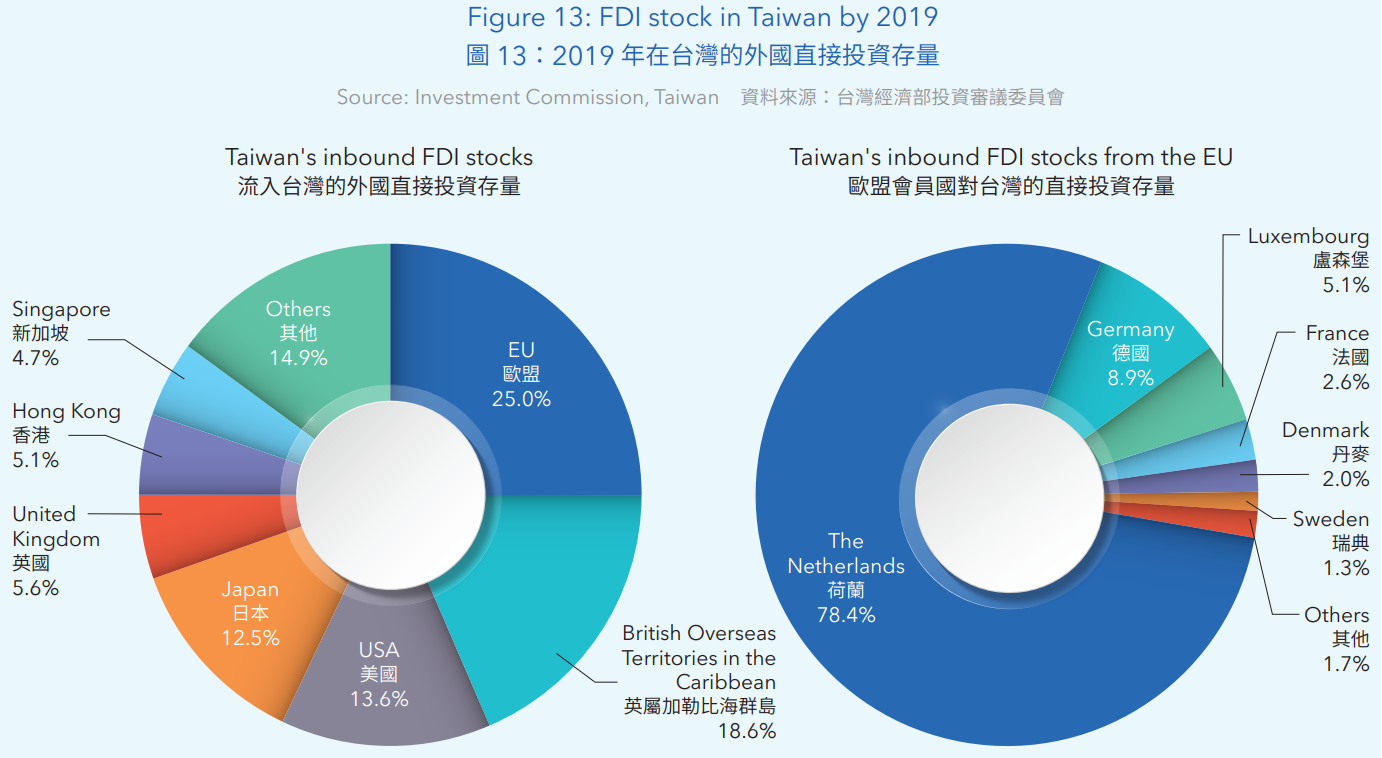
► The EU is the 4th largest investor in Taiwan, amounting to 25% of the total foreign direct investment present on the island;
► As tensions with the Mainland have been escalating, Taipei has been keen to build closer ties with like-minded international actors.
Investment Deal In the Making?
The Investment Forum in Taipei is helpful both for the EU (which wants to diversify supply chains) and Taiwan (which wants to build better relations with important global actors).
The event is geared towards pitching to Taiwan the European investment arena, but it could also help solidify the ground for a future investment deal.
During a speech at the European Chamber of Commerce in Taipei earlier this month, President Tsai said she hopes the two sides will start discussing an investment agreement, complete with broadened economic and trade cooperation.
For context, the Forum will happen only one month after the Czech leader of the Senate, Miloš Vystrčil, paid an official visit to Taipei, and mere weeks after an article was published by nine MEP’s and China experts, calling on the EU to reassess its ‘One China’ policy.
Current State of EU-Taiwan Relations
Aside from being like-minded on the international stage—maintaining dialogues on human rights, judicial exchange, and supporting LGBT rights—Taiwan and the EU sport a vivid economic relationship.
The total trade between the two sides stands at €50.5 billion, with €23.6 billion worth of EU exports flowing into Taiwan, and €27 billion worth of Taiwanese exports flowing into the EU.
The trade volume between the two sides has been increasing for the past 8 years, thus allowing the EU to become Taiwan’s 4th largest trading partner. In turn, Taiwan is the EU’s 15th largest trading partner.
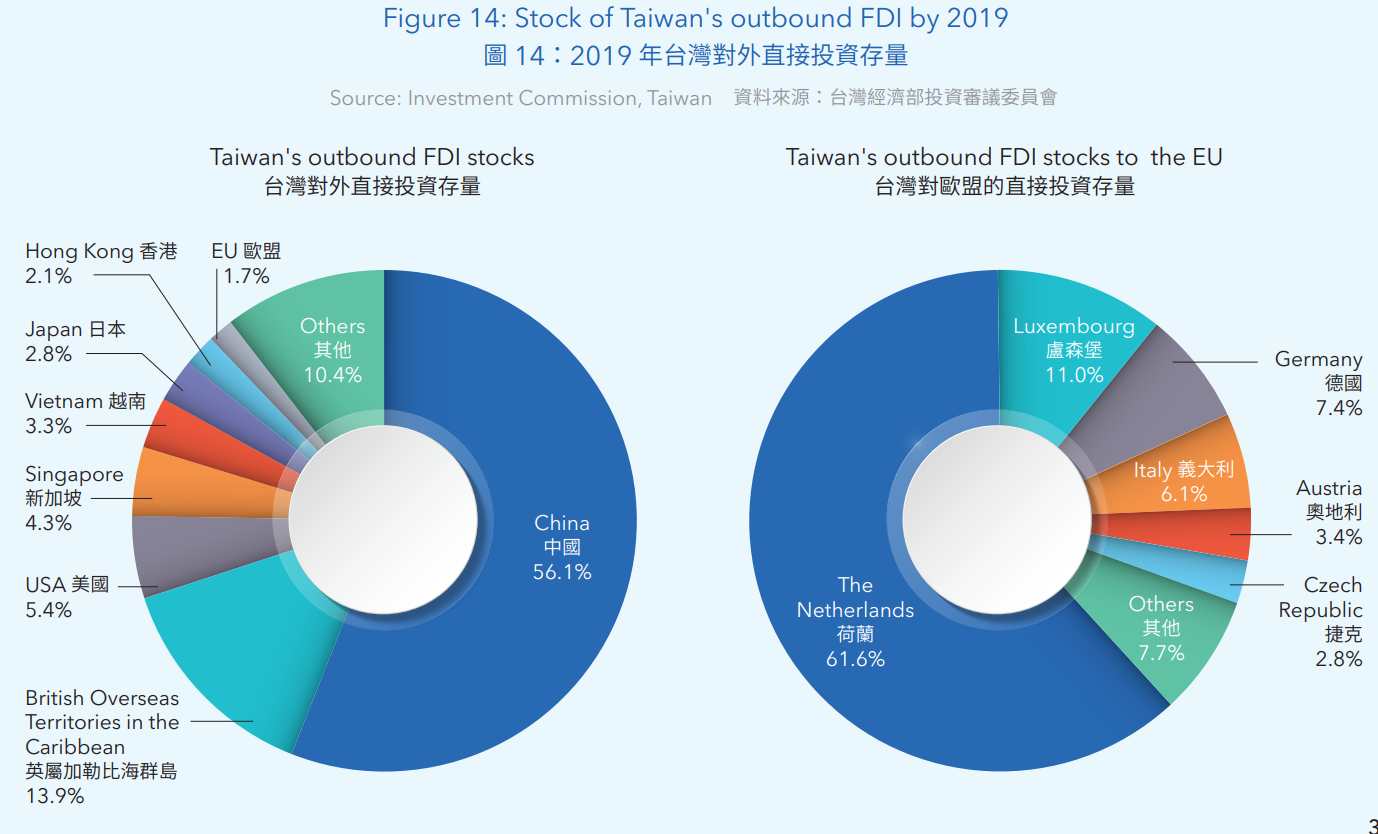
The EU is also the largest provider of FDI in Taiwan (25% of total), though only 1.7% of Taiwan’s FDI flows into the EU (thus making the investment forum more salient). The EU FDI into Taiwan is, however,not very diversified: more than 75% of it comes from the Netherlands.
Within the EU, Taiwan does the most trade with Germany (31.4%) and the Netherlands (28.9%), with France being in a far 3rd spot (7.4%).
Also, bear in mind the #Taiwancanhelp initiative from April, when Taiwan offered to donate 7 million masks to the EU, UK, and Switzerland.
Uneasy Neighbourhood
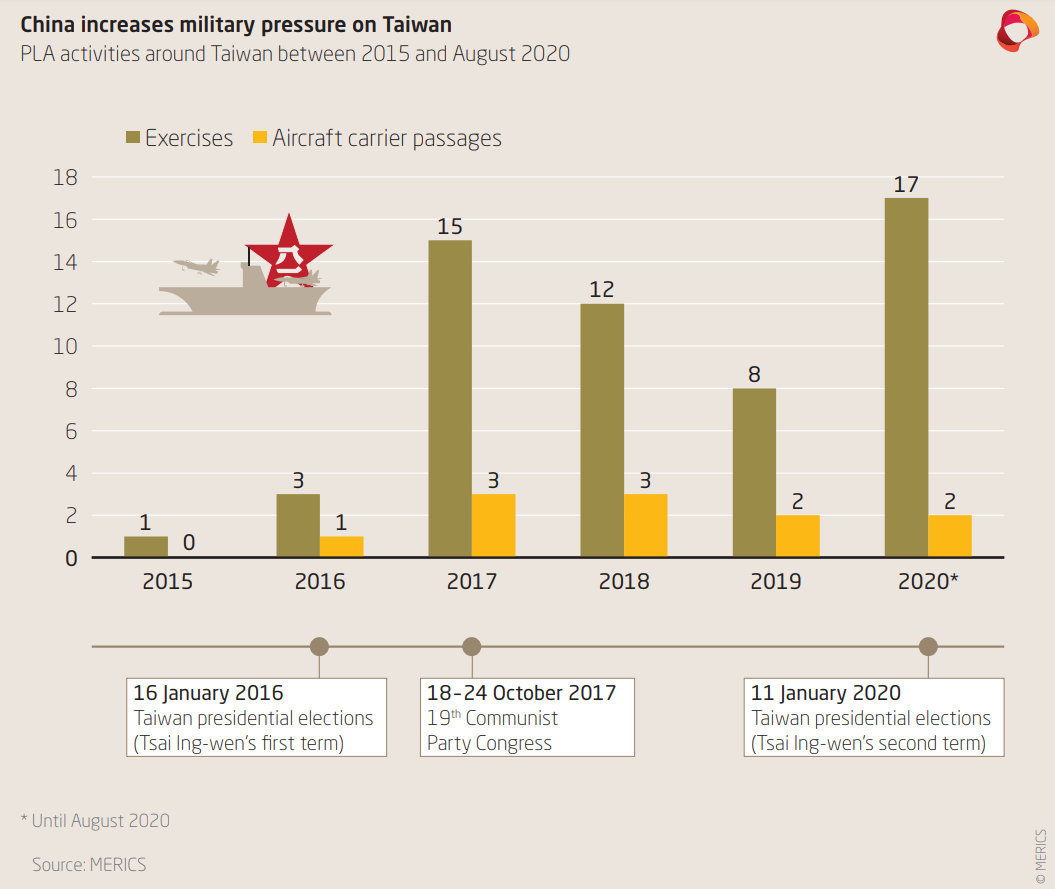
As PLA military activities in the Taiwan Strait have increased in number, Taipei has been investing more efforts into boosting its international standing, including with the EU.
Until recently, the ‘One Country, Two Systems’ framework in Hong Kong was promoted by Beijing as a potential peaceful way for Taiwan to reunite with the Mainland. However, Hong Kong protests, and their culmination in the national security law, have effectively eliminated that possibility.
Moreover, since January, the PLA has staged no less than 17 military exercises in Taiwan’s vicinity, more than in the entirety of 2017, 2018, or 2019.
Another strong arm tactic took place on September 18, when Beijing deployed 18 fighter jets and bombers in the Taiwan Strait, while US economic representative Keith Krach was present in Taipei for a series of meetings.
Taiwan’s army is also not sufficiently prepared for a potential conflict. Until recently, Taiwan’s defence was secured through sales of high-quality weapons from its allies in the US and Europe, but the balance is shifting.
China’s enhanced military capabilities, coupled with decreases in weapons sales to Taiwan, as well as the outdated status of current Taiwanese military tech and equipment, have made the Pentagon reckon that the island is in an increasingly disadvantageous military position against the mainland.

TAKEAWAYS
► ENGAGE!
The Taiwan Strait is heating up, and the EU can play an active role in cooling it down, even if it means systemic rivalry with China develops further. As experts argued in the Handelsblatt/Le Monde article, it is high time for the EU to support Taiwan, not by supporting its independence, since that would cause unnecessary friction with the Mainland, but through supporting its current status as a liberal democracy outside of Beijing’s direct sphere of influence.
To that end, the EU can expand its economic ties with Taipei. Only 1.7% of Taiwan’s FDI goes to the EU (compared to the 56% that goes to mainland China), so this is one area of opportunities for improved relations. In expanding its trade with Taiwan,the EU would also work towards the goal of diversifying supply chains, which would fall in line with recent German and French strategies for the Indo-Pacific region. Based on all this, the upcoming economic forum should be quite an important event.

READ MORE
President Tsai calls for Taiwan-EU bilateral investment deal, Taiwan Today, Sep 3
EU-Taiwan Relations - European Economic and Trade Office, 2020
China's military buildup, attitude toward Taiwan raises conflict fears, Business Insider (Benjamin Brimelow), Sep 3
Towards a "Principles First Approach" in Europe's China Policy - MERICS, Sep 2020
5. Zhenhua Scandal - China’s ‘Cambridge Analytica’ or Overblown Story?
On September 14, a leak emerged about Shenzhen-based company Zhenhua Data, which has allegedly collected a database of personal information on 2.4 million high-profile individuals - including Europeans.
► The leak has been reported by some media as a breakthrough story, due to Zhenhua’s alleged ties with the People’s LIberation Army and the Chinese Communist Party;
► But other experts suggest the findings are not of high importance, since they lack the analysis to make them useful for military purposes and the ties with PLA are actually speculative in nature;
► Still, outgoing chief of the UK National Cyber Security Centre, Ciaram Martin, urges increased caution regarding data protection.
"Cambridge Analytica on steroids"
The Zhenhua leak was initially shared with US academic Christopher Balding, who previously lived in Shenzhen and intended to research Huawei. Balding then shared the information with an Australian cybersecurity consultancy, Internet 2.0.
Zhenhua gathered detailed personal information, such as dates of birth, addresses, marital status, photos, political orientation, relatives, and social media of high-profile individuals.
The data was gathered from both public sources (Twitter, Facebook, LinkedIn, TikTok, Instagram, news) and private sources (bank records, job applications, criminal records, psychological profiles). Some of the data is also believed to have originated in the “dark web”.
The people targeted included politicians, the British royal family, celebrities, and military personnel, China watchers, and relatives of foreign leaders. The company’s goal appears to have been to sell analytical reports based on the gathered data to Chinese military, government, and commercial clients.
Analyzing the Leak
On closer inspection, however, Zhenhua’s story may not be as dramatic as some media presented it.
The company’s data collection might have been done using AI, but it lacked the analytical capacity to make the materials useful for military or intelligence operations. Furthermore, Zhenhua is a small firm that does not appear to be used now by the Chinese authorities, but wanted to target them as potential customers.
Zhenhua markets itself as a patriotic company and states that its main targeted customer is the Chinese army. This offers a perspective into Zhenhua’s ambitions and may show the interests of the Chinese military.
Still, Zhenhua’s partners include TRS, Huarong, and Global Tone CommunicationTechnology, which have previously interacted with the PLA or the central government, and have all provided data analysis for clients within these two institutions.
Warnings from a Pro
In this context, it is useful to take note of an advice from the outgoing chief of the UK National Cyber Security Centre, Ciaram Martin.
In an interview with POLITICO, Martin issued a warning that Chinese companies gather large amounts of data to build AI models.
He stated that attention should be paid to Chinese applications, such as TikTok, that may acquire substantial amounts of data on its users. Consequently, this would give China a “competitive advantage” in artificial intelligence–fuelled data processing, equating to a risk for Western democracies.
Nonetheless, Martin did not solely categorize TikTok as a security threat and states that “anything to do with social media and data poses a set of challenges where people should exercise great care”. He, therefore, urged the European countries to beef up data protection.

TAKEAWAYS
► CAUTION BUT RATIONAL
Zhenhua’s story is a tale of two paradoxical, yet fully compatible, cautions.
The first one is a caution against paranoia, which shows how any discourse on China can become imbued with overblown reporting and aggrandized rhetoric. Zhenhua appears to not be a second Cambridge Analytica, but a company whose data gathering methods are rendered almost useless by the fact that it lacks good data analysis. Moreover, for privacy protection’s sake, it is useful to note that even more sophisticated mechanisms are already applied by Western governments and companies (e.g. Facebook).
The second caution is a caution against overrelaxation. Simply saying “our guys do it, therefore why would China not do it?” is also very risky. It obscures a wider trend of Chinese services being interested in crafting military-civil cooperation and establishing complex profiles on important Western individuals. If that is currently an issue, think how much bigger it will become once 5G (and other future generations) become the norm, and everything from households to hospitals could be guided by the ‘Internet of things’. Caution is needed, but it should always be based on cool-headed facts.

READ MORE
Chinese firm harvests social media posts, data of prominent Americans and military, Washington Post (Gerry Shih), Sep 14
Ex-UK cyber chief warns of Chinese data grab , Politico (Nicholas Vinocur), Sep 18