EU-China Briefing - 28 September 2020
YOUR WEEKLY SHOT OF EU-CHINA NEWS
BY FLAVIAN BERNEAGĂ AND GRZEGORZ STEC
1. Xi Pledges Carbon Neutrality by 2060
During the UN 75th General Assembly, held over video conference on September 22, President Xi vowed China will reach peak emissions before 2030 and carbon neutrality by 2060.
► The announcement was surprising, given that Xi’s speech was focused on combating COVID-19;
► Experts praised the climate leadership initiative, but indicated its carbon-intensive economy makes structural reform difficult;
►The EU also welcomed China’s commitment, but also said “a lot” is yet to be done.
A Promise as Large as China
The pledge (minutes after Donald Trump’s speech) was framed in connection to the fight against COVID-19, with Xi saying the virus outlined the necessity of a “green revolution”.
The 2060 deadline marks the first time China has established a long-term goal on emission targets. Until now, all commitments simply stated China would peak emissions before 2030. On the other hand, Xi did not outline how these targets would be reached and what the exact deadline would be.
Xi said: “Humankind can no longer afford to ignore the repeated warnings of Nature and go down the beaten path of extracting resources without investing in conservation, pursuing development at the expense of protection, and exploiting resources without restoration.”
The significance of China’s commitment is enormous, given that it is currently responsible for 28% of global CO2 emissions. During the first months of the pandemic, the emissions in China dropped by 25%, though they gained back ground as coal plants, cement factories, and heavy industry resumed work.
How Feasible Is It?
Xi’s announcement bears both strategic and concrete benefits, though both of them are reliant on China actively meeting its commitment.
On a geostrategic level, China will be seen in a better light for announcing its commitment now (instead of after the US election). It also marks a clear global leadership initiative, after the coronavirus had largely stalled climate targets.
Much is dependent on the Chinese government laying out concrete plans, which will require not only technological innovation but also a designed transition in the economy and the workforce.
As of now, 60% of China’s power production is coal-reliant (new coal-fired power plants went into operation in 2020 at the fastest rate since 2015). In broad terms, China’s 14th Five-Year Plan, to be announced in the spring of 2021, will be decisive in understanding whether or not the announcement is empty talk.
Existing trends offer a worrying perspective: the Chinese government has stalled financial support for wind and solar power installations, starting in 2021. To that end, the 2021 Five-Year Plan needs to provide more impetus on policy geared towards supplying electricity from renewable sources.
The elephant in the room is China’s fossil fuel industry - this big stakeholder would need to adapt to an energy sector it no longer dominates. According to Michal Meidan of OIES, the dual circulation economy “lays the foundation for accelerated innovation in key technologies underpinning the global energy transition”.
The EU’s Take
News of the pledge were welcomed in Brussels, although EU leaders are equally keen to find out if China will follow through.
Recall that during the video summit between EU leaders and Xi Jinping on September 14, the European side hoped China would adopt the 2060 deadline. Furthermore, the EU suggested peak emissions should be reached by 2025, instead of 2030.
On tackling climate change, the EU and China displayed commitment to cooperation, one of the few areas that did not appear to be marked by an increasingly present systemic rivalry.
Nonetheless, while Ursula von der Leyen welcomed Xi’s announcement, calling it “an important step”, she also declared “a lot of work remains to be done”, implying that pledges are only the bare minimum for cooperation.

TAKEAWAYS
► HOLD YOUR CHEER
In a so-far rather turbulent 2020, Xi’s announcement appears an burst of oxygen on a topic as crucial as climate change, but we should recall this is not the first time Xi sends a message pleasant to the EU’s ears. At the 2017 Davos Summit, he threw his support behind multilateralism and pledged to open up the economy, which contrasted with Donald Trump’s isolationist speech. But these promises have not materialized in the way Europeans interpreted them. In fact, we now see the shift to Marxist political economy thinking and the increased role of the SOEs within the dual circulation strategy. Similarly, the EU has not been satisfied when it comes to cooperation on WTO reform.
We also don’t quite know how China plans to meet its climate thresholds. Currently, 72% of coal-fired plants to be constructed outside of China are dependent on Chinese money and coal remained the dominant fuel within China in 2019. The story is not all grim, though. Coal’s share of total energy consumption in China dropped to a historic low of 58% in 2018, while renewable energy consumption grew by 29% (to 45% of global renewable energy consumption). The big problem here is the pace of change. Under current patterns, coal usage is not decreasing at a sufficient rate to hit the 2030 peak and 2060 carbon neutrality targets, and neither is renewable energy gaining enough ground to offset the balance.
All that is left for now on this subject is to wait for the 14th Five Year Plan in the spring and see if the Chinese government is truly putting together one of the more ambitious environmental projects of our era, or if Xi’s 2020 UNGA speech is just another Davos. We have our fingers crossed that Xi really meant it, which would create real space for reinvigorated EU-China cooperation.

READ MORE
Statement by HE Xi Jinping President of the People's Republic of China At the General Debate of the 75th Session of The United Nations General Assembly - Ministry of Foreign Affairs of the People’s Republic of China, Sep 22
China’s carbon pledge revives hopes of a climate game change - Financial Times (Christian Shepherd), Sep 23
EU backs China carbon neutral pledge but ‘more work to be done’ - SCMP (Stuart Lau), Sep 23
2. Ambassador Zhang Ming’s Hearing at the European Parliament - Overview
On September 21, the European Parliament’s Foreign Affairs Committee held a hearing with Zhang Ming, China’s Ambassador to the EU, as the guest.
► Zhang raised narratives of cooperation and repudiated systemic rivalry, borrowing rhetoric from Xi’s summit with European leaders a week before;
► The EU side, particularly through Gunnar Wiegand, the EEAS Director on Asia, expressed a sterner stance, pointing to the ongoing shift towards a more “realist” China policy at the EU level;
► Reinhard Bütikofer, the Parliament’s Chair of the Delegation for Relations with the PRC, delivered an introductory remark that stressed the EU’s change in approach is in reaction to China’s increasingly aggressive foreign policy.
Echoing the Summit
The MEP’s and Zhang rehashed the points made on September 14 between Xi, Merkel, Michel, and von der Leyen.
On CAI, Zhang encouraged the EU to find a “mutually accommodating spirit”. This was new wording for the concept of limiting the EU’s demand, which has been rejected by von der Leyen, who has refused to “meet China halfway”, arguing that the EU’s market is far more open than China’s.
Mirroring Xi’s “four insists”, Zhang said that, while the EU and China may have their disagreements, these are based on differences in history, tradition, and social systems. As a result, what needs to be promoted instead is peaceful coexistence, openness and cooperation, multilateralism, and increased dialogue.
Zhang also rebuked systemic rivalry as unnecessary given that “our rival is the virus, not each other”. Still, he pointed out that China does not want to see “meddling” in its internal affairs, a response to the EU’s reactions to human rights abuses in China.
The Ambassador also pointed out China’s progress since his arrival to Brussels in 2017, arguing that China’s ranking on ease of doing business went up, from 78th to 31st. Conversely, Zhang stated the EU has become more protectionist, causing unease among Chinese businesses seeking to operate in the European market (we discuss this in another news bite).
Not Impressed
The EP’s Foreign Affairs Committee was joined by Gunnar Wiegand, the Managing Director for Asia and the Pacific of the EEAS. In his comments, Wiegand delivered a solid message that the EU’s approach to China has become “more realist”.
Wiegand stressed that China’s actions, as well as the spread of the virus, have greatly contributed to this sense of realism. He further argued that 2020—a “pivotal year for EU-China relations”—will define China’s commitment to its cooperation agenda, which may be defining for establishing the EU-China Agenda 2025.
Wiegand borrowed from Deng Xiaoping’s famous saying of “seeking truth from facts” (which Deng borrowed from Mao), in order to express that the EU should look at the plain realities and assess whether the benefits it extracts outweigh the costs within the EU-China status quo.
On the EU’s stance in US-China disputes, Wiegand said that, “while we maintain close relations with China and the US, we are unequivocally non-equidistant. The Transatlantic relationship runs close and deep, whatever the policy differences may be”.
Though it dominated, systemic rivalry was not the only topic, with Wiegand himself arguing that cooperation is indeed needed on global issues, such as fighting climate change.
On the One China Policy, Wiegand said the EU reserves the right to pursue good relations with Taipei (which he evaluated as “excellent”) and that it may plan to expand them further, while acknowledging the Mainland is the one that has the EU’s diplomatic recognition. German/EPP MEP Michael Gahler went even further, saying the Mainland’s actions in the Taiwan Strait “may undermine our commitment to One China Policy”.
Bütikofer’s Overview
Reinhard Bütikofer highlighted the deterioration in EU-China relations, attributing it to China’s aggressive policy and to the EU’s skepticism that Beijing will indeed reform.
On the external side, he mentioned that China’s actions have led to territorial conflicts with no fewer than 10 countries. At the diplomatic level, he criticized “wolf warrior” diplomats, holding them responsible for worsened relations with most of Western Europe.
Chinese domestic policies also became Bütikofer’s targets, as he pointed out the disregard for rule of law in Hong Kong, the “worst police state on Earth” in Xinjiang, and the subversion of minority language rights in Inner Mongolia.
Bütikofer also argued the EU reached a point of “promise fatigue”, where multiple pledges made by China in the past (on CAI, WTO, Hong Kong, and BRI) have remained unfulfilled, thus eroding the credibility of the Chinese government.
While saying he is “not happy” that the EU and China became systematic rivals, “that is a fact, and it is a result of recent developments”.
Finally, Bütikofer stressed that even systemic rivals can find common areas of cooperation, “but only on the basis of international law and in support of a rules-based order”. As such he offered four concrete areas of cooperation: climate, CAI, science and technology cooperation, and global peace.

TAKEAWAYS
► RUNNING OUT OF TIME
As we have argued in the past, China has nothing new to bring to the table that could kick-start relations with the EU. Zhang simply deployed the same narrative we have heard from Wang Yi and Xi Jinping (peaceful coexistence, win-win cooperation, and dialogue). This rhetoric has become a contour without much substance and no longer resonates with European audiences or policymakers.
Most of the questions raised by MEP’s in the debate with Zhang Ming had to do with human rights or systemic rivalry in some way or another, which shows us a direction of souring relations. For the trend to be reversed, Beijing would have to put forward a groundbreaking proposal that would unlock a deadlock on market access, human rights (less likely), multilateralism reforms or the climate. The last point seems most possible given Xi’s UNGA announcement, but the EU’s “promise fatigue” means that it would have to be backed-up by concrete actions. Nonetheless, the expectation that China will change course is, at this point, unrealistic.

READ MORE
Committee on Foreign Affairs - European Parliament, Sep 21
Remarks by HE Ambassador Zhang Ming At the European Parliament AFET Committee Meeting - Mission of the People's Republic of China to the European Union, Sep 21
3. EU in China, China in EU - A Tale of Reports by Two Chambers of Commerce
Two separate reports, drafted by the EU Chamber of Commerce in China and the Chinese Chamber of Commerce in the EU, espouse discontent with market barriers and the politicization of commerce.
► The EU Chamber’s report articulates that market access for European companies in China is limited and, even when opening up does happen, it happens in sectors that no longer offer the biggest opportunities;
► The Chinese Chamber’s report decries the alleged politicization of matters, which it sees as not related to security, and the seemingly protectionist regulations enacted by the Commission;
► Nonetheless, both reports indicate that emerging industries have become critically important, requiring revamped industrial policies on both sides.
The EU Chamber’s Report
The European Business in China - Position Paper, released on September 10, is the EU Chamber’s most important report, as it makes more than 800 recommendations to the Chinese government, across 34 sectors.
The report argues that China is moving in “multiple directions at the same time”, as “One Economy, Two Systems” continues to take shape. As such, some sectors (i.e., the automotive) have continued to open up, while in others the state becomes more entrenched through SOEs and state-owned bank financing.
There is also a question of whether market reforms are meaningful. For instance, the banking sector opened recently only after state-run banks came to dominate the domestic market. The report likens this level of opening to European companies being allowed on the platform only after the train has already departed.
In the state-dominated part of the economy, the 97 mammoth SOE’s enjoy uncontested access to the market and are bound to be one step ahead as, in July, the government promised them an enhanced role. Even more, key sectors for the future (renewables, telecom, internet, and high tech) are becoming harder for foreign investors to access.
The report decries the inability of EU citizens to return to China (as opposed to Chinese nationals being allowed in Europe), thus making the Chamber question whether, “while foreign capital and technology are desired in China, foreigners themselves are not”.
Nonetheless, it should be noted that on September 23, the Chinese Ministry of Foreign Affairs and the National Immigration Administration announced that foreigners with valid Chinese residence permits will be allowed the return to China for work, personal matters, and reunions starting from September 28.
The Chamber perceives that China and the EU have different definitions of ‘openness’, with the EU encouraging market access and multilateralism, treating them as “rights”, while China sees these as “privileges” and cherry picks the level of openness it desires.
The report recommends that the Commission draft policy that will work regardless of whether China opens up or not. In other words, legislation on procurement or market distortions need to be put in place. If China relaxes market access, it won’t be needed; if it doesn’t, it will help the EU negotiate while on an uneven playing field.
The Chinese Chamber’s Report
The Chinese Chamber of Commerce in the EU was founded in 2018 by three companies (Bank of China, China Three Gorges, and COSCO) and represents ≈1000 enterprises in the EU. The report is the result of four-months of in-depth interviews with Chinese companies operating in Europe.
The report mainly addresses two broad matters: (1) excessively treating as sensitive what Chinese companies see as non-security sectors is making life difficult for those companies in Europe; and (2) new market barriers (investment screening, procurement screening, new standards on FDI) stemming from the EU’s increasingly regulatory environment, “spelling uncertainty for their investment, survival, and development”.
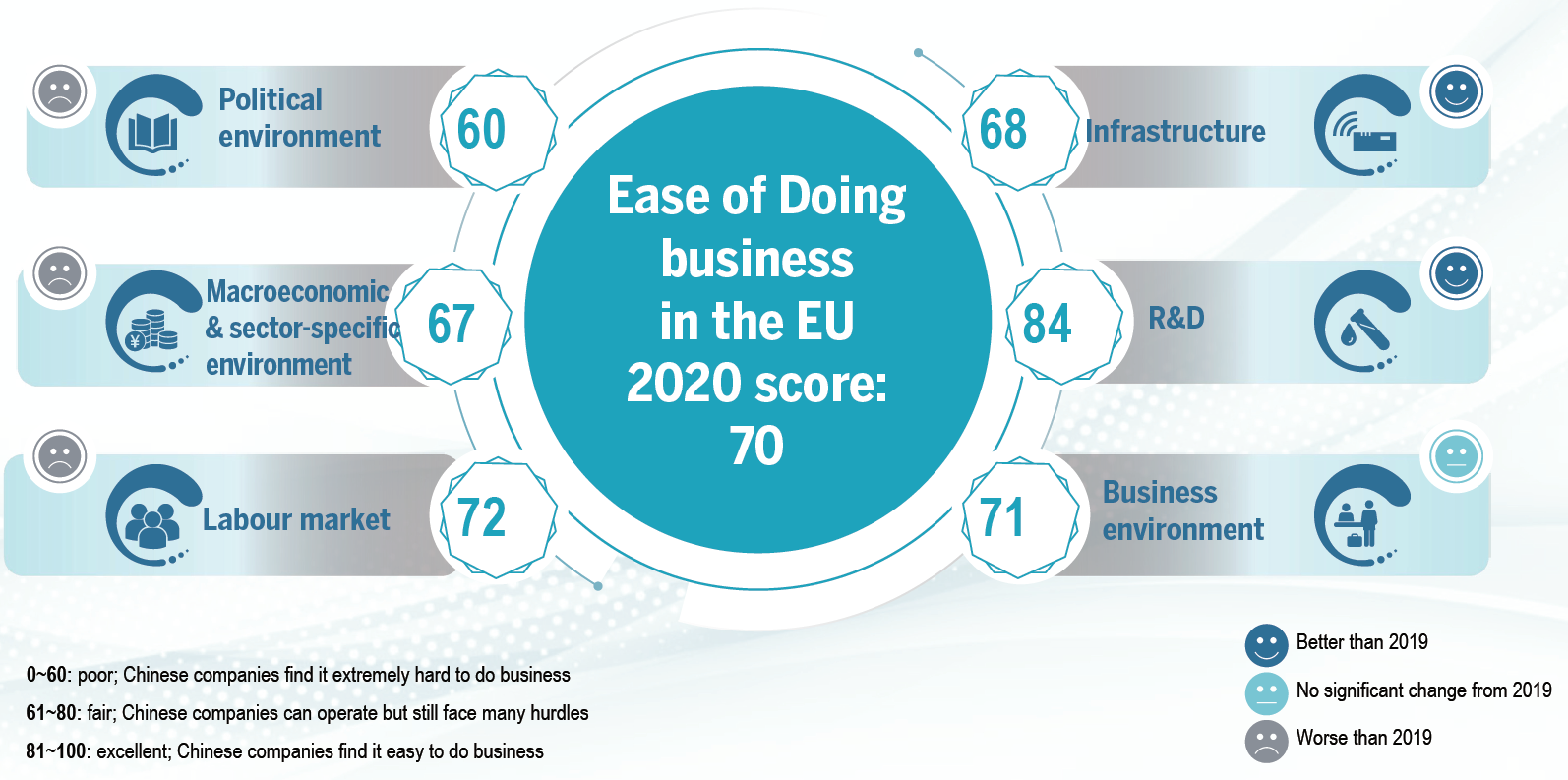
The report shows Chinese businesses have a less favorable view than last year on their ease of doing business in the EU. Namely, 68% of respondents think the EU has tightened its China policy, 72% think the EU market is grimmer for them than in 2019, and 55% have a harder time hiring European and foreign talent due to reputation issues.
On 5G, the Chamber feels that certain member states assessed Chinese companies as high-risk solely on the basis of the parent company’s location, and have made security issues spill over into technological selection criteria.
The report says that Chinese SOEs are “independent in decision-making procedures” and listed on the stock exchange. As such, putting up barriers (antitrust review, foreign investment screening, and foreign subsidy review) will reduce investment and certainty of transaction.
The report concludes with a series of recommendations. It suggests, among others, nurturing mutual trust, a “frank and thorough dialogue” on cybersecurity, a stall in “overregulation and excessive screening” on investments by the EU, and a proposal to allow Chinese companies into the EU’s adoption of industry and R&D standards.
The Chamber also stated that it has sent feedback to the Commission on the White Paper on foreign subsidies, arguing a change in legislation is not necessary, since the proposed policies “lack a clear legal basis” and may be incompatible with WTO regulation.
The Broader Picture
These two reports and their recommendations show us politicization has become acute and emerging industries (digital, 5G, etc.) are becoming critical.
On that note, it is worthwhile to look at how China is displaying its newest ‘strategic emerging industries’. On September 23, the central government announced plans to allocate more funding and delegate more power to local governments on financing these industries.
The plans categorized eight main areas for development: 5G network; biotech and vaccine development; high-end manufacturing, i.e. robotics; materials for airplanes and chip-making; new energy tech; green tech; smart vehicles; and digital business.
Beijing’s announcement fell just one week before the EU’s summit on industrial policy, which seeks to help implement the EU’s green and digital plans for the future.

TAKEAWAYS
► SPEAKING PAST EACH OTHER
It will be difficult to find a middle ground here. Both sides argue politicization of the economy is a barrier to commerce in itself, which, objectively speaking, is accurate. That China chooses specific sector development strategically, or that it allows no external competition for SOEs, or that the EU raises defensive measures on investment and FDI: all fall within the spectrum of politicization.
This does not mean they are equally legitimate, since the EU market is indeed much more open and the defensive measures would not exist if its partner followed suit. From China’s point of view, the level of opening up granted so far is a privileged concession, and the EU’s defensive measures are put in place to minimize the risks coming from openness that it sees as a norm (although let’s see how the discussion on strategic autonomy develops).
Nonetheless, the two sides stick to their respective narratives and both speak past each other, conveying the same arguments, but not quite managing to impact each other’s standing. This is likely a big problem in CAI negotiations. Consensus is not quite on the horizon.

READ MORE
CCCEU 2020 Recommendation Report - Acting for Common Future - China Chamber of Commerce to the EU, Sep 10
European Business In China Position Paper 2020/2021 - European Union Chamber of Commerce in China
China unveils ‘strategic emerging industries’ plan in fresh push to get away from US technologies, SCMP (Frank Tang), Sep 24
4. Expanded Crackdown in Tibet - New Data Emerge
On September 7 and September 21, we told you about the CCP’s repressive campaigns in Tibet, Inner Mongolia, and Xinjiang. This week, more reporting surfaced on these practices in Tibet.
► Instances of forced labour and, most likely, coercive vocational and ideological training were registered in Tibet;
► The motivation for it has to do with the central government’s hopes that such actions will lead minorities to assimilate into the Han majority culture;
► International responses on human rights violations followed, with both Charles Michel and Emmanuel Macron asking for independent investigations at the UNGA.
Tibet - New Data
According to reporting, Tibetan farmers have been coerced to hand over land and enter “vocational training” centers aimed at making them suited for low-skilled industrial labour, often in factories outside Tibet. To that end, quotas for mass transfers of Tibetans were implemented, complete with collective housing in the cities where they are sent.
In 2020 alone, 500,000 Tibetans (15% of the region’s population) went through these ‘training’ centers. Authorities have physically visited villages to gather data, so as to eliminate “can’t do, don’t want to do and don’t dare to do” attitudes towards work, They have described these visits as targeting “lazy people”.
To supplant “laziness”, the training camps emphasize ideological training and strict discipline, which includes forced labour, military drills in uniforms, andanti-separatism education.
The Chinese Ministry of Foreign Affairs has denied claims of forced labour, but the practice itself is difficult to track. Since the rural farmers are sent to other provinces, external observers are left without any means of contacting them.
The Strategy Behind
Coercive tactics are not new to Tibet. Omnipresent surveillance and neighbourhood police stations were part of the CCP’s campaigns in Tibet between 2012 and 2016.
These earlier tactics were deemed so ‘successful’ that Chen Quanguo, who was party secretary in Tibet, was sent in 2016 to Xinjiang to enforce the same practices on the Uyghurs. Now, the two provinces have switched roles, as forced labour practices used in Xinjiang are making their way into Tibet.
According to Adrian Zenz, the strategy is centered around cultural assimilation theories of ethnic minorities promoted by Chinese anthropologist Fei Xiaotong in the 1990’s. Fei asserted that different minorities in China are bound to assimilate into the “superior” Han culture, organically leading to a creation of “the Chinese nation-race.” To support this process, the central government tried to leverage economic development policies to encourage the migration of Han workers to Tibet.
However, Tibetans have not taken part in “mixing and melding” as the authorities hoped for, which has led to this shift in paradigm under Xi. Now, the main narrative is not economic opportunity but poverty alleviation; the prospect of assimilation is enforced through ideological training, instead of being indirectly linked to economic prospects.
The core assimilationist principle remains and is greatly aided by the state’s surveillance capacities. Now, the central government can categorize Tibetans based on income and education, force them to work far from home, and send their children to boarding schools for indoctrination.
Coercive minority policies will most likely continue to be deployed. Xi Jinping conveyed this message on September 26 during a conference on Xinjiang, when he called these policies “totally correct”, saying “our national minority work has been a success”.
International Responses
Over the past week, both Charles Michel and Emmanuel Macron expressed their discontent with China’s human rights record, and called for an international investigation in Xinjiang.
In his speech at the 75th UNGA, Charles Michel told world leaders that the EU will keep promoting universal human rights “including those of minorities, such as the Uyghurs, or in Hong Kong”.
Also addressing the UNGA, Emmanuel Macron underscored that “human rights are not a Western idea that can be treated as interference”, and called on the UN to organize an international mission to analyze in depth the situation of the Uyghurs.
The IPAC released a statement, signed by 63 legislators from 16 parliaments, which includes three demands: Magnitsky-style sanctions; government advisories for businesses sourcing materials from Tibetan forced labour, and an independent international investigation into Tibet and Xinjiang.
In spite of these statements, Hong Kong opposition activist Joshua Wong was arrested on September 24 for taking part in a protest last year on October 5th. In response, the EU called the arrest “troubling” and reiterated that such developments “undermine trust and impact EU-China relations”.

TAKEAWAYS
► BOUND TO CLASH
The scale of the “training” programs”, their deployment in two large minority-populated provinces (plus the language policy in Inner Mongolia), and Xi’s official endorsement, tell us one thing: These approaches are here to stay. Moreover, any attempt to launch a meaningful dialogue on the issue is brushed aside as foreign meddling in China’s internal affairs, so strong wording and condemnations are unlikely to affect China’s policies.
Since talk is cheap, the EU should look at alternatives, unless it wants to merely remain with a ‘feel-good’ attitude of its own moral compass. To that end, the European Magnitsky Act announced by von der Leyen at the SOTEU is a welcome development and one that directly addresses what is happening in Xinjiang and Tibet. Another alternative is to enforce inspections of supply chains to identify any use of forced labour and reject such products. In any scenario, a change of approach on China’s side will not happen through strong wording.

READ MORE
China sharply expands mass labor program in Tibet - Reuters (Cate Cadell), Sep 22
Prevalence of forced labor in the Tibetan Autonomous Region - IPAC, Sep 22
EU leader at UN calls out China for its human rights record and its business practices - SCMP (Stuart Lau), Sep 26
5. The EU, US, Huawei, and China Intersect in Serbia
The recent Serbia-Kosovo deal signed with the ‘blessing’ of Donald Trump may have an impact on China’s Digital Silk Road.
► Part of the deal spells out that neither Belgrade nor Pristina will use 5G equipment from “untrusted vendors” in their communications networks;
► This is particularly troubling for China, which enjoys warm relations with Serbia as a country where public opinion is increasingly pro-China, in spite of the comparatively larger investments provided by the EU;
► However, Serbia’s hands are not fully tied, as the 5G deal is not legally binding and self-interest of the ruling elite is likely to play a role in the decision-making later on. Belgrade is rather testing the waters, and will act on the matter later based on Serbia’s national interest.
Implications for the Huawei-Serbia Friendship
It is quite clear that “untrusted vendors” is a knock at Huawei, a company that currently has a solid partnership with Serbia.
Specifically, Belgrade brought Huawei on board for its “Safe City” project, which aims to install 1000 surveillance, facial-recognition cameras throughout the Serbian capital, as well as in Novi Sad and Niš.
In 2018, Huawei was also called on by the Serbian Ministry of Finance to provide traffic surveillance systems. Similarly, Huawei is now planning to open its South and Southeast Europe data center in the city of Kragujevac, which would be Huawei’s third European center, joining centers in Germany and the Netherlands.
Huawei also has a role in Serbian telecom, through a €150 million partnership with the state-owned Telekom Srbija to install high-speed internet.
Overview of Chinese Presence in Serbia
As highlighted in the recent study by the Center for Strategic and International Studies, Serbia’s ties with China are extensive and can be seen as troublesome.
Alleged corruption, party patronage networks, and politicized public administration of the Serbian state were conducive to flourishing relations with Beijing. According to researchers, Vučić can allow Chinese SOEs to bypass public scrutiny when devising large infrastructure projects accessing public resources.
There is also a public opinion component. In 2018, 56% of Serbian respondents in a poll held favorable opinions of China, much higher than the 27% of the EU. This is a stark contrast to 2005, when only 3% shared the same sentiments on China and 32% wanted Serbia to rely on Brussels for its foreign policy.
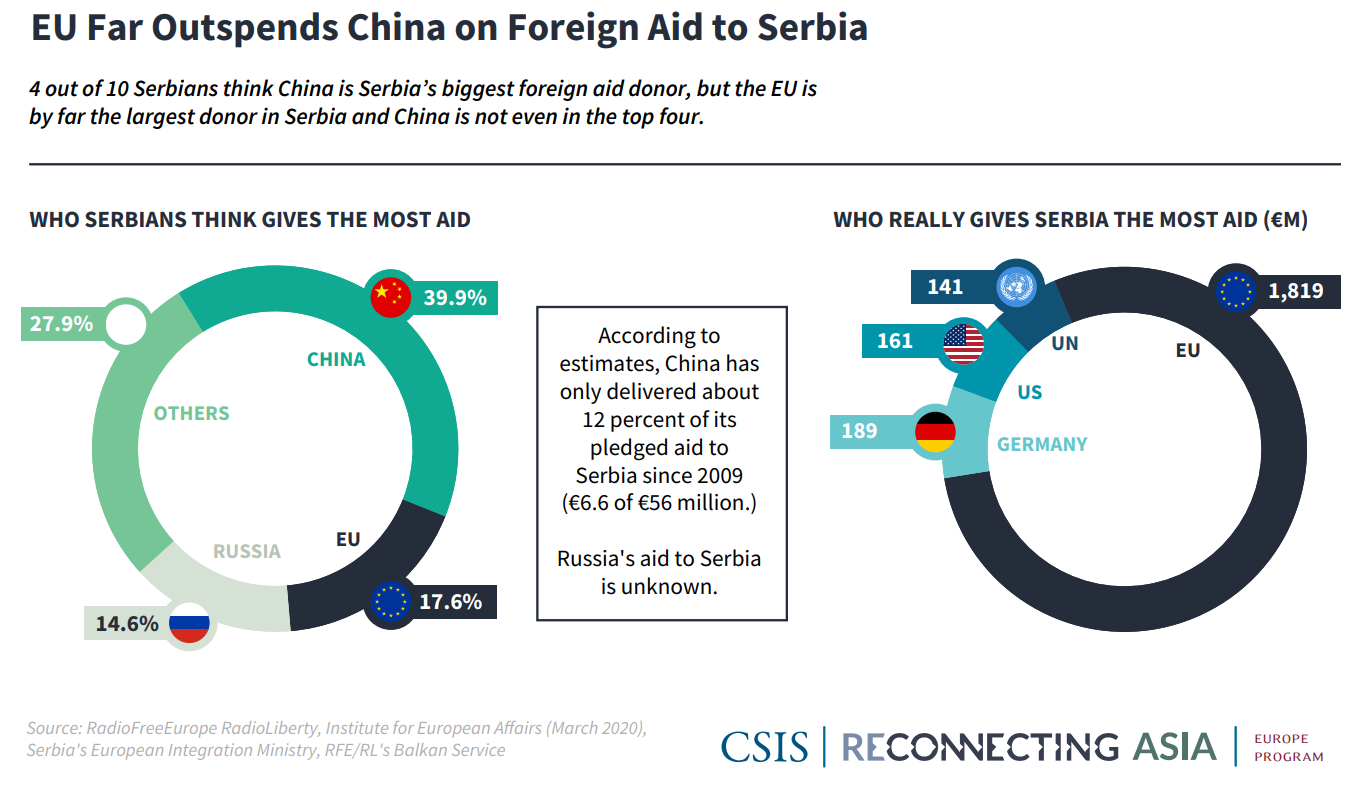
Even more, almost 40% of Serbians think China gives the most aid to Serbia (and only 17.6% think the EU does). This is starkly opposite to the reality, as the EU has provided Serbia with € 1,819 million since 2009, while China is estimated to have sent only €6.6 million.
Nonetheless, Chinese companies in Serbia are well and thriving. 93% of Chinese projects in Serbia are carried out by Chinese companies. Their main sectors of activity are transportation, manufacturing, ICT, and energy.
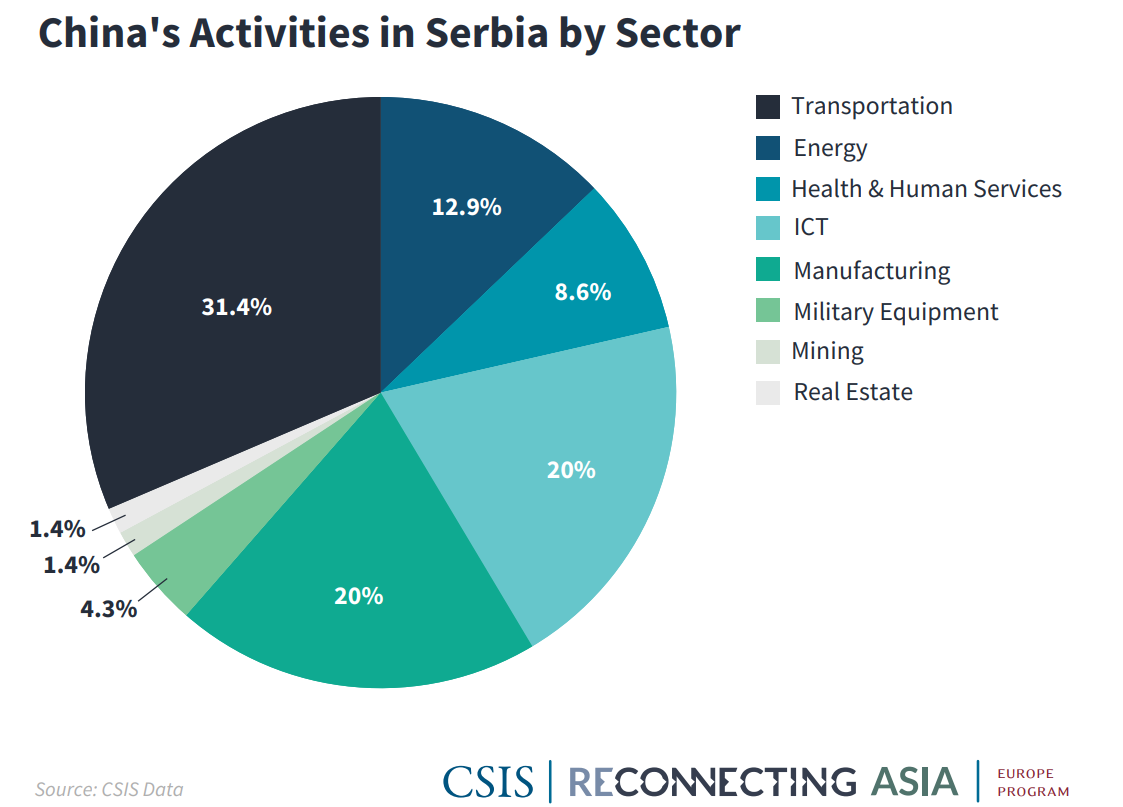
Serbia is quite the hotspot for Chinese projects on ICT. 14 of the 18 ICT projects planned within the 17+1 are based in Serbia (and 40% of them were launched in 2019). Take, for instance, the case of Hikvision, which installed 900 surveillance cameras all around Serbia (and is also believed to have built surveillance equipment in Xinjiang).
Also, keep in mind recent sale of missile defence systems to Serbia by China.
Will Huawei Leave Serbia?
The short answer is “not likely”. Belgrade is testing the waters to see what red lines will be sent from both Washington and Beijing.
Vučić is not very eager to cut off good relations with Beijing, For him personally, they are an inexpensive source of political capital. For this reason, he made sure to contact China’s ambassador to Serbia, Chen Bo, and reassure him that Chinese companies are not threatened by the Kosovo deal.
On the other hand, Serbia cannot afford US financial sanctions either. This was evident in December, when military purchases from Russia were halted out of fear of sanctions.
Since the 5G deal is not legally binding and since Huawei is not explicitly named in the deal, Belgrade has room to maneuver.
To Vučić’s advantage, most European countries plan to phase out, not ban Huawei, with deadlines as faw away as 2027. This offers Serbia the opportunity to wait (the public auction on 5G in Serbia will happen in the first months of 2021 anyway) and make a decision based on the status quo of its relations with Beijing, Washington, and Brussels.

TAKEAWAYS
► THE CHALLENGE OF HEDGING
Serbia appears to be attempting to play the big powers against one another, which is characteristic of its foreign policy but is also dictated by favorable terms it extracts from China (and Russia). The problem with this approach is that Belgrade needs to constantly reassess and redefine which lines it can cross and which ones it can’t.
For now, we cannot assert with certainty what will happen to Huawei in Serbia. Much depends on how much the US and EU collaborate on addressing their challenges related to China, including on 5G, which will affect the political costs of Belgrade sticking with cooperation with the Chinese company. If US-EU cooperation deepens, Belgrade will have less incentive to be a pro-China oasis in Europe. There are many “if’s” in this equation, so, just like Belgrade, we should wait and look at the wider geopolitical movements to understand where Huawei’s fate in Serbia is headed.

READ MORE
In Serbia, China’s Digital Silk Road Might Be in Trouble Very Soon - The Diplomat (Vuk Vuksanovic), Sep 23
Serbia’s 5G deal with Washington: The art of muddling through - ECFR (Majda Ruge, Stefan Vladisavljev), Sep 22
Becoming a Chinese Client State: The Case of Serbia - CSIS (Heather Conley, Jonathan Hillman, Maesea McCalpin, Donatienne Ruy), Sep 2020